Thyroid hormone sets the resting metabolic rate of nearly every tissue: how fast the heart beats, how quickly the gut moves, how much heat the body makes, how efficiently mitochondria burn fuel. When it falls, the whole system slows in a way that reads as fatigue, cold, weight gain, dry skin, constipation, and mental fog.
The evaluation problem is that thyroid function is usually screened with TSH — a pituitary signal, not a tissue measurement. TSH is an excellent first-line test and an incomplete answer.
Contents(12 sections)
Key takeaways
TSH is a pituitary output; free T4, free T3, reverse T3, and antibodies describe what tissues actually receive.
Roughly 80% of active T3 is produced outside the thyroid, mostly by deiodinase enzymes in liver and peripheral tissue.
Hashimoto's thyroiditis is the leading cause of hypothyroidism in iodine-sufficient countries; antibodies often precede lab abnormality by years.
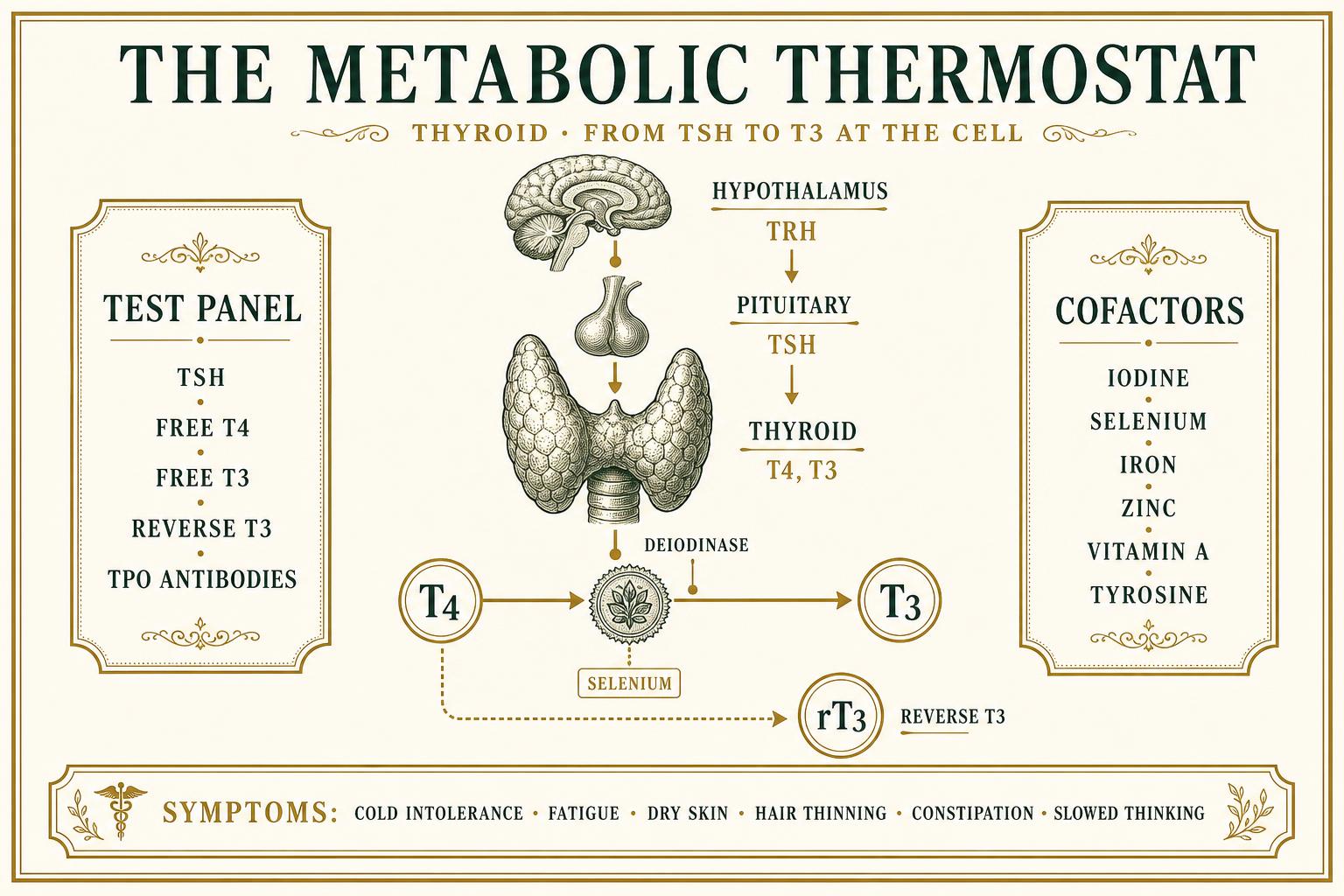
Selenium, iron, zinc, iodine, and adequate calories are prerequisites for normal conversion.
The Primer
How the system works
The hypothalamus releases TRH, the pituitary responds with TSH, and the thyroid produces mostly T4 — a storage form with limited activity. Peripheral tissues then convert T4 into T3, the hormone that actually binds nuclear receptors and changes gene expression.
That conversion step is where most real-world variability lives. A thyroid can produce adequate T4 while the body converts poorly, and the person feels hypothyroid with a normal-looking screening test.
The symptom picture
Low thyroid function presents as cold intolerance, fatigue that sleep does not fix, weight gain with unchanged intake, constipation, dry skin, hair thinning at the outer eyebrows, slow reflexes, low mood, heavy or irregular periods, and a resting heart rate at the low end.
Overactive thyroid runs the opposite direction: heat intolerance, palpitations, anxiety, weight loss, tremor, loose stools, and poor sleep.
What derails conversion
Chronic caloric restriction, illness, inflammation, high cortisol, low selenium or iron, heavy alcohol use, and poorly managed insulin resistance all suppress the conversion of T4 to T3 or shunt it toward the inactive reverse T3. This is often adaptive — the body downshifting metabolism under stress — but it is worth naming rather than treating as an isolated gland failure.
The Deep Dive
The panel that answers the question
- TSH — sensitive to small changes in hormone availability; rises early in primary hypothyroidism. Diurnal variation is real (higher in the early morning), so draw timing matters when values sit near a decision threshold.
- Free T4 — the unbound reservoir available for conversion.
- Free T3 — the active hormone. Low free T3 with normal T4 points to a conversion problem rather than a glandular one.
- Reverse T3 — the inactive isomer produced when T4 is deiodinated at the inner ring. Elevated levels accompany illness, calorie deficit, inflammation, and high cortisol.
- TPO and thyroglobulin antibodies — identify autoimmune thyroiditis. Positivity frequently precedes clinical hypothyroidism by years and changes surveillance rather than immediate treatment.
Tier II · Members only · Free
Continue into the deep dive
Tier I is free and always open. Tier II — the full mechanisms, dosing detail, nuance, and citations — unlocks with a free Vital Codex membership.
- Every Tier II deep dive across all hubs
- Saved reading progress across articles
- Member knowledge modules and their quizzes
- The Dispatch, if you opt in
Frequently asked
Is a normal TSH enough to rule out a thyroid problem?
For screening, largely yes. For a symptomatic person, no. Free T4, free T3, and antibodies add information that TSH alone cannot provide, particularly when the issue is conversion rather than gland output.
Should I take iodine?
Only with a clear reason. Iodine deficiency is real in some populations, but supplemental excess can trigger dysfunction and worsen autoimmune thyroiditis. Test or assess intake before dosing.
Can diet reverse hypothyroidism?
It can improve conversion, antibody activity, and symptoms, and it can correct nutrient-driven dysfunction. It does not regenerate a gland already destroyed by autoimmunity — that case needs replacement hormone.
Do goitrogens in cruciferous vegetables matter?
Practically, no, at normal intakes with sufficient iodine. Very large amounts of raw cruciferous vegetables in an iodine-deficient person are the narrow scenario where it becomes relevant; cooking reduces the effect substantially.
Continue exploring: Hormones — Endocrine rhythm, cortisol regulation, and signaling health.
Explore Hormones