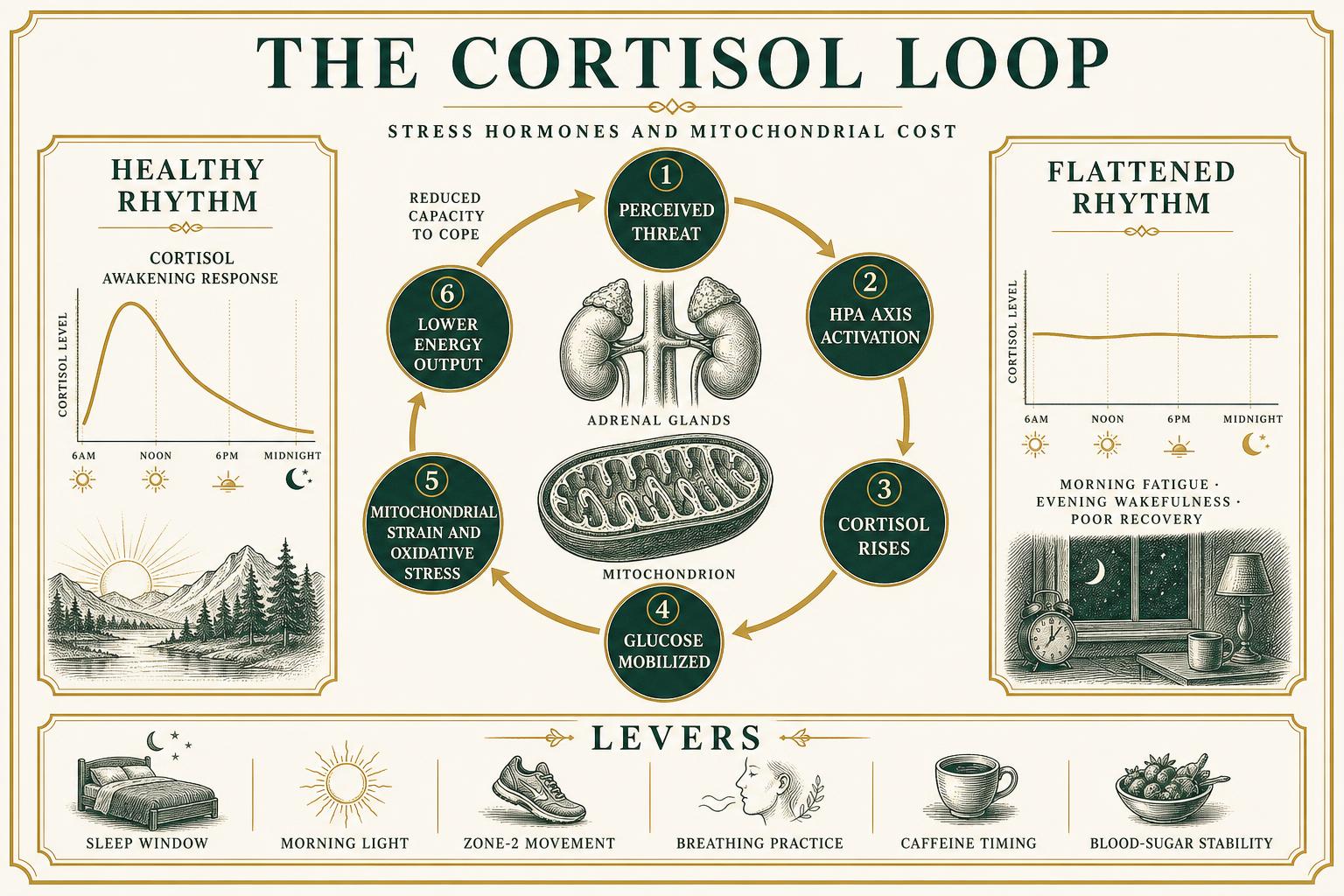
Cortisol is not a damage signal. In short pulses it is one of the most effective metabolic mobilizers the body has, and it actively improves mitochondrial output. The problem is duration. When glucocorticoid exposure stops being episodic, the same signal that sharpens mitochondrial function begins to degrade it — and the degraded mitochondria then impair the feedback that would normally shut cortisol off.
Contents(12 sections)
Key takeaways
Acute cortisol enhances mitochondrial calcium buffering and respiratory capacity; chronic exposure reverses both.
The relationship is biphasic (hormetic), not linear — dose and duration determine direction.
The hippocampus and prefrontal cortex are the most vulnerable tissues, and they are also the tissues that terminate the stress response.
Sleep, Zone 2 aerobic work, and predictable meal timing are the highest-yield levers for restoring the loop.
The Primer
Why a stress hormone touches cellular energy
Cortisol's job in a short crisis is to make fuel available: raise blood glucose, mobilize fatty acids, and prime cells to burn them. To do that it has to talk directly to mitochondria, the structures that convert fuel into usable energy. Short bursts leave mitochondria better at their job.
Chronic elevation is a different signal entirely. Sustained cortisol shifts mitochondria toward fragmentation, less efficient energy production, and more oxidative byproducts. The felt experience is familiar: tired but wired, poor recovery, thin memory, low tolerance for further stress.
The loop that closes
Here is the part that makes it self-reinforcing. The brain regions that tell the stress axis to stand down — the hippocampus and prefrontal cortex — are metabolically expensive. When their mitochondria lose capacity, the off-switch weakens, cortisol stays elevated longer, and mitochondrial capacity degrades further.
That is why chronic stress rarely resolves by simply removing the stressor. The regulatory machinery itself needs repair.
What actually restores it
Sleep is not optional here: overnight is when the axis resets and mitochondrial quality control runs. Zone 2 aerobic exercise increases mitochondrial density and, at moderate volumes, lowers resting cortisol. Predictable meal timing stabilizes glucose so cortisol is not repeatedly recruited to correct it.
Excess high-intensity training, chronic caloric restriction layered on top of high stress, and alcohol as a wind-down tool all push the loop the wrong way.
The Deep Dive
Receptor biology and the mitochondrial genome
Glucocorticoid receptors are not confined to the cytosol and nucleus. A subpopulation translocates to mitochondria, where glucocorticoid response elements in the mitochondrial genome allow direct transcriptional influence over OXPHOS subunit expression. This gives cortisol two routes to bioenergetics: nuclear-encoded regulation of PGC-1α and mitochondrial biogenesis, and direct mtDNA-level effects.
Acute exposure increases mitochondrial calcium uptake capacity and Bcl-2 translocation to the outer membrane, raising the threshold for permeability transition. Chronic exposure produces the inverse: reduced Bcl-2, lowered calcium buffering, and a lower threshold for cytochrome c release.
Tier II · Members only · Free
Continue into the deep dive
Tier I is free and always open. Tier II — the full mechanisms, dosing detail, nuance, and citations — unlocks with a free Vital Codex membership.
- Every Tier II deep dive across all hubs
- Saved reading progress across articles
- Member knowledge modules and their quizzes
- The Dispatch, if you opt in
Frequently asked
Is high cortisol always bad?
No. Acute pulses improve mitochondrial function and cognition. The pathological pattern is chronic elevation with a flattened diurnal slope, not a single high reading.
Does a salivary cortisol test tell me anything useful?
A four-point diurnal salivary curve is more informative than a single serum draw because it captures slope and the awakening response. A single morning serum cortisol mostly rules out frank adrenal pathology.
Can mitochondrial damage from chronic stress be reversed?
Largely yes, in animal models and in the human markers we can measure. Dendritic remodeling and respiratory capacity recover with sustained sleep, aerobic training, and reduced load — over months, not days.
Do supplements help?
Fundamentals dominate. Adaptogens such as ashwagandha have modest evidence for lowering perceived stress and cortisol, but they do not substitute for sleep, aerobic capacity, and glycemic stability.
Continue exploring: Hormones — Endocrine rhythm, cortisol regulation, and signaling health.
Explore Hormones