Menopause is defined clinically by twelve consecutive months without menstruation, but physiologically it is a whole-system remodel: estradiol withdrawal changes mitochondrial function in the brain, bone remodelling rates, vascular tone, insulin sensitivity, and thermoregulatory set-point simultaneously. That is why single-symptom interventions — one herb for hot flashes, one pill for sleep — routinely underperform.
The framework below is organised by time of day rather than by symptom, because most of the relevant biology is circadian: cortisol rhythm, NAD+ salvage, bone turnover, and hepatic estrogen clearance all run on a clock. None of it replaces menopausal hormone therapy, which remains the most effective treatment for moderate-to-severe vasomotor symptoms (The North American Menopause Society Position Statement, Menopause, 2022); it is the terrain the rest sits on.
Menopause is not a broken switch. It is a full-body remodel.
Contents(17 sections)
The essentials at a glance
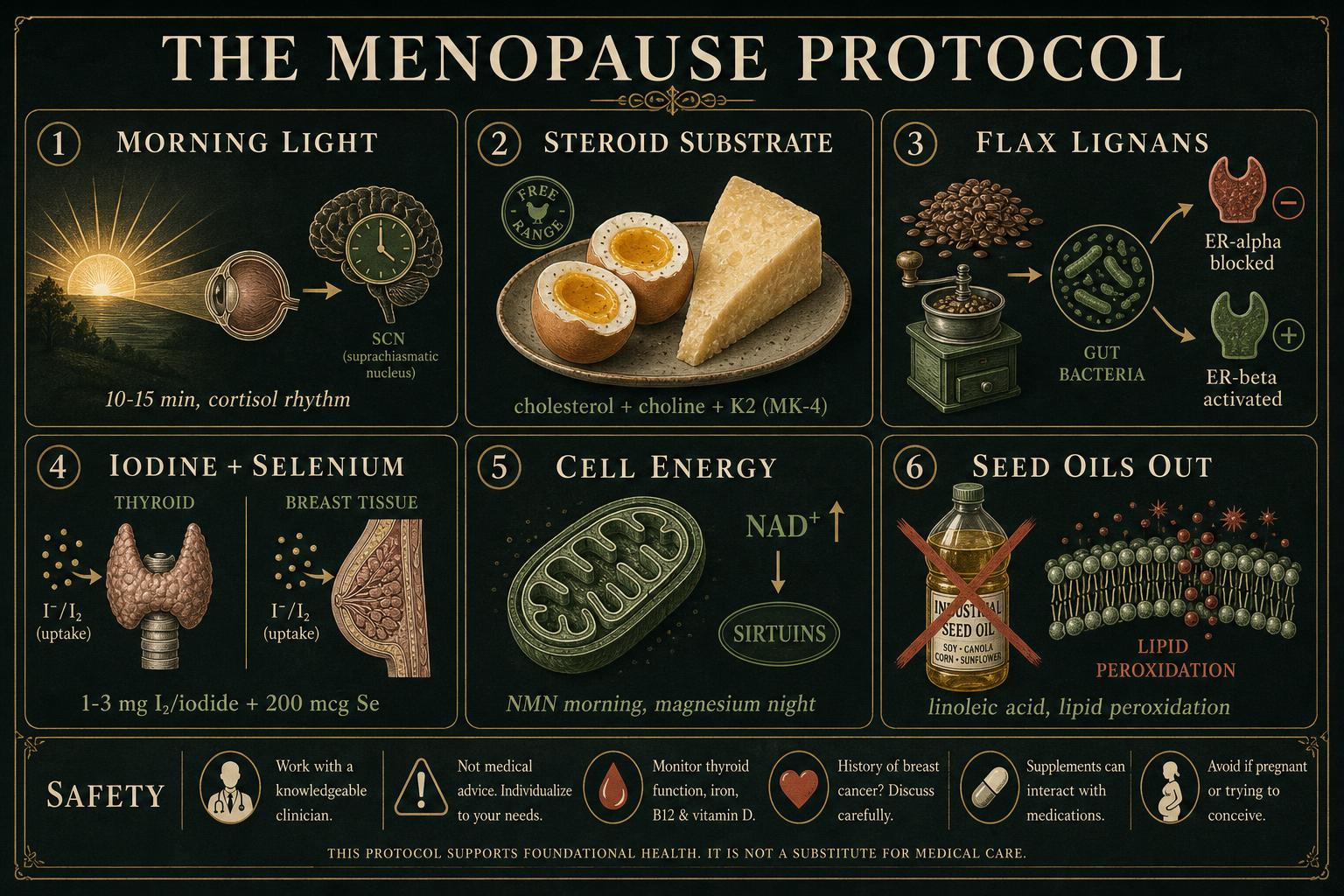
Removing industrial seed oils comes first: linoleic acid incorporates into cell membranes and mitochondrial cardiolipin, where peroxidation products amplify vasomotor instability and neuroinflammation.
Morning daylight within an hour of waking sharpens the cortisol awakening response and is the single most reliable non-drug lever on menopausal sleep fragmentation.
Flaxseed lignans are converted by gut bacteria into enterolignans that behave as weak selective estrogen receptor modulators — modest for hot flashes, meaningful for terrain.
Iodine has extra-thyroidal roles in breast tissue, but it must be paired with selenium and is genuinely risky in autoimmune thyroid disease. This is the part of the protocol that needs a clinician.
Bone and brain are the long-run stakes: vitamin D3 with K2, adequate protein, magnesium, and resistance training matter more over a decade than any botanical.
The Primer
Rule one: take the seed oils out
Soybean, canola, corn, sunflower, safflower, and cottonseed oils dominate processed foods, restaurant cooking, and packaged snacks. They are rich in linoleic acid, which is chemically unstable and oxidises readily. Removing them is not a moral position about fat — it is about reducing the daily load of oxidised lipid your cell membranes have to absorb while every other system is already being remodelled. Read labels; the dose is hidden in ordinary food.
Replace them with olive oil, butter or ghee from pasture-raised animals, coconut oil, and whole-food fats.
Morning: light, substrate, and lignans
Daylight, 10–15 minutes. Outdoors, no sunglasses, within 30–60 minutes of waking. Window glass blocks much of the relevant spectrum. This sets the master clock, which sets the cortisol curve, which sets how deeply you sleep sixteen hours later.
Free-range eggs, 2–3, with runny yolks. Cholesterol is the obligatory precursor for every steroid hormone your adrenals and peripheral tissues still make. Runny yolks preserve heat-sensitive choline and leave the cholesterol unoxidised. Free-range matters: pasture access raises omega-3 and carotenoid content and lowers the omega-6 load compared with confinement eggs.
Freshly ground flaxseed, 2 tablespoons. Grind immediately before eating — pre-ground flax oxidises quickly and becomes the opposite of what you wanted. Lignans plus fibre plus alpha-linolenic acid, all in one spoon.
Iodine complex, 1–3 mg (molecular iodine/iodide blend), always with 200 mcg selenium. See the cautions below before starting.
Vitamin D3 5,000 IU with K2 100 mcg. D3 improves calcium absorption; K2 directs that calcium into bone matrix rather than arterial wall.
NMN 300–500 mg (optional, morning). NAD+ precursor, taken in phase with the circadian salvage pathway. Human evidence is early and modest — treat it as frontier, not foundation.
Midday: adaptogens and stable fat
Maca or shatavari tincture, 1–2 mL. Maca has small randomised trials for mood and vasomotor scores in postmenopausal women; shatavari is traditional with thin clinical data. Sublingual liquid extracts act quickly and avoid gastric upset.
1–2 oz full-fat grass-fed cheese. Aged raw-milk cheddar or gouda from herds not treated with growth hormone is the ideal form — a dense source of the MK-4 form of vitamin K2 alongside stable saturated fat and protein.
Evening: repair and cooling
EPA/DHA, 1,000–2,000 mg combined, with dinner. Membrane composition, joint comfort, mood, and triglycerides.
Magnesium 200–400 mg. Glycinate for muscle relaxation and sleep; L-threonate when brain fog is the dominant complaint.
Holy basil or hops tincture, 1–2 mL, 30 minutes before bed. Hops contains 8-prenylnaringenin, the most potent known dietary phytoestrogen, and hops extracts have reduced hot flash scores in small trials. Holy basil targets evening cortisol.
The unglamorous levers that outperform supplements
Resistance training two to three times a week, 1.2–1.6 g protein per kg body weight daily, a cool dark bedroom, alcohol kept low, and treatment of sleep apnoea if present. In head-to-head terms, these move bone density, body composition, and sleep quality more than anything in a dropper bottle.
The Deep Dive
Seed oils, cardiolipin, and vasomotor instability
Linoleic acid is incorporated into phospholipids and into cardiolipin, the mitochondrial inner-membrane lipid required for respiratory supercomplex assembly. Cardiolipin is unusually susceptible to peroxidation, and its oxidation products impair electron transport and promote cytochrome c release. Because estradiol withdrawal already reduces mitochondrial efficiency in the hypothalamus and prefrontal cortex (Brinton, Trends in Neurosciences, 2008; Yin et al., Journal of Neurochemistry, 2015), adding a peroxidisable substrate load compounds the deficit that expresses as thermoregulatory instability and cognitive complaint.
Tier II · Members only · Free
Continue into the deep dive
Tier I is free and always open. Tier II — the full mechanisms, dosing detail, nuance, and citations — unlocks with a free Vital Codex membership.
- Every Tier II deep dive across all hubs
- Saved reading progress across articles
- Member knowledge modules and their quizzes
- The Dispatch, if you opt in
Frequently asked
Does this replace hormone therapy?
No. For moderate-to-severe hot flashes, night sweats, and genitourinary symptoms, systemic or local hormone therapy remains the most effective treatment, and for many women started within ten years of menopause the benefit-risk balance is favourable. This protocol addresses the terrain — membranes, mitochondria, circadian rhythm, bone, detoxification capacity — and works alongside hormone therapy rather than in competition with it.
Is iodine safe for everyone at 1–3 mg?
No. That dose is many times the 150 mcg RDA. In people with Hashimoto's thyroiditis, nodular thyroid disease, or a history of thyroid surgery, iodine at this level can trigger hypothyroidism or thyrotoxicosis. Test TSH, free T4, and thyroid antibodies first, always pair with selenium, and only proceed under clinical supervision.
Are phytoestrogens risky with a history of breast cancer?
The observational data on dietary soy and flax intake after breast cancer is reassuring and in some cohorts favourable, but concentrated extracts and hops-derived 8-prenylnaringenin are a different exposure from food. Anyone with estrogen-receptor-positive disease, or taking tamoxifen or an aromatase inhibitor, should decide this with their oncologist rather than from general guidance.
How long before anything changes?
Sleep and energy often respond to light timing and seed-oil removal within two to three weeks. Vasomotor symptoms respond to botanicals over six to twelve weeks if they respond at all. Bone density and body composition are measured in years, which is why the training and protein components deserve the most persistence.
What should be measured?
TSH, free T4, thyroid antibodies, ferritin, vitamin D (25-OH), B12, HbA1c, fasting insulin, ApoB, hs-CRP, and a baseline DEXA. Repeat thyroid panels if iodine is used. Everything in this protocol becomes safer and more legible when it is anchored to numbers.
Research Notes & Sources(expand)
- The North American Menopause Society. "The 2022 Hormone Therapy Position Statement." Menopause, 2022.
- Brinton RD. "Estrogen regulation of glucose metabolism and mitochondrial function." Trends in Neurosciences, 2008.
- Yin F, et al. "The perimenopausal aging transition in the female rat brain." Journal of Neurochemistry, 2015.
- Chen MN, Lin CC, Liu CF. "Efficacy of phytoestrogens for menopausal symptoms: a meta-analysis." Climacteric, 2015.
- Kessler JH. "The effect of supraphysiologic levels of iodine on patients with cyclic mastalgia." The Breast Journal, 2004.
- Institute of Medicine. Dietary Reference Intakes for iodine — tolerable upper intake level 1,100 mcg/day for adults.
- Yoshino J, Baur JA, Imai S. "NAD+ intermediates: the biology and therapeutic potential of NMN and NR." Cell Metabolism, 2018.
- Yi L, et al. "The efficacy and safety of β-nicotinamide mononucleotide supplementation in healthy middle-aged adults." GeroScience, 2023.
- Meissner HO, et al. "Therapeutic effects of pre-gelatinized Maca on early-postmenopausal women." International Journal of Biomedical Science, 2006.
- Erkkola R, et al. "A randomized study of hop extract in menopausal women." Phytomedicine, 2010.
This is an educational framework, not medical advice. Clear any new protocol with your healthcare provider — particularly iodine and concentrated phytoestrogens — especially with autoimmune thyroid history or estrogen-receptor-positive conditions.
Continue exploring: The Vital Codex library on hormones, mitochondrial energy, and the terrain that carries both through midlife.
Explore Hormones