Magnesium is required for every reaction that uses ATP, which means it is required for nearly everything a cell does. It is also the mineral most likely to be quietly insufficient in an otherwise reasonable diet, and the one least likely to be caught by a standard blood panel.
The practical consequence is a cluster of vague complaints — muscle cramps, restless sleep, palpitations, low stress tolerance, constipation — that resolve with repletion but never appeared abnormal on paper.
Contents(16 sections)
Key takeaways
Magnesium is a cofactor in more than 600 enzymatic reactions, including every ATP-dependent step.
Serum magnesium reflects less than 1% of body stores and stays normal until depletion is severe.
Roughly half of adults in Western populations consume less than the estimated average requirement; U.S. survey estimates put inadequate intake near 45%.
Marginal intake is not harmless: under the triage theory, the body funds short-term survival functions such as ATP production before long-term maintenance such as DNA repair.
Higher dietary intake (~550 mg/day vs ~350 mg/day) tracked with larger gray matter and hippocampal volumes in a 6,001-person cohort (Eur J Nutr 2023;62:2039–2051).
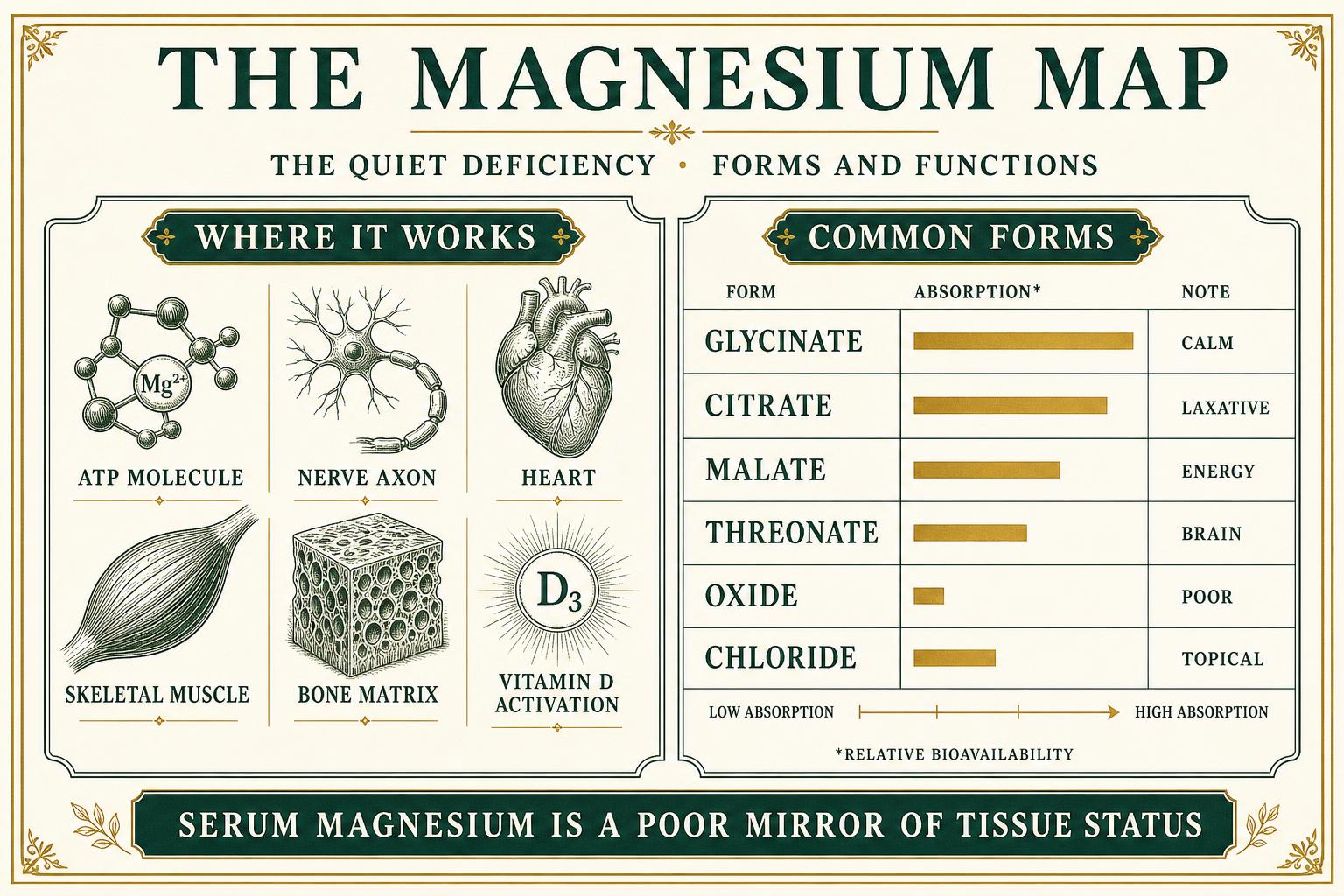
Glycinate, malate, and citrate are the practical oral forms; oxide is poorly absorbed and mostly laxative.
The Primer
What magnesium actually does
ATP is biologically active only when bound to magnesium — the working molecule is Mg-ATP. That single fact explains the breadth of symptoms: energy production, muscle relaxation, nerve signaling, blood-vessel tone, blood-sugar handling, and DNA repair all depend on adequate magnesium.
It also acts as a natural calcium antagonist. Calcium drives contraction; magnesium permits relaxation. When magnesium is low, muscles and vessels sit closer to a contracted state — cramps, tension, tight vasculature, and a nervous system that struggles to settle at night.
Why the shortfall is common
Modern intake fell for structural reasons: soil mineral depletion, grain refining that removes the magnesium-rich germ and bran, and diets built on processed foods. Dark leafy greens are the densest common source because magnesium sits at the center of the chlorophyll molecule — a diet low in greens is structurally low in magnesium. Losses rose at the same time — alcohol (a diuretic that drives urinary excretion even when gut absorption is normal), chronic and intermittent stress, sleep deprivation, high sweat volume, proton-pump inhibitors, diuretics, and poorly controlled blood sugar all increase magnesium loss.
Signals worth noticing
Eyelid twitches, calf cramps at night, restless legs, tension headaches, sighing or air-hunger, constipation, palpitations, sensitivity to loud noise, and difficulty falling asleep despite fatigue. None are specific to magnesium. Several appearing together in a person with a low-magnesium diet is worth acting on.
The Deep Dive
The testing problem
Only about 1% of body magnesium is extracellular; roughly 60% is in bone and most of the remainder is intracellular. Serum magnesium is defended tightly by bone exchange and renal reabsorption, so it remains within reference range through substantial total-body depletion — a state described in the literature as chronic latent magnesium deficiency.
Better readouts exist but are inconsistently available: red blood cell magnesium (reflects a longer window), ionized magnesium (the physiologically active fraction), and the magnesium retention test, in which an intravenous load is given and urinary excretion measured — high retention implies deficit. In practice, dietary review plus a trial of repletion is the pragmatic route.
Tier II · Members only · Free
Continue into the deep dive
Tier I is free and always open. Tier II — the full mechanisms, dosing detail, nuance, and citations — unlocks with a free Vital Codex membership.
- Every Tier II deep dive across all hubs
- Saved reading progress across articles
- Member knowledge modules and their quizzes
- The Dispatch, if you opt in
Frequently asked
Will a blood test tell me if I am deficient?
Usually not. Serum magnesium stays in range until depletion is advanced because bone and kidney tightly defend the extracellular pool. RBC magnesium is a better window, and dietary review plus symptom pattern is often more informative than either.
Which form should I take?
Glycinate for sleep and general repletion, malate if fatigue is prominent, citrate if constipation is also an issue. Avoid relying on magnesium oxide for repletion.
Can I take too much?
From food, no. From supplements, excess most often shows up as loose stools, which is a useful self-limiting signal. The real caution is reduced kidney function, where magnesium can accumulate to dangerous levels — that situation requires medical supervision.
Does magnesium help blood pressure?
Modestly. Meta-analyses of supplementation show small average reductions in systolic and diastolic pressure, larger in people who were deficient to begin with. Magnesium supports nitric oxide and prostacyclin production and eases vasodilation, so the effect is mechanistically real — but it is a supporting lever, not a primary treatment.
Is the RDA enough?
It is enough to prevent deficiency disease, which is what it was designed for. Whether it is enough for long-term maintenance is a separate question, and the triage-theory argument plus the brain-volume and bone data suggest it may not be. Higher targets in the 500–600 mg total-intake range are reasonable for healthy adults; the four-figure doses promoted in some corners of the internet are not supported by outcome trials and are unsafe in kidney disease.
Does magnesium status affect creatine?
Yes, indirectly. The creatine kinase reaction that regenerates ATP from phosphocreatine is magnesium-dependent, so low magnesium blunts the energetic system creatine supports — in muscle and in brain. Supplementing creatine on a magnesium-insufficient background is working against a bottleneck.
Can magnesium help migraines?
It is one of the better-supported nutritional options. Trials show reduced attack frequency and severity, plausibly through a raised threshold for cortical spreading depression and reduced glutamate and substance P release. Doses used in migraine research exceed general repletion doses, and a fair trial runs eight to twelve weeks.
Continue exploring: Nutrition — Protein sufficiency, micronutrient density, and food quality.
Explore Nutrition