A strict carnivore diet can be genuinely strong in protein, vitamin B12, heme iron, zinc, selenium, choline, creatine, carnosine, and taurine. Many people also get short-term relief from bloating, food reactions, blood-sugar swings, and cravings when ultra-processed food and irritating plant foods are removed.
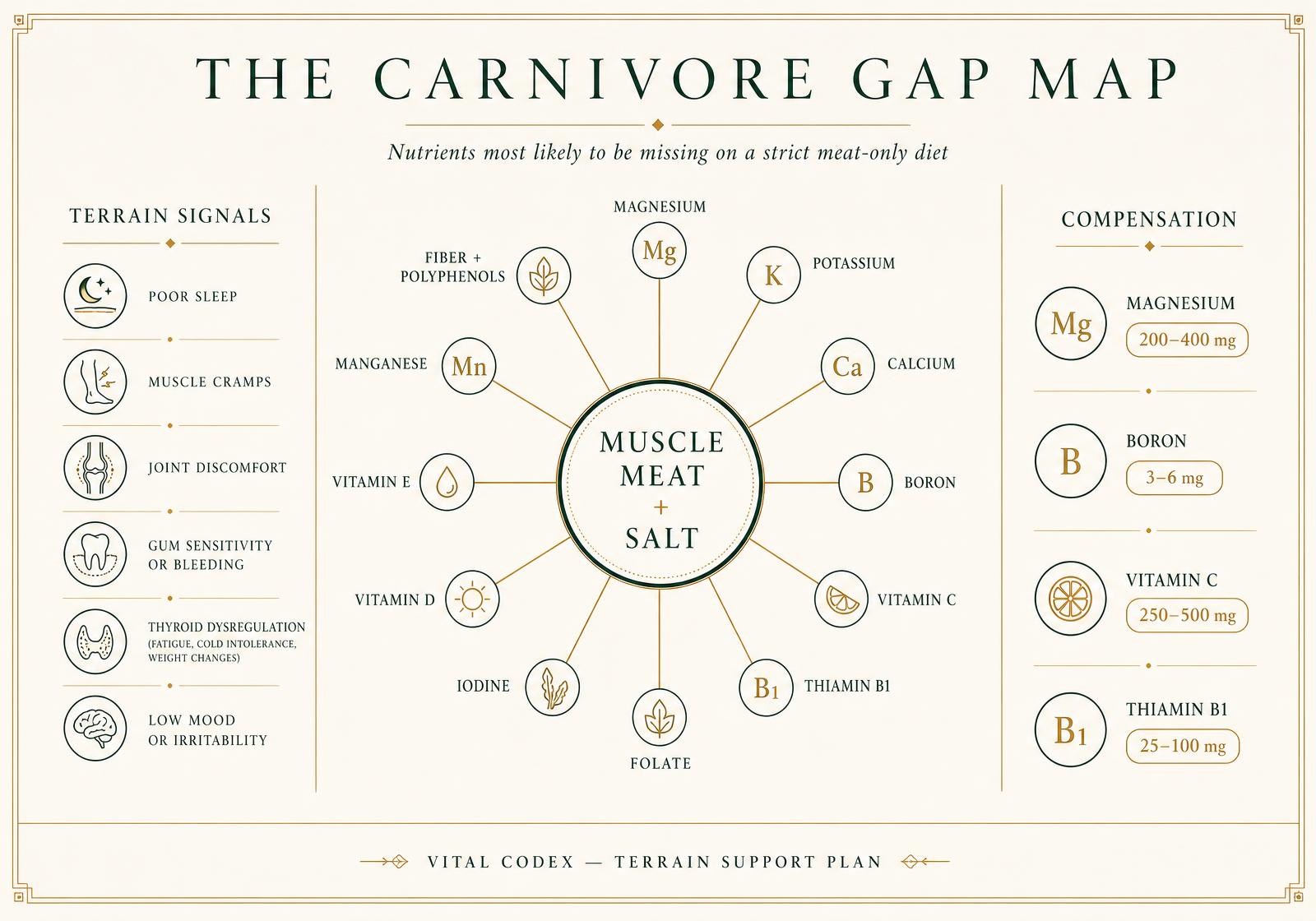
The problem is not that meat is bad. The problem is that muscle meat plus salt is not a complete terrain-building diet for everyone. Most people never eat liver, kidney, heart, spleen, marrow, or connective tissue regularly, and even those who eat free-range eggs and dairy can still run low on the minerals and repair cofactors that normally arrive with plants, mineral water, and organs. Carnivore-diet reviews and modeled carnivore menus repeatedly flag vitamin C, vitamin D, calcium, magnesium, potassium, iodine, thiamin, folate, vitamin E, manganese, and fiber as recurring nutrients of concern.
Muscle meat plus salt is not a complete terrain-building diet for everyone.
Contents(17 sections)
Key takeaways
Twelve inputs are predictably low on strict carnivore: magnesium, potassium, calcium, boron, vitamin C, thiamin, folate, iodine, vitamin D, vitamin E, manganese, and fiber-plus-polyphenols.
Magnesium is usually the first bottleneck — 200–400 mg elemental daily, adjusted for bowel tolerance.
Sodium alone does not create electrolyte balance; potassium is the mineral most often ignored in salt-focused carnivore practice.
Boron is the clearest plant-derived loss, because its food sources are fruit, legumes, nuts, tubers, greens, coffee, and tea. Calcium fructoborate at 3 mg elemental boron daily is the practical foundation, 6 mg for a focused trial.
Liver does not solve the list. It is nutrient dense but does not cover magnesium, potassium, calcium, boron, vitamin C, vitamin D, vitamin E, or gut-microbial signaling.
Seafood is optional, not required. Contamination concerns are legitimate, and iodine can be handled with iodized salt or a measured supplement alongside adequate selenium.
The Primer
The main terrain gaps
| Likely gap | Why it matters | Best compensation strategy |
|---|---|---|
| Magnesium | Sleep, muscle relaxation, nerves, ATP energy, glucose handling, vitamin D use | Magnesium glycinate, malate, or taurate; mineral water or ionic minerals |
| Potassium | Hydration, muscles, nerves, blood pressure, heat and exercise tolerance | Measured electrolyte plan; mineral water; dairy if tolerated |
| Calcium | Bones, teeth, muscle contraction, nerve signaling | Full-fat dairy if tolerated, or measured calcium with magnesium, boron, D and K context |
| Boron | Mineral retention, vitamin D function, hormones, joints, inflammation, connective tissue | Calcium fructoborate: 3 mg elemental boron daily; 6 mg for a focused trial |
| Vitamin C | Collagen, gums, skin, capillaries, antioxidant recycling, repair | 250–500 mg daily; raw organs are too inconsistent for most people |
| Thiamin (B1) | Mitochondrial energy, nerves, digestion, stress adaptation | Thiamin HCl or benfotiamine; pork, free-range eggs and dairy help but rarely suffice |
| Folate | Methylation, blood cells, repair, homocysteine, neurotransmitters | Modest liver rotation or a conservative folate supplement |
| Iodine | Thyroid, temperature, energy, reproductive and brain signaling | Iodized salt or measured low-dose iodine, with adequate selenium |
| Vitamin D | Mineral placement, immune balance, hormones, connective tissue | Sunlight plus individualized supplementation, with magnesium and boron |
| Vitamin E | Cell membrane and lipid protection | Mixed tocopherols, especially when fat intake is high |
| Manganese | Cartilage, bone matrix, antioxidant enzymes, glucose metabolism | Low-dose trace-mineral formula or measured manganese |
| Fiber and polyphenols | Gut barrier, microbial metabolites, immune balance, bile and gut–brain signals | Tolerance-based reintroduction; do not force fiber during active gut symptoms |
A simple strict-carnivore supplement base
For someone eating mostly beef, salt, free-range eggs, butter, and cheese with little or no plant food, a practical baseline looks like this:
- Magnesium: 200–400 mg elemental daily, adjusted for tolerance
- Calcium fructoborate providing 3 mg elemental boron daily, with food
- Vitamin C: 250–500 mg daily, divided if desired
- Thiamin: 25–100 mg thiamin HCl daily, or a low-dose benfotiamine formula
- Iodine: iodized salt or a clearly labeled low-dose supplement
- Vitamin D: based on sun exposure, season, skin tone, and personal testing
- Mixed tocopherols: a modest option when plant foods are absent
- Trace minerals: a quality ionic concentrate to cover smaller gaps
For people focused on joints, recovery, mineral balance, hormonal transition, or inflammatory terrain, calcium fructoborate providing 6 mg elemental boron daily is the more purposeful trial level.
The Deep Dive
What an animal-based diet does well
A well-chosen animal-based diet supplies complete protein and all essential amino acids, B12, B6, riboflavin, niacin, phosphorus, highly absorbable heme iron, zinc, selenium, choline, creatine, carnosine, taurine, carnitine, retinol from liver and yolks, vitamin K2 and calcium from full-fat dairy and aged cheese, and glycine from collagenous cuts. Removing ultra-processed food, seed oils, refined carbohydrate, alcohol, and reactive foods can produce real improvements in appetite control, digestive comfort, energy stability, and metabolic markers.
But strict carnivore is not the same thing as a varied ancestral animal-based diet. Most modern carnivore eating is ribeye, ground beef, bacon, eggs, butter, cheese, and salt — very different from consuming whole animals, varied tissues, seasonal foods, and mineral-rich water. The missing pieces rarely announce themselves. They show up as a gradually less resilient terrain: poor sleep, cramps, constipation, low mood, joint stiffness, slower recovery, thyroid symptoms, low libido, gum sensitivity, and declining stress tolerance.
Tier II · Members only · Free
Continue into the deep dive
Tier I is free and always open. Tier II — the full mechanisms, dosing detail, nuance, and citations — unlocks with a free Vital Codex membership.
- Every Tier II deep dive across all hubs
- Saved reading progress across articles
- Member knowledge modules and their quizzes
- The Dispatch, if you opt in
Frequently asked
Can a strict carnivore diet be nutritionally complete?
It can be rich in protein, B12, iron, zinc, selenium, choline, and several animal-specific nutrients. But a narrow meat-only pattern often leaves predictable gaps in magnesium, potassium, calcium, boron, vitamin C, thiamin, folate, iodine, vitamin D, vitamin E, manganese, and fiber-related microbial inputs.
Why is liver not enough to close every carnivore nutrient gap?
Liver is nutrient dense, but most people do not eat it regularly, and it does not reliably solve magnesium, potassium, calcium, boron, vitamin C, vitamin D, vitamin E, fiber, or broad gut-microbial signaling needs.
What are the most important supplements on a meat-only diet?
Magnesium, calcium fructoborate, vitamin C, thiamin, a measured iodine strategy, vitamin D based on sun exposure, and trace-mineral support are the highest-priority starting points. Calcium, folate, vitamin E, manganese, and potassium depend on food choices and personal needs.
Why use calcium fructoborate instead of borax?
Calcium fructoborate provides a measured amount of elemental boron, more closely resembles plant-associated boron complexes, carries the most focused human joint and inflammatory research, and is the more promising form for gut-terrain research.
Do I need seafood on a carnivore diet?
No. Seafood can be useful but is not required, and it should not be treated as a risk-free nutritional foundation given mercury, arsenic, and microplastic concerns. A broader animal-food strategy plus measured supplements can cover key terrain gaps without frequent seafood intake.
Continue exploring: Continue with the nutrition hub for mineral and micronutrient fundamentals.
Explore Nutrition