Coffee is the most widely consumed bioactive plant extract on earth, and it is almost always discussed as though it contained one molecule. It contains more than a thousand. Caffeine is simply the one you can feel.
That distinction matters because the health literature on coffee and the health literature on caffeine do not say the same thing. Cohort studies consistently associate coffee drinking with lower all-cause mortality, lower type 2 diabetes incidence, and lower rates of liver disease and Parkinson's — and the associations hold, sometimes more strongly, for decaffeinated coffee. Meanwhile the controlled trials on isolated caffeine describe a much narrower story: adenosine blockade, alertness, performance, blood-pressure and sleep costs, and tolerance.
The practical consequences run through everything else in this article. Species and altitude set your caffeine dose before you touch a grinder. Processing and roast set your chlorogenic acid load. Filter choice decides whether you drink the cholesterol-raising diterpenes. Storage decides whether you are drinking coffee or oxidised lipids. And timing decides whether the dose you take helps your day or quietly taxes the night.
Most of the health signal attached to coffee does not come from caffeine. It comes from the polyphenol load caffeine happens to travel with.
Contents(17 sections)
Story at a glance
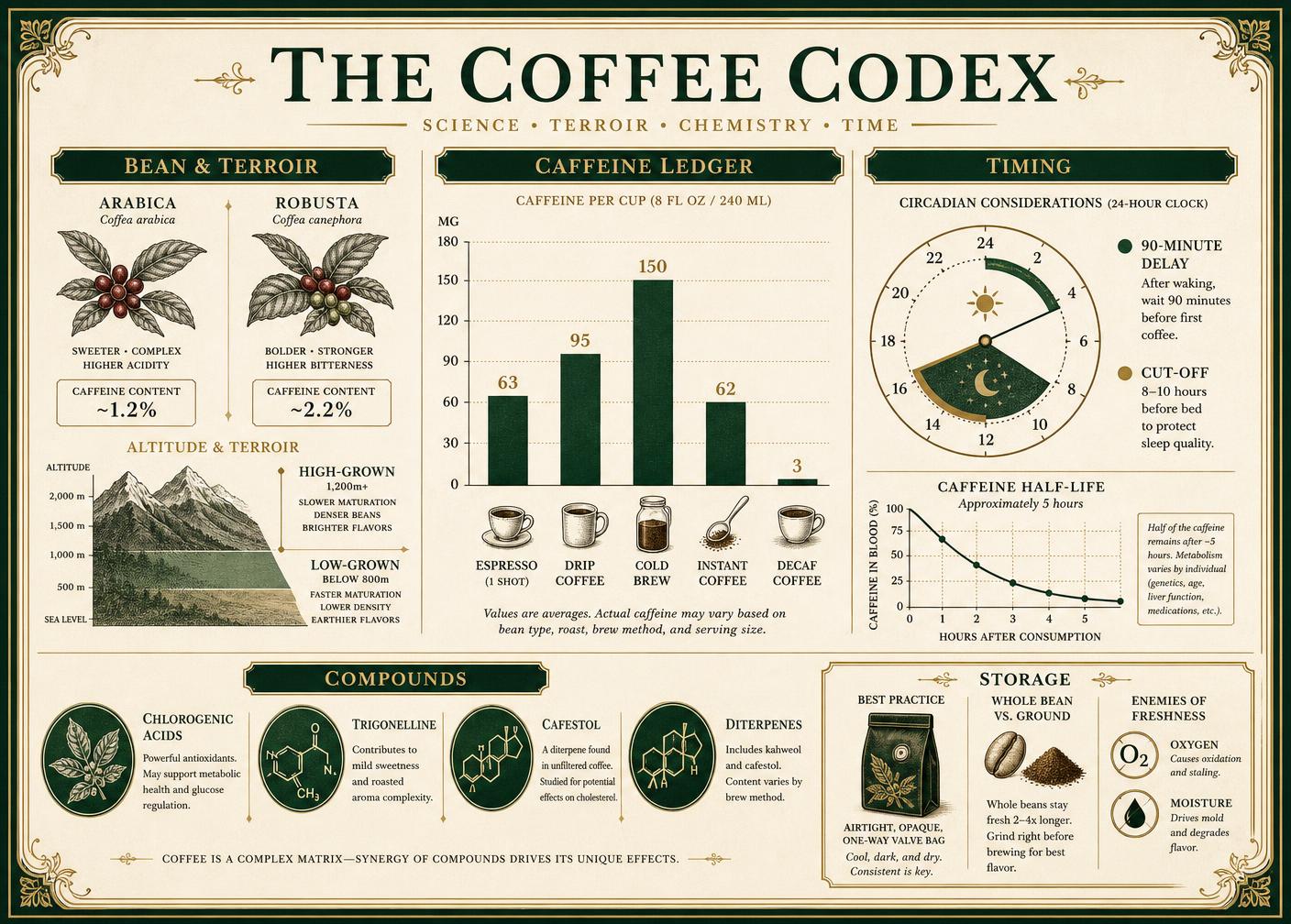
Arabica averages roughly 1.2% caffeine by dry weight; Robusta roughly 2.2%. Species choice is the single largest lever on the dose in your cup — larger than roast level, which barely moves caffeine at all.
A standard 240 ml drip coffee delivers about 95 mg caffeine; a single espresso about 63 mg; a cold brew serving frequently 150–250 mg. Serving size, not drink name, drives the number.
Chlorogenic acids — not caffeine — are the most plausible mechanism behind coffee's metabolic and liver associations. Light roasts retain substantially more of them; roasting degrades them progressively.
Unfiltered coffee (French press, boiled, espresso to a lesser degree) carries cafestol and kahweol, diterpenes that raise LDL cholesterol. Paper filters remove nearly all of them.
Caffeine's half-life averages ~5 hours but ranges from ~2 to over 10 depending on CYP1A2 activity, pregnancy, oral contraceptives, liver function, and smoking. Fast and slow metabolisers should not follow the same schedule.
Caffeine within 8–12 hours of bedtime measurably reduces slow-wave sleep even when people report no difficulty falling asleep. Subjective tolerance is not physiological tolerance.
The "wait 90 minutes after waking" advice is a reasonable heuristic tied to the cortisol awakening response, not a hard biological law. The stronger rule is the evening cut-off.
Pesticide residue in brewed coffee is generally low — roasting degrades many residues and most do not extract into water — but the exposure risk is real for growers, and shade-grown organic coffee has clear ecological and worker-safety advantages.
Mycotoxin fear is largely overstated in well-regulated markets, where ochratoxin A limits are enforced and roasting reduces levels; poor storage in humid conditions is the actual risk factor.
Whole beans stored airtight, opaque, cool and dry, ground immediately before brewing, is the entire storage protocol. Freezing works only if the beans are sealed and not repeatedly thawed.
The Primer
The two species that make almost all coffee
Commercial coffee is dominated by two species. Coffea arabica accounts for roughly 60–70% of world production and Coffea canephora — sold as Robusta — most of the rest. A third, Coffea liberica, is a rounding error outside a handful of markets.
The difference is not just flavour. Arabica averages about 1.2% caffeine by dry weight, Robusta about 2.2% — often close to double. Robusta also carries roughly double the chlorogenic acid content, which contributes to its harsher, more bitter profile, and lower lipid and sugar content, which is why it produces the thick crema espresso blends are built around.
Arabica is the more delicate plant: it wants altitude, cool nights, and consistent rainfall, and it is far more vulnerable to coffee leaf rust and the coffee berry borer. Robusta tolerates heat, lower elevation, and pest pressure — which is exactly why it requires less agrochemical input in many settings and why climate models predict its share will rise.
Why altitude and terroir change the cup
High-grown Arabica — typically above 1,200 metres, and the best lots well above 1,500 — matures slowly because nights are cool. Slow maturation means more time to accumulate sugars and acids, denser beans, and the bright, complex profile that specialty grading rewards.
Low-grown coffee ripens faster, producing softer, less dense beans with flatter acidity and more earthy character. Neither is a health claim: altitude affects flavour, density, and price far more than it affects the compounds that matter physiologically.
Shade-grown coffee — grown under a canopy rather than in full-sun monoculture — slows maturation further, supports dramatically higher bird and insect biodiversity, reduces erosion, and typically requires less synthetic input. The strongest argument for shade-grown is ecological and social rather than nutritional, and it is a good argument.
Processing and roast
After picking, the cherry must be removed. Washed processing ferments and rinses the fruit away, producing clean, acidic cups. Natural (dry) processing dries the whole cherry, producing heavier, fruitier, sometimes fermented profiles. Honey and anaerobic methods sit in between and have proliferated in specialty coffee.
Roast is where the most persistent myth lives. Dark roast is not "stronger" in caffeine. Caffeine is remarkably heat-stable and survives roasting nearly intact. What changes is bean density and mass loss: dark roast beans are lighter and larger, so a scoop measured by volume holds fewer beans and slightly less caffeine, while a dose measured by weight is close to identical.
What roast genuinely destroys is chlorogenic acids — the polyphenols most credibly linked to coffee's metabolic effects. Light roasts retain considerably more; very dark roasts can lose the majority. Roasting also decomposes trigonelline into niacin and into the aroma compounds that make coffee smell like coffee.
Pesticides, residues, and what actually reaches the cup
Conventional coffee is a heavily sprayed crop in some regions, and the honest picture has two halves.
For the drinker, measured residues in brewed coffee are typically low. Three filters sit between the field and the cup: the bean is inside a fruit that is removed during processing, roasting at 200 °C+ degrades many residues, and brewing extracts water-soluble compounds while many pesticide residues are not. Regulatory surveys in the EU and US routinely find green and roasted coffee among the lower-violation commodity categories.
For the grower, the picture is different. Agrochemical exposure in producing regions is a documented occupational health problem, with weaker protective equipment access and enforcement than importing countries assume. Certified organic and shade-grown purchasing is best understood as a labour and ecosystem decision that also happens to reduce your own residue exposure at the margin.
Mycotoxins — chiefly ochratoxin A — occupy a similar space. They are real, they are regulated with enforced limits in the EU and elsewhere, roasting reduces them substantially, and surveys of retail coffee in regulated markets generally find levels well below limits. The genuine risk sits with poorly dried, poorly stored coffee in humid conditions, which is a storage and supply-chain issue rather than an inherent property of coffee.
Storage: the part most people get wrong
Coffee's enemies are oxygen, moisture, heat, and light, in that order. Roasted coffee begins degassing CO₂ immediately and oxidising soon after; its aromatic oils go stale in the same way any unsaturated lipid does.
The protocol is short:
- Buy whole beans with a roast date, not a best-before date. Aim to use them within about four weeks of roasting.
- Store airtight, opaque, cool, and dry — a one-way-valve bag or sealed canister in a cupboard, not on top of the espresso machine and not in the fridge, where condensation and odour transfer both work against you.
- Grind immediately before brewing. Ground coffee exposes vastly more surface area and stales in days rather than weeks.
- Freezing works, but only properly: divide into single-use airtight portions, freeze once, and take a portion out to brew without repeatedly warming and refreezing the bag.
Caffeine content: what is actually in your cup
Approximate caffeine per common serving:
| Drink | Typical serving | Caffeine |
|---|---|---|
| Drip / filter coffee | 240 ml | 95 mg (70–140) |
| Espresso | 30 ml single | 63 mg (50–80) |
| Americano (double) | 240 ml | ~125 mg |
| Cold brew | 350 ml | 150–250 mg |
| Instant | 240 ml | 62 mg |
| Decaf | 240 ml | 2–5 mg |
| Robusta-heavy commercial blend | 240 ml | up to ~200 mg |
Cold brew is the reliable surprise. Long steeping at a high coffee-to-water ratio extracts a lot of caffeine, and typical serving sizes are large. A single café cold brew can exceed three drip coffees.
Health authorities converge on roughly 400 mg per day as a level not associated with adverse effects in healthy non-pregnant adults, with 200 mg per day the common guidance in pregnancy. Those are population ceilings, not targets.
Timing: the two rules that matter
The evening rule is the important one. Caffeine's mean half-life of ~5 hours means a 200 mg dose at 4 pm leaves roughly 100 mg circulating at 9 pm and 50 mg at 2 am. Controlled work has shown that caffeine taken even 6 hours before bed measurably reduces total sleep time, and polysomnography studies show reduced slow-wave sleep and delayed melatonin onset in people who report sleeping "fine." A cut-off 8–10 hours before bed is the defensible default; slow metabolisers need more.
The morning rule is softer than the internet suggests. The popular advice to delay coffee 90–120 minutes after waking is built on the cortisol awakening response — the natural cortisol surge in the first 30–45 minutes after waking — and the reasonable idea that stacking caffeine on top of it is redundant and may accelerate tolerance. The direct human evidence for that specific claim is thin. What is well supported is that delaying the first cup reduces the sleep-pressure masking that keeps people from noticing they are chronically underslept. Treat 90 minutes as a useful experiment, not a rule.
For performance, caffeine's ergogenic effect is one of the best-replicated findings in sports science: roughly 3–6 mg/kg taken 45–60 minutes before exercise improves endurance, time-to-exhaustion, and perceived exertion in most people.
The Deep Dive
Mechanism: adenosine, not energy
Caffeine does not create energy. It is a competitive antagonist at adenosine A1 and A2A receptors. Adenosine accumulates across waking hours as a byproduct of cellular energy turnover and is the principal biochemical signal of sleep pressure. Blocking its receptors removes the perception of that pressure without discharging it — which is why sleep debt reappears intact once the drug clears.
Downstream, A2A blockade in the striatum disinhibits dopaminergic signalling, which explains caffeine's mood and motivation effects and its mild reinforcing properties. Peripheral effects — modest increases in blood pressure, catecholamine release, lipolysis, and diuresis in non-habituated users — follow from the same antagonism plus sympathetic activation.
Tier II · Members only · Free
Continue into the deep dive
Tier I is free and always open. Tier II — the full mechanisms, dosing detail, nuance, and citations — unlocks with a free Vital Codex membership.
- Every Tier II deep dive across all hubs
- Saved reading progress across articles
- Member knowledge modules and their quizzes
- The Dispatch, if you opt in
Frequently asked
Does dark roast have more caffeine than light roast?
No. Caffeine is heat-stable and survives roasting almost intact. Dark roast beans lose mass and become less dense, so if you measure by volume you get slightly less caffeine per scoop; measured by weight, the two are nearly identical. What dark roasting does reduce substantially is chlorogenic acid content.
Is Arabica or Robusta better for health?
Neither cleanly. Robusta carries roughly double the caffeine and more chlorogenic acids; Arabica is lower in caffeine and generally lower in bitterness. If you are caffeine-sensitive, Arabica is the safer default. If you want the polyphenol load with less caffeine, a light-roast Arabica with a decaf blend is a reasonable compromise.
Should I wait 90 minutes after waking before drinking coffee?
It is a reasonable experiment, not an established rule. The rationale — avoiding stacking caffeine on the cortisol awakening response — is plausible but under-tested in humans. The better-supported benefit is that delaying the first cup lets you feel your true sleep pressure instead of masking it. The evening cut-off has far stronger evidence behind it.
How late can I drink coffee without affecting sleep?
Use 8–10 hours before bed as the default cut-off, and later than that only if you know you clear caffeine quickly. Controlled trials show measurable sleep disruption from caffeine taken 6 hours before bed even in people who report no problem falling asleep. Slow metabolisers, people on oral contraceptives, and pregnant people should stop earlier.
Does coffee raise cholesterol?
Unfiltered coffee does. Cafestol and kahweol, diterpenes present in French press, boiled, Turkish, and to a lesser degree espresso, raise LDL cholesterol — historically by around 8–10% at high unfiltered intakes. Paper filters remove nearly all of them, which is why filtered coffee shows no such effect.
Is there dangerous mould or mycotoxin in coffee?
In regulated markets this is largely overstated. Ochratoxin A limits are enforced, roasting reduces levels substantially, and retail surveys generally find results well below limits. The genuine risk comes from poorly dried or humid-stored coffee. Buying from reputable roasters and storing beans dry addresses it.
Does organic coffee matter for pesticide exposure?
For the drinker, marginally: fruit removal, roasting, and water extraction mean measured residues in brewed coffee are typically low. For the people growing it, it matters considerably more. Organic and shade-grown purchasing is best framed as an ecological and occupational-health choice with a small personal-exposure benefit attached.
Is decaf worth drinking?
Yes, and it is underrated. Decaffeination removes the caffeine but leaves most of the chlorogenic acids and melanoidins, and many of coffee's strongest epidemiological associations — lower type 2 diabetes and liver disease risk — persist with decaf. Modern water-process and CO₂ methods avoid the solvent concerns attached to older approaches.
How much caffeine is too much?
Roughly 400 mg per day is the commonly cited ceiling for healthy non-pregnant adults, about 200 mg in pregnancy. Individual tolerance varies severalfold. Anxiety, palpitations, tremor, reflux, and disrupted sleep are the practical signals that your dose is above your personal limit regardless of what the population number says.
Does coffee dehydrate you?
Not at the doses most people drink. The mild diuretic effect is offset by the fluid volume of the drink itself, and habitual users habituate to it. Controlled comparisons of coffee versus water in regular drinkers find no meaningful difference in hydration status.
Research Notes & Sources(expand)
Poole R, et al. "Coffee consumption and health: umbrella review of meta-analyses of multiple health outcomes." BMJ 2017;359:j5024. doi:10.1136/bmj.j5024 — the standard umbrella synthesis behind the 3–4 cup nadir for all-cause mortality.
Ding M, et al. "Association of coffee consumption with total and cause-specific mortality in 3 large prospective cohorts." Circulation 2015;132:2305–2315. Nonlinear inverse association, present for decaffeinated coffee.
Carlström M, Larsson SC. "Coffee consumption and reduced risk of developing type 2 diabetes: a systematic review with meta-analysis." Nutrition Reviews 2018;76(6):395–417. Dose-response of roughly 6% risk reduction per cup per day, including decaf.
Kennedy OJ, et al. "Coffee, including caffeinated and decaffeinated coffee, and the risk of hepatocellular carcinoma: a systematic review and dose–response meta-analysis." BMJ Open 2017;7:e013739.
Urgert R, Katan MB. "The cholesterol-raising factor from coffee beans." Annual Review of Nutrition 1997;17:305–324 — the foundational cafestol/kahweol work and the basis of the filtered-versus-unfiltered distinction.
Drewnowski A, Rehm CD. "Sources of caffeine in diets of US children and adults." Nutrients 2016 — serving-level caffeine distributions; USDA FoodData Central for per-serving values.
Drake C, Roehrs T, Shambroom J, Roth T. "Caffeine effects on sleep taken 0, 3, or 6 hours before going to bed." Journal of Clinical Sleep Medicine 2013;9(11):1195–1200. PMID: 24235903 — the canonical demonstration that a 6-hour buffer is insufficient.
Burke TM, et al. "Effects of caffeine on the human circadian clock in vivo and in vitro." Science Translational Medicine 2015;7(305):305ra146 — 200 mg evening caffeine delays melatonin onset ~40 minutes.
Cornelis MC, El-Sohemy A, Kabagambe EK, Campos H. "Coffee, CYP1A2 genotype, and risk of myocardial infarction." JAMA 2006;295(10):1135–1141 — the origin of the fast/slow metaboliser cardiovascular literature; later replication has been mixed.
Nehlig A. "Interindividual differences in caffeine metabolism and factors driving caffeine consumption." Pharmacological Reviews 2018;70(2):384–411 — comprehensive review of CYP1A2, ADORA2A, and clearance modifiers.
Farah A, Donangelo CM. "Phenolic compounds in coffee." Brazilian Journal of Plant Physiology 2006;18:23–36 — chlorogenic acid content by species and roast degradation curves.
Manghi P, et al. "Coffee consumption is associated with intestinal Lawsonibacter asaccharolyticus abundance and prevalence across multiple cohorts." Nature Microbiology 2024. doi:10.1038/s41564-024-01858-9 — the strongest recent microbiome signal for coffee.
Membrez M, et al. "Trigonelline is an NAD⁺ precursor that improves muscle function during ageing." Nature Metabolism 2024;6:433–447 — the trigonelline/NAD⁺ thread, preclinical with human correlational support.
Bunker ML, McWilliams M. "Caffeine content of common beverages" and subsequent USDA/FDA reference values; FDA guidance on 400 mg/day; ACOG and EFSA guidance on 200 mg/day in pregnancy.
EFSA Panel on Contaminants. Ochratoxin A in food, and EU Commission Regulation limits for roasted and soluble coffee — the regulatory basis for the mycotoxin discussion.
Guenther PM, et al.; EU EFSA pesticide residue monitoring annual reports — coffee residue violation rates in context with other commodity categories.
Bunn C, et al. "A bitter cup: climate change profile of global production of Arabica and Robusta coffee." Climatic Change 2015;129:89–101 — suitability modelling behind the climate section.
Killer SC, Blannin AK, Jeukendrup AE. "No evidence of dehydration with moderate daily coffee intake." PLoS ONE 2014;9(1):e84154.
Guest NS, et al. "International Society of Sports Nutrition position stand: caffeine and exercise performance." JISSN 2021;18:1 — the 3–6 mg/kg ergogenic dosing basis.
Continue exploring: The Vital Codex library on nutrition, metabolism, and the daily inputs that shape them.
Explore Nutrition