Collagen supplements occupy an unusual position: the mechanism critics dismiss — "it just gets digested into amino acids" — is largely correct, and the clinical trials still show effects. The resolution is that specific di- and tripeptides survive digestion, reach the bloodstream intact, and act as signals to fibroblasts rather than merely as raw material.
Contents(13 sections)
Key takeaways
Effective doses: 2.5–10 g daily hydrolyzed peptides for skin, 10–15 g for tendon and joint protocols.
Specific peptides (prolyl-hydroxyproline, hydroxyprolyl-glycine) survive digestion and signal fibroblasts.
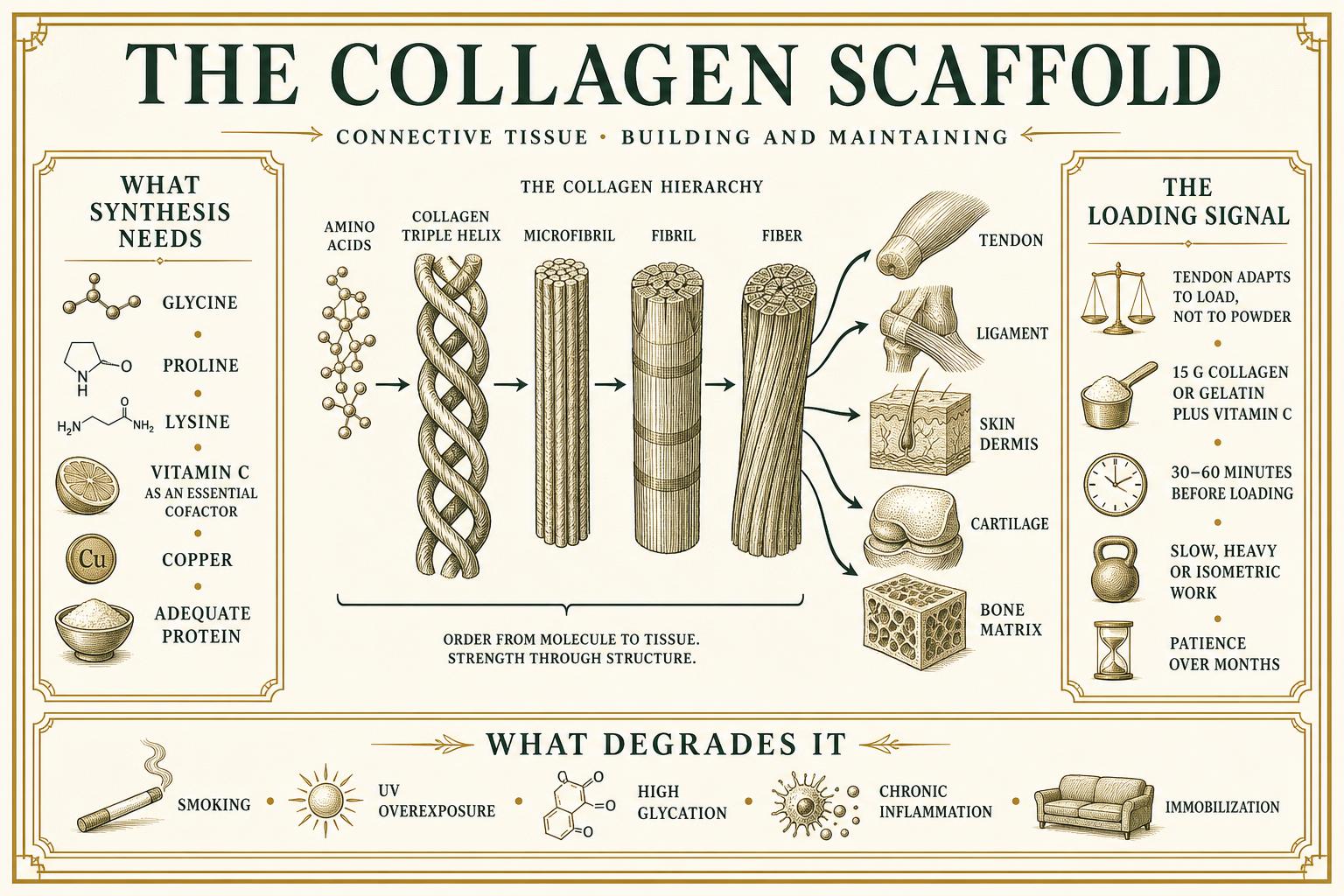
Vitamin C is required for collagen synthesis; take them together.
For tendon and ligament, the dose only works with mechanical loading 30–60 minutes later.
The Primer
What collagen is and where it fails
Collagen is the structural protein of skin dermis, tendon, ligament, cartilage, bone matrix, and vessel wall — roughly a third of total body protein. Synthesis declines with age from around the mid-twenties, and cumulative UV exposure, smoking, and high glycemic load accelerate degradation through matrix metalloproteinase activity and glycation cross-linking.
The visible consequences are dermal thinning and reduced elasticity. The functional ones are slower tendon remodeling and stiffer, less resilient connective tissue.
What supplementation actually shows
Meta-analyses of randomized trials in skin report consistent improvements in hydration and elasticity over 8 to 12 weeks at 2.5–10 g daily, with smaller and less consistent effects on wrinkle depth. Effect sizes are modest but real, and they appear across independent trials rather than only in industry-funded single studies.
Joint pain trials in athletes and in knee osteoarthritis show reduced activity-related pain at 5–10 g daily. Tendon and ligament work is newer and more specific: 15 g of gelatin or hydrolyzed collagen with vitamin C, taken roughly an hour before loading, increased markers of collagen synthesis in controlled human trials.
What it does not do
It does not selectively rebuild the tissue you care about most — you cannot direct it to your face. It does not replace sun protection, which remains the highest-yield intervention for skin aging by a wide margin. And it does not work as an isolated protein source for muscle: collagen is low in leucine and a poor choice for muscle protein synthesis.
The Deep Dive
Bioactive peptides and the signaling mechanism
Hydrolyzed collagen is enzymatically cleaved into peptides of roughly 2,000–5,000 Da. Most is digested to free amino acids, but a fraction of proline-hydroxyproline-containing di- and tripeptides resists brush-border peptidases and appears in plasma within an hour of ingestion, with measurable concentrations of Pro-Hyp and Hyp-Gly.
In cell and animal work these peptides act as chemoattractants for fibroblasts and upregulate type I collagen, hyaluronic acid synthase, and elastin expression. That is the mechanistic bridge: the effect is plausibly signal-mediated, not substrate-mediated, which also explains why total protein intake alone does not reproduce it.
Tier II · Members only · Free
Continue into the deep dive
Tier I is free and always open. Tier II — the full mechanisms, dosing detail, nuance, and citations — unlocks with a free Vital Codex membership.
- Every Tier II deep dive across all hubs
- Saved reading progress across articles
- Member knowledge modules and their quizzes
- The Dispatch, if you opt in
Frequently asked
Does collagen survive digestion?
Mostly not as intact protein, but specific di- and tripeptides such as Pro-Hyp do reach the bloodstream and appear to act as signals to fibroblasts.
How long before I see skin changes?
Trials typically report measurable hydration and elasticity changes at 8–12 weeks. Shorter self-trials are not informative.
Marine or bovine?
Both work. Marine peptides show somewhat higher bioavailability in comparative studies; bovine products more often include type III alongside type I.
Can collagen replace my protein shake?
No. Collagen lacks tryptophan and is low in leucine, making it a poor stimulus for muscle protein synthesis. Use it alongside, not instead of, complete protein.
Continue exploring: Nutrition — Protein sufficiency, micronutrient density, and food quality.
Explore Nutrition