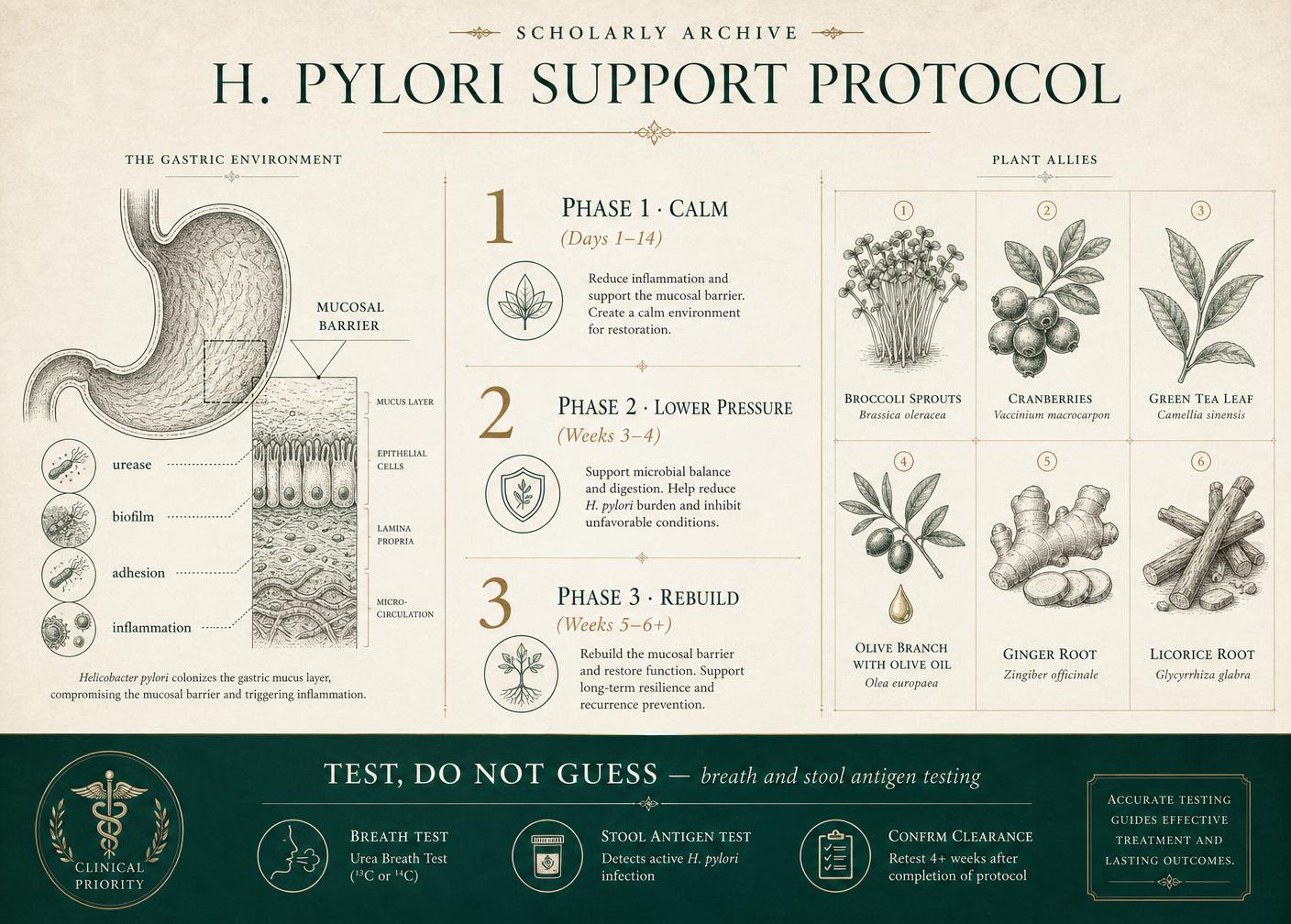
H. pylori is a stomach-adapted bacterium that persists in acid by producing urease, forming biofilm, and adhering to the gastric lining — and when it persists untreated it drives chronic gastritis, peptic ulcer disease, and long-term gastric cancer risk. A useful natural protocol does not try to replace eradication therapy; it lowers microbial pressure, calms inflammation, and helps the mucosal barrier repair.
Because antibiotic resistance keeps complicating eradication, the practical question is what widely available foods and nutrients genuinely support the stomach alongside proper care. This protocol is built from supermarket and pharmacy ingredients — broccoli sprouts, probiotics, unsweetened cranberry, green tea, extra virgin olive oil, ginger, and DGL licorice — staged over six weeks rather than stacked all at once.
Contents(16 sections)
Key takeaways
H. pylori persistence is driven by adhesion, inflammation, and mucosal damage — not microbial load alone, so a protocol should address all four rather than stacking antimicrobials.
Broccoli sprouts (sulforaphane) are the most evidence-backed food option in H. pylori-associated gastritis, with both antimicrobial and cytoprotective activity.
Cranberry works mainly through anti-adhesion rather than direct killing, which is why unsweetened juice or standardized extract belongs in a food-first plan.
Probiotics (Lactobacillus and Bifidobacterium species, including L. reuteri) may reduce colonization pressure and improve tolerance of standard eradication therapy.
H. pylori is a testable infection: breath and stool antigen testing exist, and confirmed infection warrants guideline-based eradication therapy because ulcer and cancer risk are real.
The Primer
What H. pylori does in the stomach
H. pylori survives where most bacteria cannot. It neutralizes acid around itself with urease, sticks to gastric tissue, forms biofilm, and evades immune clearance. Over time that combination damages the mucosal barrier and creates chronic inflammation, which shows up as bloating, nausea, reflux, upper abdominal pain, belching, early fullness, and poor tolerance of meals.
Not everyone with H. pylori has symptoms. But persistent infection is strongly associated with chronic gastritis and is a major risk factor for peptic ulcers and gastric malignancy. The strategy follows from the biology: make it harder for the organism to cling, inflame, and injure, while giving the lining what it needs to recover.
The five goals of a real protocol
A support plan is more useful than a supplement list when it is organized by purpose. Five priorities cover the ground:
- Lower bacterial pressure with antimicrobial, anti-adhesion, and anti-biofilm foods and nutrients.
- Calm gastric inflammation and oxidative stress to reduce irritation and tissue injury.
- Support mucus production and mucosal repair so the lining becomes more resilient.
- Improve meal tolerance and remove dietary patterns that keep symptoms active.
- Reinforce recovery with sleep, meal timing, hygiene, and retesting when medically appropriate.
The foundation diet
Phase one is subtraction. Minimize ultra-processed foods, fried foods, excess sugar, heavy late-night meals, and any personal trigger that clearly worsens burning, reflux, nausea, or pain. Coffee, alcohol, and very spicy food are not universal triggers, but they commonly aggravate active gastritis and are usually worth removing for two to four weeks while the stomach is inflamed.
Meals tend to be better tolerated when they are smaller and simpler: soft cooked vegetables, soups and stews, well-cooked proteins, moderate healthy fats, and fruit as tolerated. Four habits do most of the work:
- Finish the last meal at least three hours before bed to reduce reflux and overnight gastric stasis.
- Chew thoroughly and slow the pace of meals.
- Favor cooked over raw food during the symptom-heavy phase, especially with bloating or pain.
- Avoid constant grazing if it worsens symptoms; defined meals allow time for gastric emptying.
The core ingredients, by function
Broccoli sprouts and sulforaphane. The most evidence-backed food in this space. Sulforaphane has antimicrobial and cytoprotective activity relevant to H. pylori-associated gastritis, and crucifer-derived compounds continue to appear in reviews as promising because they may suppress bacterial activity while supporting antioxidant defense. One serving of fresh sprouts daily, or a standardized sulforaphane supplement when sprouts are unavailable.
Probiotics. Lactobacillus and Bifidobacterium species — and strain-specific evidence for L. reuteri — may reduce colonization pressure, improve local immune balance, reduce treatment side effects, and ease symptoms. Unsweetened yogurt, kefir, and fermented vegetables work if tolerated; capsules are often more practical during active irritation.
Cranberry. Its value is anti-adhesion rather than killing — making it harder for the organism to persist on gastric tissue. Use unsweetened juice or a standardized extract. Sweetened juice defeats the purpose.
Green tea. Catechins carry antimicrobial, antioxidant, and anti-inflammatory activity relevant to gastritis, and green tea is cheap and easy to sustain long term. Sensitive stomachs usually do better with weaker brews, taken with food, or decaffeinated during the acute phase.
Garlic and ginger. Garlic contributes antimicrobial compounds; ginger is repeatedly cited for anti-inflammatory, antioxidant, and gastroprotective effects. Cooked garlic and ginger tea are far easier to tolerate than large raw doses on an already irritated lining.
Extra virgin olive oil. Polyphenols with investigated anti-H. pylori and gastroprotective activity. Best used as the daily fat inside a low-irritation diet — replacing refined oils is one of the easiest immediate upgrades.
Honey, especially manuka. Antimicrobial and soothing potential, best framed as symptom support rather than eradication. Small amounts, not aggressive dosing.
DGL licorice. Deglycyrrhizinated licorice is compelling for mucosal support rather than eradication. It earns its place when the lining feels raw, meals burn, or reflux and ulcer-like discomfort dominate.
What it means in plain English
No single ingredient clears H. pylori. What reliably helps is a quieter diet, a small set of evidence-supported foods used consistently, real mucosal repair support, and testing so you know whether you are improving or just masking symptoms.
The Deep Dive
The staged six-week structure
Phase 1 — Calm the stomach (days 1–14). Remove irritants and build a soothing meal pattern: soups, stews, soft vegetables, simple proteins, olive oil, ginger tea. Avoid alcohol, excess coffee, fried food, very spicy meals, and late-night eating. Add ginger tea once or twice daily, DGL before meals if burning or reflux is present, a simple probiotic taken consistently, and small amounts of fresh broccoli sprouts if tolerated.
Phase 2 — Lower microbial pressure (weeks 3–4). With the stomach calmer, expand into active support: broccoli sprouts or sulforaphane, probiotics, unsweetened cranberry, green tea, garlic in tolerated amounts, and optional curcumin or lactoferrin. The point is complementary mechanisms — anti-adhesion, anti-inflammatory support, microbiome support, gentle antimicrobial pressure — not a maximalist stack. A smaller set used consistently outperforms a long list started at once.
Tier II · Members only · Free
Continue into the deep dive
Tier I is free and always open. Tier II — the full mechanisms, dosing detail, nuance, and citations — unlocks with a free Vital Codex membership.
- Every Tier II deep dive across all hubs
- Saved reading progress across articles
- Member knowledge modules and their quizzes
- The Dispatch, if you opt in
Frequently asked
Can natural remedies eradicate H. pylori on their own?
There is no reliable evidence that any food or supplement regimen consistently eradicates H. pylori. Foods like broccoli sprouts, cranberry, and green tea can lower microbial pressure and reduce inflammation, but when infection is confirmed, guideline-based eradication therapy remains the treatment with documented cure rates.
What is the single most evidence-backed food for H. pylori?
Broccoli sprouts, for their sulforaphane content. Sulforaphane has both antimicrobial and cytoprotective activity studied specifically in H. pylori-associated gastritis, which is why it functions as a foundation food rather than an optional extra.
Should I take probiotics during antibiotic eradication therapy?
Reviews commonly report that probiotic adjuncts reduce treatment side effects and may improve tolerance and outcomes during eradication therapy. Lactobacillus and Bifidobacterium species are the most studied. Coordinate timing with your clinician.
Why cranberry if it does not kill the bacteria?
Cranberry's relevance is anti-adhesion — making it harder for H. pylori to remain attached to gastric tissue. Since persistence depends on adhesion, not just microbial load, reducing attachment is a legitimate and complementary mechanism.
When should I stop self-managing and see a doctor?
Immediately, if you have ongoing weight loss, black stools, vomiting blood, severe persistent pain, unexplained anemia, or difficulty eating. Also see a clinician for testing if symptoms persist beyond a few weeks — H. pylori is diagnosable, and untreated infection carries ulcer and cancer risk.
Continue exploring: Nutrition — Protein sufficiency, micronutrient density, and food quality.
Explore Nutrition