N-acetyl cysteine (NAC) is a stabilized, more bioavailable form of the amino acid L-cysteine that your body uses to build glutathione — the central antioxidant and detoxification molecule inside every cell. It has been an approved drug since 1963, sits on the World Health Organization's list of essential medicines, and remains the hospital standard of care for acetaminophen overdose.
Its dual identity is what makes it unusual: half rigorously validated pharmaceutical, half active research frontier spanning psychiatry, fertility, longevity signaling, and bacterial biofilm disruption.
Glutathione taken orally is largely destroyed in digestion. NAC works because it delivers the one ingredient the cell cannot make fast enough.
Contents(20 sections)
Key takeaways
NAC is a direct precursor to glutathione, the master intracellular antioxidant; cysteine is the rate-limiting ingredient.
It is the clinical gold standard for acetaminophen overdose, near fully hepatoprotective when given within eight hours.
It breaks disulfide bonds — thinning airway mucus and physically degrading bacterial biofilm matrices in vitro.
It modulates extracellular glutamate, which underlies trials in OCD, addiction, and compulsive-behavior disorders.
Typical supplemental dose is 600–1,200 mg/day; respiratory and psychiatric protocols run higher under supervision.
The Primer
What NAC does
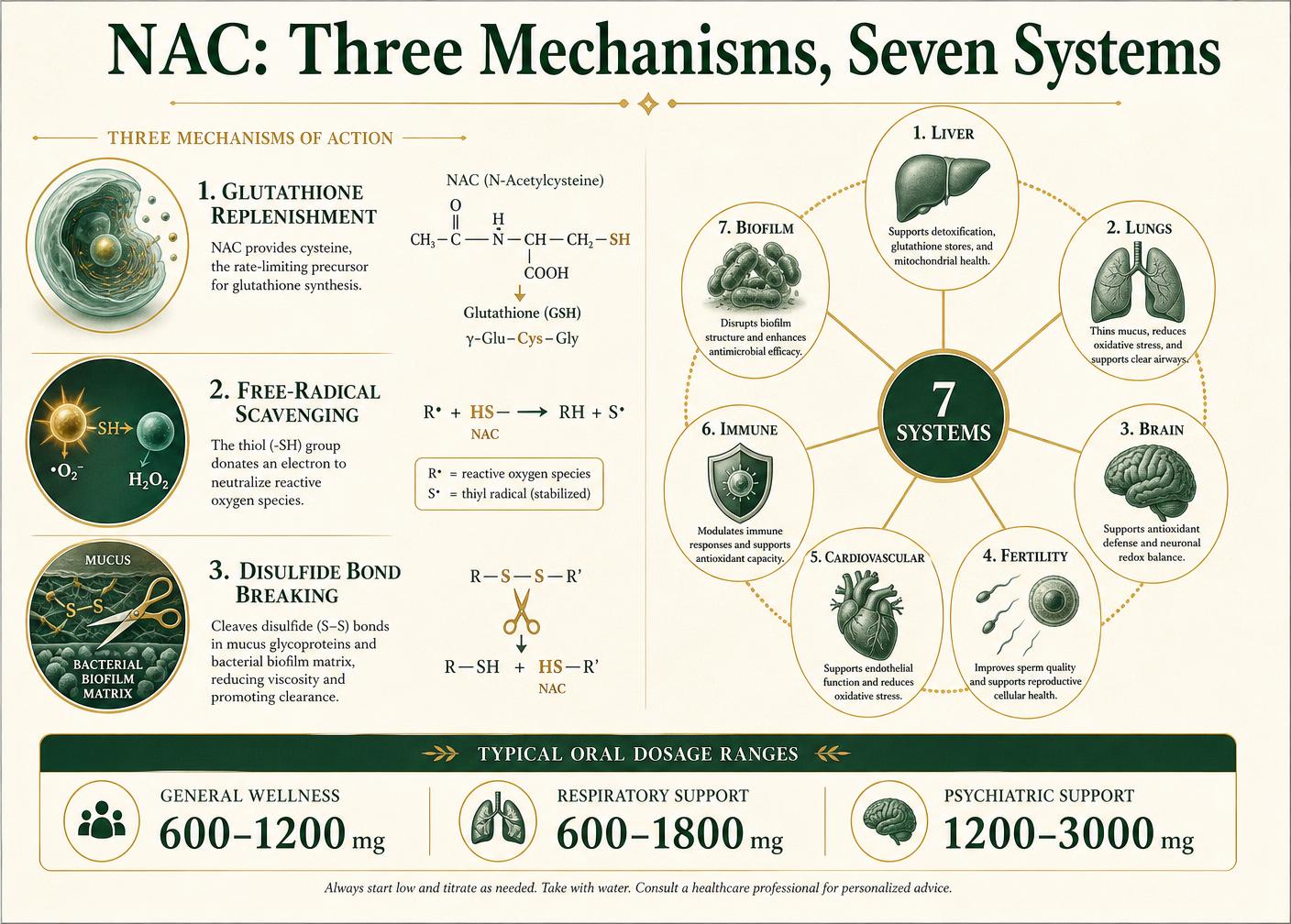
NAC delivers cysteine, the rate-limiting amino acid in glutathione synthesis. Once glutathione is topped up, three things get easier for the body:
- Neutralizing free radicals produced by normal metabolism, alcohol, poor sleep, pollution, and exercise.
- Phase II liver detoxification, in which glutathione is conjugated to processed toxins so they can be safely excreted.
- Mucolytic action in the airways — NAC breaks disulfide bonds in mucus, thinning it so it clears more easily.
Three mechanisms behind its range
NAC's unusually wide list of applications makes more sense once you see that it does not work through a single pathway.
- Glutathione replenishment. Supplying cysteine directly accelerates the body's own antioxidant production rather than trying to supplement glutathione itself.
- Direct free-radical scavenging. The reactive sulfhydryl (thiol) group neutralizes reactive oxygen species on its own, independent of glutathione, protecting lipids, proteins, and DNA.
- Disulfide bond breaking. The same chemistry that thins mucus also dismantles the matrix holding bacterial biofilms together.
Laboratory work also shows NAC can inhibit mTOR signaling, a metabolic pathway tied to cellular aging — part of why it draws interest in longevity research.
Where it fits
- Liver and metabolic support — daily glutathione buffering for people carrying a modern toxin load (alcohol, medications, environmental exposure).
- Respiratory support — chronic congestion, post-viral mucus, sinus congestion, seasonal exposure.
- Recovery — post-exercise oxidative stress, jet lag, elevated inflammatory load.
- Mood and cognition — modulates glutamate signaling; studied as adjunct support in OCD, addiction, and cognitive resilience.
How to take it
- Dose: 600–1,200 mg per day, once or twice daily with water.
- Timing: with food if your stomach is sensitive; otherwise anytime.
- Onset: benefits build over days to weeks as the glutathione system stabilizes.
- Sulfur note: NAC has a mild sulfur smell — normal, not a sign of a bad batch.
Who should be careful
- Pregnant or nursing women should consult a clinician.
- People on nitroglycerin, anticoagulants, or certain psychiatric medications should check for interactions.
- If you have active asthma with sensitive airways, start low — the mucolytic effect can be strong.
Who tends to benefit most
NAC is not a universal supplement, but a few groups have a plausible reason to be short on cysteine or heavy on oxidative load:
- Anyone over 60. Glutathione synthesis capacity falls with age, and glycine often falls with it.
- Chronic respiratory patterns — smokers and ex-smokers, chronic bronchitis, COPD, recurrent sinus congestion, post-viral mucus that lingers for weeks.
- Liver stress — regular alcohol, fatty liver, multiple prescription medications processed through phase I/II pathways, occupational solvent exposure.
- Autoimmune and gut-driven inflammation, including gluten-driven inflammation, where chronic immune activation consumes glutathione faster than diet replaces it.
- High environmental or occupational exposure — mold and mycotoxins, pesticides, heavy metals, urban air pollution, wildfire smoke.
- Low-protein or restricted eaters — vegans, appetite-suppressed elders, post-bariatric patients, anyone eating well under 1 g protein per kg.
- Compulsive-behavior patterns — skin-picking, hair-pulling, nail-biting, nicotine or gambling dependence, where the glutamate mechanism, not the antioxidant one, is the point.
The bigger frame
NAC is not a miracle. It is a competent, cheap tool that supports the pathway your body already uses to keep itself clean. It pairs well with the fundamentals — hydration, sleep, minerals, movement, adequate protein — and does its best work when those inputs are already in place.
The Deep Dive
Glutathione synthesis and the rate-limiting step
Glutathione (GSH) is a tripeptide of glutamate, cysteine, and glycine assembled in two ATP-dependent steps: glutamate-cysteine ligase (GCL) forms γ-glutamylcysteine, then glutathione synthetase adds glycine. GCL is both rate-limiting and feedback-inhibited by GSH itself, and its activity is constrained by intracellular cysteine availability — which is why cysteine, not glutathione, is the useful supplemental target.
NAC is deacetylated in the gut and liver to release cysteine. Oral bioavailability of intact NAC is low (roughly 4–10%), but its function does not depend on intact absorption: the cysteine it delivers is the active contribution. Glycine can become co-limiting in older adults, which is the rationale behind the GlyNAC combination studied by Sekhar and colleagues, where combined glycine plus NAC improved oxidative stress markers, mitochondrial function, and several aging biomarkers in small trials.
Tier II · Members only · Free
Continue into the deep dive
Tier I is free and always open. Tier II — the full mechanisms, dosing detail, nuance, and citations — unlocks with a free Vital Codex membership.
- Every Tier II deep dive across all hubs
- Saved reading progress across articles
- Member knowledge modules and their quizzes
- The Dispatch, if you opt in
Frequently asked
Is NAC the same as glutathione?
No. Glutathione taken orally is largely broken down in digestion. NAC delivers the raw material your cells need to build glutathione where it actually gets used — inside the cell.
Can I get enough cysteine from food?
Poultry, eggs, dairy, legumes, and cruciferous vegetables supply cysteine and support baseline health, but dietary intake does not reliably raise blood glutathione the way supplemental NAC does. That is the core reason it is taken as a standalone capsule when measurable antioxidant support is the goal.
How long until I notice something?
Mucus clearance and easier breathing often show up in the first week. Liver and antioxidant benefits are quieter and build over weeks.
Does NAC really break down bacterial biofilms?
In laboratory studies, yes — it degrades the extracellular matrix that holds biofilms together and inhibits new biofilm formation. Human clinical trials confirming a treatment protocol are still limited, so treat it as a promising adjunct mechanism rather than established therapy.
Is it safe long term?
NAC has been used continuously for decades in millions of people, including in chronic respiratory conditions at doses above typical supplemental use. It is one of the most established supplements in the literature, with gastrointestinal upset the main practical limit.
How much NAC should I actually take?
Start at 600 mg once daily. For general glutathione and liver support, 600–1,200 mg/day is the working range. Respiratory use benefits from 1,200–1,800 mg/day, and compulsive-behavior protocols run 1,200–3,000 mg/day divided into two or three doses under supervision. Higher is not better; above roughly 1,200 mg/day side effects rise faster than benefit for most people.
Do I need to cycle it?
There is no evidence that continuous use causes tolerance or dependence, and chronic respiratory trials have run for a year or more. Many people still prefer five days on, two off, or a week off every couple of months — reasonable, not required.
What should I pair it with?
Glycine is the single highest-value addition, especially after 60, because it becomes co-limiting for glutathione synthesis. Selenium, riboflavin, magnesium, and molybdenum keep the recycling and sulfur-clearance arms working, and sulforaphane raises the enzyme capacity NAC feeds.
Why does NAC make some people feel worse before better?
Usually one of three things: sulfur handling is impaired (sulfite sensitivity, low molybdenum), the starting dose was too high, or stored toxins are being mobilized faster than the bowel and kidneys clear them. Drop to 200–300 mg, fix hydration, minerals, and bowel regularity, then rebuild.
Is NAC still hard to buy?
Availability wobbled after a US regulatory challenge to its supplement status, but enforcement discretion was announced and it is widely sold again. Quality varies more than price does — choose a brand that publishes third-party purity and identity testing.
Continue exploring: Nutrition — Protein sufficiency, micronutrient density, and food quality.
Explore Nutrition