Most people hear "detox" and picture juice fasts, charcoal capsules, or a weekend in a sauna. The more accurate picture is continuous physiology: the liver, kidneys, bile, stool, lungs, sweat, immune system, and cellular recycling machinery are constantly sorting, transforming, binding, moving, and eliminating unwanted material.
The goal is not a mythical total cleanse. It is to lower incoming exposure, keep the exit routes functioning, and use emerging tools carefully where the science is promising but incomplete. That matters because the modern body burden is no longer just heavy metals — it may include oxidized seed-oil byproducts, pesticide residues, solvent metabolites, PFAS "forever chemicals," plastic additives such as phthalates and bisphenols, microplastics, nanoplastics, and the inflammatory debris these exposures create.
This is educational content, not personal medical advice. Nothing here should be used to start, stop, or alter medical treatment without a qualified clinician.
Detoxification is a routing problem, not a cleansing ritual.
Contents(27 sections)
Key takeaways
Exposure reduction outperforms every supplement: a 2026 short-term randomized trial found rigorous plastic-contact reduction lowered urinary bisphenols by 58.5% and MBzP by 46.7% in seven days.
Sweat is a secondary route, not the primary one — and dynamic exercise produced greater sweat concentrations of nickel, lead, copper, and arsenic than passive sauna in a direct comparison.
Sulforaphane from broccoli sprouts has among the strongest human data, increasing urinary excretion of benzene, acrolein, and crotonaldehyde conjugates.
PFAS recirculate through bile, which is why bile-acid sequestration is one of the few mechanistically targeted approaches available.
Therapeutic plasma exchange lowered circulating microplastics in people with high baseline counts — proof of concept, not a wellness protocol, and contamination from plastic disposables confounds low-baseline results.
No validated method removes microplastics already lodged in tissue. Gut interception before absorption is the most promising near-term target.
Binders are not universally benign: charcoal binds medications and nutrients, and cilantro alone may mobilize metals without reliably eliminating them.
The Primer
The simple truth
Your body already knows how to detoxify. The problem is that modern exposure can exceed the capacity of those systems, or keep reloading them every day. The highest-return sequence is unglamorous: stop adding unnecessary load; keep bowel movements, bile flow, hydration, sleep, exercise, and sweating working; feed the nutrients that let the liver and antioxidant systems operate; and only then consider advanced tools.
1. Remove the biggest daily inputs
Replace plastic food storage with glass or stainless steel, and never microwave food in plastic. Avoid putting hot food, coffee, or oily foods into plastic. Filter drinking water — reverse osmosis or a high-quality carbon-block system is the most practical home strategy for lowering multiple contaminants, including many PFAS compounds. Shift away from packaged, fried, and ultra-processed foods, which lowers seed-oil, food-contact, and packaging-derived exposure simultaneously. Use stainless steel, cast iron, glass, or verified PFAS-free cookware rather than damaged non-stick surfaces.
A 2026 short-term randomized trial found that rigorously lowering plastic contact across sourcing, processing, packaging, storage, and preparation reduced urinary bisphenols by 58.5%, mono-n-butyl phthalate by 31.5%, and MBzP by 46.7% in only seven days. That is not evidence that tissue microplastics disappear in a week; it is strong evidence that exposure reduction rapidly lowers plastic-associated chemical burden.
2. Make daily elimination non-negotiable
The gut is an exit route. Bile carries many fat-soluble compounds from the liver into the intestine, and if transit is slow some compounds are reabsorbed instead of leaving. Aim for regular, easy bowel movements. Build meals around vegetables, fruit, legumes if tolerated, herbs, and other fiber-rich whole foods, using a mixture of soluble and insoluble fiber rather than one supplement. Drink enough filtered water for your climate, activity, and sweat loss.
Fiber is not yet proven to pull microplastics out of human tissue. It remains a logical, low-risk action: it speeds transit, increases stool bulk, and may trap larger particles in the gut before they cross the intestinal barrier.
3. Sweat, but intelligently
Sweat is not the body's main exit route — urine, stool, bile, and breath do more of the daily work — but it is a real secondary route for some compounds. Exercise enough to sweat most days if medically appropriate, and treat sauna as an adjunct rather than a replacement for movement, sleep, food quality, or bowel regularity. Start conservatively at 10–20 minutes, two to three times weekly, then build by tolerance. Replace fluids and electrolytes afterward, and include mineral-rich foods, because aggressive sauna use also increases loss of useful minerals.
Arsenic, cadmium, lead, mercury, and other metals have been detected in sweat. In a direct comparison, dynamic exercise produced significantly greater sweat concentrations of nickel, lead, copper, and arsenic than sitting in a sauna, suggesting training may outperform passive heat for some metal-elimination pathways.
4. Use fasting as cellular housekeeping
Time-restricted eating is not a toxin flush. Its value is metabolic: periods without continuous feeding activate cellular repair and recycling pathways including autophagy and mitophagy, which break down damaged proteins and dysfunctional mitochondria. Begin with a 12-hour overnight food break and, if it suits you, move toward a 14–16-hour window. Do not combine aggressive fasting with under-eating, poor sleep, high stress, heavy alcohol intake, or training overload. Break the fast with nutrient-dense protein, vegetables, and stable fats.
5. Protect the liver's own antioxidant systems
The liver does not need a cleanse. It needs raw materials and a lower incoming chemical load. Prioritize cruciferous vegetables — broccoli sprouts, broccoli, cabbage, arugula, kale, Brussels sprouts — alongside sulfur-rich foods such as garlic, onions, free-range eggs, and quality protein. Add polyphenol-rich foods: berries, herbs, olive oil, cacao, green tea, and colorful plants. Keep protein adequate, especially if fasting, sweating frequently, or recovering from illness.
Sulforaphane from broccoli sprouts is among the more compelling food-based tools. Human trials show increased urinary excretion of conjugated benzene, acrolein, and crotonaldehyde metabolites, consistent with activation of Phase II detoxification pathways.
6. Light in the morning, darkness at night
Your circadian clock helps time liver metabolism, glucose handling, mitochondrial energy production, and repair. Get outdoor morning light soon after waking, spend meaningful time outside during the day, reduce bright and blue-heavy light in the final hours before bed, and keep the bedroom dark and cool.
Cohort evidence links greater daytime light exposure and lower nighttime light exposure with lower risk of metabolic dysfunction-associated steatotic liver disease. Animal and mechanistic research shows many liver metabolic and detoxification genes follow circadian rhythms.
7. Make the microbiome part of the plan
The gut microbiome influences barrier strength, bile-acid signaling, inflammatory tone, and whether compounds leave through stool or recirculate. Eat a broad range of tolerated plant fibers, include fermented foods if they work for you, avoid unnecessary antibiotics, avoid chronic excess alcohol and ultra-processed food, and use exercise to support microbial diversity and bile-acid metabolism. This matters especially because pollutants can damage the very gut ecosystem needed to process and excrete them.
8. Treat seed oils as a long-term membrane issue
Industrial seed oils are a major source of linoleic acid, which is incorporated into cell and mitochondrial membranes and is vulnerable to oxidation. Remove soy, corn, canola, sunflower, safflower, cottonseed, grapeseed, and generic "vegetable oil" from routine use, and avoid restaurant fry oils and packaged foods where possible. Use whole-food fats that fit your diet — extra-virgin olive oil, avocado, coconut, ghee, butter, properly sourced animal fats — and eat omega-3-rich seafood where appropriate. Membrane turnover is slow; the win comes from consistent replacement over months and years.
9. Be careful with binders
Binders can be useful in the right context but are not universally benign. Soluble fibers are the safest first-line option for most people. Modified citrus pectin and alginate have preliminary human evidence for increasing excretion of some metals. Activated charcoal binds medications and nutrients and should not be a casual daily supplement. Cilantro may mobilize metals but has weak human evidence alone and may redistribute them without reliably eliminating them. For confirmed heavy-metal toxicity, testing and clinician-guided treatment matter more than internet protocols.
10. Build capacity before chasing interventions
If sleep is poor, food is ultra-processed, constipation is frequent, hydration is low, and daily plastic exposure is high, no exotic detox product will compensate. Clean inputs, strong sleep, daily movement, regular sweating, strong digestion, protein and minerals and plant diversity — with fasting layered on only when recovery capacity is good — remains the foundation.
The Deep Dive
Detox is a routing problem
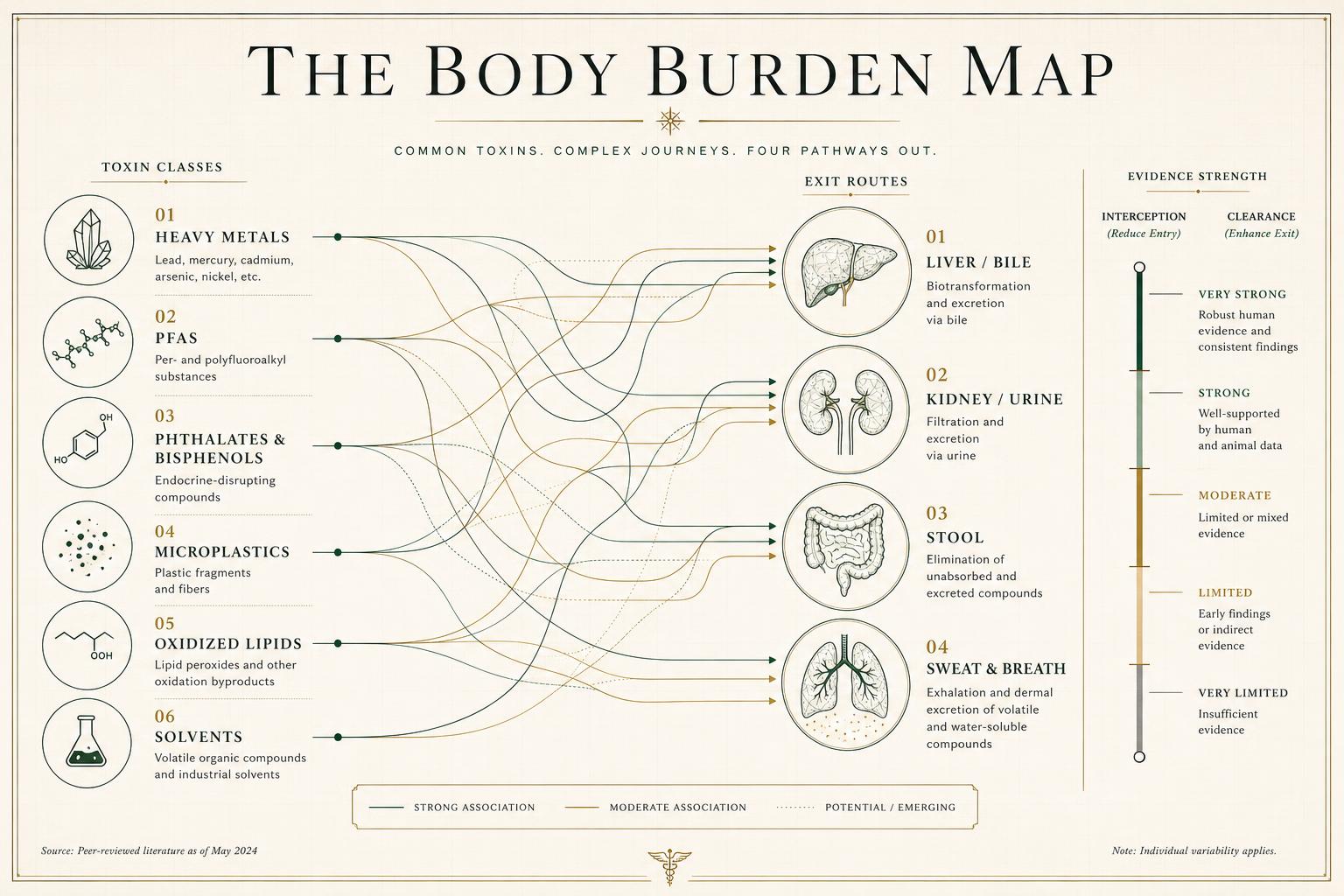
Stop thinking of toxins as one category. Different compounds leave through different routes.
| Substance class | Main handling route | Most practical now | Frontier direction |
|---|---|---|---|
| Heavy metals | Kidneys, bile/stool, sweat, bone turnover | Source removal, clinician-guided testing, fiber, movement and sweating | Better binder combinations, targeted chelation, mineral-safe protocols |
| PFAS | Bile and enterohepatic recirculation | Water filtration, food-contact reduction, viscous fiber | Bile-acid sequestration, lipoprotein apheresis, engineered microbial strategies |
| Phthalates and bisphenols | Liver conjugation and urine | Lower plastic contact, fresh food, sulforaphane-rich foods | Precision microbiome support, exposure biomonitoring |
| Microplastics and nanoplastics | Mostly stool for larger particles; uncertain tissue clearance for small particles | Avoid plastic heating, low-plastic food handling, fiber-rich diet | Chitosan and polysaccharide sequestration, probiotic binding strains, blood filtration |
| Oxidized lipids and seed-oil burden | Cell-membrane turnover, mitochondrial quality control | Eliminate seed oils, omega-3-rich whole foods, fasting, exercise | Photobiomodulation, mitophagy-targeted nutrition, lipidomics-guided personalization |
| Solvents and air pollutants | Liver conjugation, urine, breath | Fresh-air strategy, filtration, sulforaphane foods | Personalized Nrf2/GST activation by genotype and exposure testing |
Tier II · Members only · Free
Continue into the deep dive
Tier I is free and always open. Tier II — the full mechanisms, dosing detail, nuance, and citations — unlocks with a free Vital Codex membership.
- Every Tier II deep dive across all hubs
- Saved reading progress across articles
- Member knowledge modules and their quizzes
- The Dispatch, if you opt in
Frequently asked
Can you detox microplastics from the body today?
Not in the way a documented metal poisoning can be treated. Most ingested particles are likely excreted, but there is no established way to remove microplastics or nanoplastics that have entered tissues. The best-supported action is aggressive exposure reduction, with fiber and gut-barrier support as plausible but unproven adjuncts.
Does sauna therapy remove heavy metals?
Metals can be detected in sweat, and sweating contributes to excretion, but sweat is supplementary rather than primary and amounts per session are small. Exercise-induced sweat may be more effective than passive sauna for certain metals. Use sauna consistently and replenish fluids and minerals.
Is cilantro a reliable heavy-metal chelator?
No. Human evidence is weak and inconsistent when it is used alone. Source removal comes first, then carefully chosen binders or clinician-guided treatment when testing indicates a genuine problem.
What is the best food-based detox tool?
Cruciferous vegetables, especially broccoli sprouts. Their strength is not pulling toxins out directly but activating the enzyme systems that process reactive chemical compounds — with human data showing increased excretion of benzene and acrolein metabolites.
Is plasma exchange the future of detox?
Possibly for narrow medical uses, not for routine wellness. Studies show it can lower circulating microplastics in people with high baseline levels. Whether that produces durable health benefit, clears particles from tissue, or is worthwhile for healthy people remains unknown.
Research Notes & Sources(expand)
Short-term randomized trial of plastic-contact reduction and urinary bisphenol and phthalate metabolites. 2026.
Comparative analysis of trace-metal excretion in sweat: dynamic exercise versus sauna bathing.
Egner PA, et al. Rapid and sustainable detoxication of airborne pollutants by broccoli sprout beverage: results of a randomized clinical trial in China. Cancer Prevention Research.
Chitosan-based fiber and circulating microplastic concentration: 2026 pilot controlled study (preliminary).
Kimchi-derived probiotic binding of nanoplastics under simulated gut conditions. 2026 research report.
Lactiplantibacillus plantarum PD01 and urinary phthalate metabolites. 2026 interim preprint.
Therapeutic plasma exchange and circulating microplastic counts. Journal of Clinical Apheresis. 2026.
Bile-acid sequestration and PFAS enterohepatic recirculation: cholestyramine mechanism literature.
Daytime and nighttime light exposure and risk of metabolic dysfunction-associated steatotic liver disease. 2026 cohort analysis.
Circadian regulation of hepatic detoxification and metabolic gene expression: mechanistic reviews.
Glymphatic clearance during sleep: foundational and current reviews.
Continue exploring: Nutrition — Protein sufficiency, micronutrient density, and food quality.
Explore Nutrition