Cell membranes are built from the fats you eat repeatedly, which means diet composition is not only a calorie question — it is a materials question. Two fats sit at opposite ends of that materials spectrum: C15:0 (pentadecanoic acid), a stable odd-chain saturated fat concentrated in ruminant milk fat and grass-fed meat, and linoleic acid (LA), a fragile omega-6 polyunsaturated fat that now dominates industrial food.
For most adults eating a modern Western diet, LA deficiency is not the problem. Intake reviews place typical LA exposure around 6% to 9% of total calories, sourced from soybean, corn, sunflower, safflower, cottonseed, canola, and grapeseed oils, packaged foods, restaurant fryers, and grain-fed animal fat. So the practical instruction is not "find more essential fatty acids." It is "stop overloading the most oxidizable one."
This is a swap argument, not a miracle-food argument. Nothing in the current literature supports the claim that a dietary pattern stops aging. What the evidence does support is narrower and still useful: reducing excess LA while increasing exposure to stable ruminant fats plausibly shifts membrane composition, oxidative vulnerability, and nutrient signaling in directions compatible with slower damage accumulation.
Membranes are built from whatever fat you keep eating. Structure is a slow vote, cast daily.
Contents(20 sections)
Key takeaways
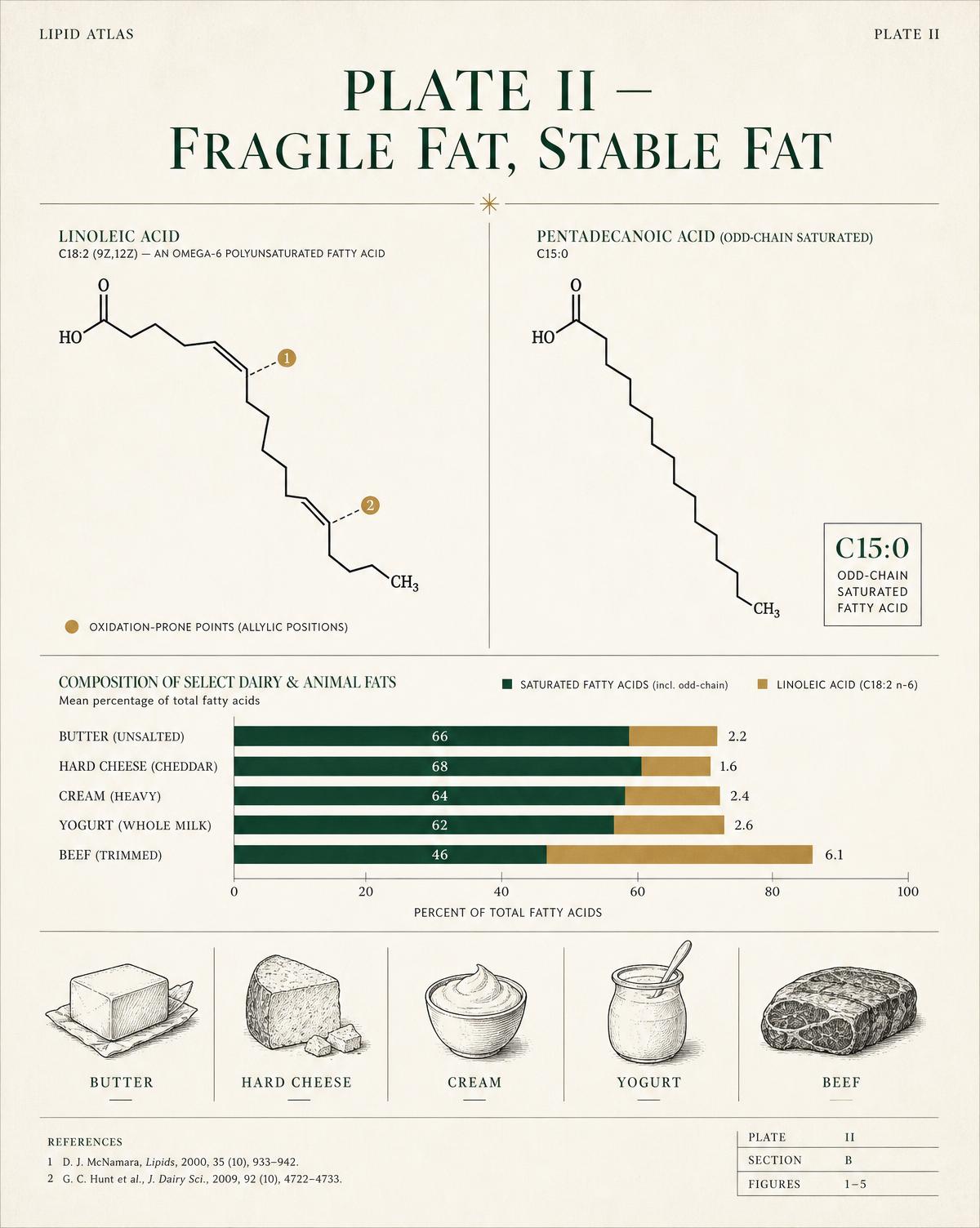
C15:0 (pentadecanoic acid) is an odd-chain saturated fat with no double bonds, found mainly in full-fat dairy and grass-fed ruminant meat; linoleic acid is an omega-6 fat with multiple double bonds, making it far more vulnerable to oxidation.
Typical Western linoleic acid intake is roughly 6% to 9% of total calories, so deficiency is not a realistic concern for most adults; excess is the more plausible problem.
Odd-chain saturated fat biomarkers, including C15:0, track inversely with cardiometabolic disease risk in meta-analyses — a different risk profile from even-chain saturated fats such as palmitic acid.
Removing the fat from dairy removes the C15:0: low-fat cottage cheese, milk, and yogurt retain protein and calcium but lose most of the odd-chain fat fraction, CLA, and fat-soluble compounds.
No human trial shows that replacing seed oil with grass-fed butter makes anyone biologically younger; the defensible claim is that the swap improves membrane inputs and reduces peroxidizable substrate over time.
The Primer
Fragile fats versus resilient fats
The difference between these two fats is structural. Linoleic acid contains multiple double bonds, and every double bond is a weak point that oxidizes more readily under metabolic stress, inflammation, heat, and ultraviolet exposure. C15:0 has no double bonds at all, which makes it chemically stable and far less vulnerable to oxidative breakdown.
That difference compounds because membranes are not fixed structures. They are rebuilt continuously from whatever fats are circulating, which means a diet that steadily supplies fragile fats leaves tissues holding more material that can be damaged. A pattern richer in stable ruminant fats builds membranes that handle the same stress with less cracking.
Where these fats come from
High-LA foods are easy to find because they are nearly everywhere: soybean, corn, sunflower, safflower, cottonseed, canola, and grapeseed oils, plus fast food, commercial dressings, packaged snacks, and much of the fat in grain-fed poultry and pork.
The stable side of the ledger is shorter and more specific: butter, ghee, hard cheeses, cream, full-fat yogurt, full-fat cottage cheese, and grass-fed beef or lamb. Low-fat dairy still delivers protein and calcium, but skimming the fat removes most of the milk-fat fraction that carries odd-chain saturated fats and other bioactive compounds. The nutrients you were told to keep and the nutrients discussed here do not live in the same part of the food.
Why full-fat and grass-fed matter
Full-fat dairy keeps the portion of milk containing C15:0, C17:0, conjugated linoleic acid, and fat-soluble vitamins. Low-fat dairy strips much of that away. The older blanket claim that full-fat dairy is inherently harmful has not held up well: newer syntheses generally report full-fat dairy as neutral or favorable for cardiometabolic health, particularly when dairy is evaluated as whole food rather than as a delivery vehicle for isolated saturated fat.
Grass-fed adds a second advantage. Pasture-based beef and dairy typically carry more omega-3 fats and CLA and a better omega-6 to omega-3 ratio than grain-heavy confinement systems. The exact magnitude varies by season, herd, and testing method, so precision claims here are not warranted — but the direction is consistent.
Fats and skin stress
This is not only a heart, liver, or waistline story. Ultraviolet light drives oxidative stress in skin lipids, and photoaging research shows that UV exposure alters skin lipid composition and contributes to peroxidation damage in skin tissue. Because LA is among the more oxidizable fats present in that environment, a body already loaded with fragile fats carries more damageable material into sun exposure.
The skin evidence is genuinely mixed and should not be flattened. Some cell and topical studies report context-specific protective effects of LA, and LA does play legitimate roles in skin barrier biology. The honest conclusion is narrower: there is no practical reason to chase additional dietary LA for skin health when modern diets already supply it in abundance.
A realistic food pattern
None of this requires eating absurd quantities of dairy fat or turning meals into a spreadsheet. A workable daily pattern looks like 2 to 3 tablespoons of grass-fed butter or ghee across the day, 2 to 3 ounces of hard cheese, half a cup to a cup of full-fat cottage cheese or plain full-fat yogurt, and 6 to 8 ounces of grass-fed beef or lamb.
Treat those as ranges, not targets. The mechanism that matters is substitution — steadily replacing fragile industrial fats with more stable, nutrient-dense animal fats from better sources. Precision adds very little; consistency adds most of the effect.
What this means in plain English
This is not about a miracle food. It is about changing the raw materials the body uses to build and maintain tissue. Lower LA intake means fewer peroxidation-prone fats in membranes. More C15:0 and other stable ruminant fats may help tissues absorb stress with less damage over time.
In practical terms: cut seed oils, choose full-fat grass-fed dairy and ruminant meat over seed-oil-heavy processed food, and stay consistent long enough for membranes to turn over. That is the whole Tier 1 instruction.
The Deep Dive
C15:0 as a longevity-relevant fat
C15:0 has drawn research attention because it does not behave like the generic "saturated fat" category that shaped mid-century nutrition advice. In mechanistic and translational work, pentadecanoic acid has been associated with activities relevant to cardiometabolic, immune, hepatic, and cellular health rather than the uniform harm the old category implied.
Part of the interest is pathway-level. C15:0 appears to interact with AMPK and mTOR, two nutrient- and energy-sensing pathways central to autophagy, repair, and longevity biology. AMPK activation generally supports energy efficiency and cellular housekeeping; lower mTOR signaling is broadly associated with better repair, reduced growth pressure, and greater stress resistance. Evidence grade matters here: this work is largely cell and animal mechanistic data plus human biomarker association, not longevity outcome trials in people. A pat of butter is not a longevity drug. But C15:0 does sit inside pathways aging researchers already take seriously.
Tier II · Members only · Free
Continue into the deep dive
Tier I is free and always open. Tier II — the full mechanisms, dosing detail, nuance, and citations — unlocks with a free Vital Codex membership.
- Every Tier II deep dive across all hubs
- Saved reading progress across articles
- Member knowledge modules and their quizzes
- The Dispatch, if you opt in
Frequently asked
What is C15:0 (pentadecanoic acid)?
C15:0, or pentadecanoic acid, is a 15-carbon odd-chain saturated fatty acid found mainly in ruminant milk fat and grass-fed meat. It has no double bonds, which makes it chemically stable and resistant to oxidation, and it has been studied for interactions with AMPK and mTOR signaling.
Why is C15:0 treated differently from other saturated fats?
Because biomarker meta-analyses consistently show odd-chain saturated fats such as C15:0 and C17:0 tracking inversely with cardiometabolic disease risk, unlike even-chain saturated fats such as palmitic acid. C15:0 also yields propionyl-CoA during beta-oxidation, which can replenish TCA cycle intermediates — a metabolic route even-chain fats do not share.
Is linoleic acid bad for you?
No. Linoleic acid is an essential fatty acid required in small amounts, and trial evidence supports replacing saturated fat with polyunsaturated fat to improve some cardiovascular markers. The concern is excess rather than presence: typical Western intake is roughly 6% to 9% of calories, so deficiency is not a realistic risk while high tissue loading of an easily oxidized fat is a plausible one.
Does low-fat dairy provide C15:0?
Very little. C15:0 lives in the milk-fat fraction, so skimming the fat removes most of it along with CLA and fat-soluble compounds. Low-fat dairy still supplies protein and calcium, but it does not do the same job as butter, cream, hard cheese, or full-fat cultured dairy for odd-chain fatty acid status.
How much full-fat dairy and ruminant meat does this pattern require?
A practical daily range is 2 to 3 tablespoons of grass-fed butter or ghee, 2 to 3 ounces of hard cheese, half a cup to a cup of full-fat cottage cheese or plain yogurt, and 6 to 8 ounces of grass-fed beef or lamb. These are ranges rather than targets — the substitution away from industrial seed oils matters more than hitting exact amounts.
Can this be measured rather than guessed?
Yes. Red-blood-cell fatty-acid testing reflects membrane composition over months rather than a single meal, and repeating it at 3- to 6-month intervals shows whether linoleic acid is falling and odd-chain fatty acid status is rising. Reference ranges differ between laboratories, so interpret the trend rather than one absolute number.
Does eating this way slow aging?
No human trial demonstrates that. The defensible claim is narrower: reducing excess linoleic acid while increasing stable ruminant fats plausibly improves membrane stability, lowers the substrate available for lipid peroxidation, and influences AMPK and mTOR signaling in directions associated with better cellular maintenance.
Continue exploring: Nutrition — Protein sufficiency, micronutrient density, and food quality.
Explore Nutrition