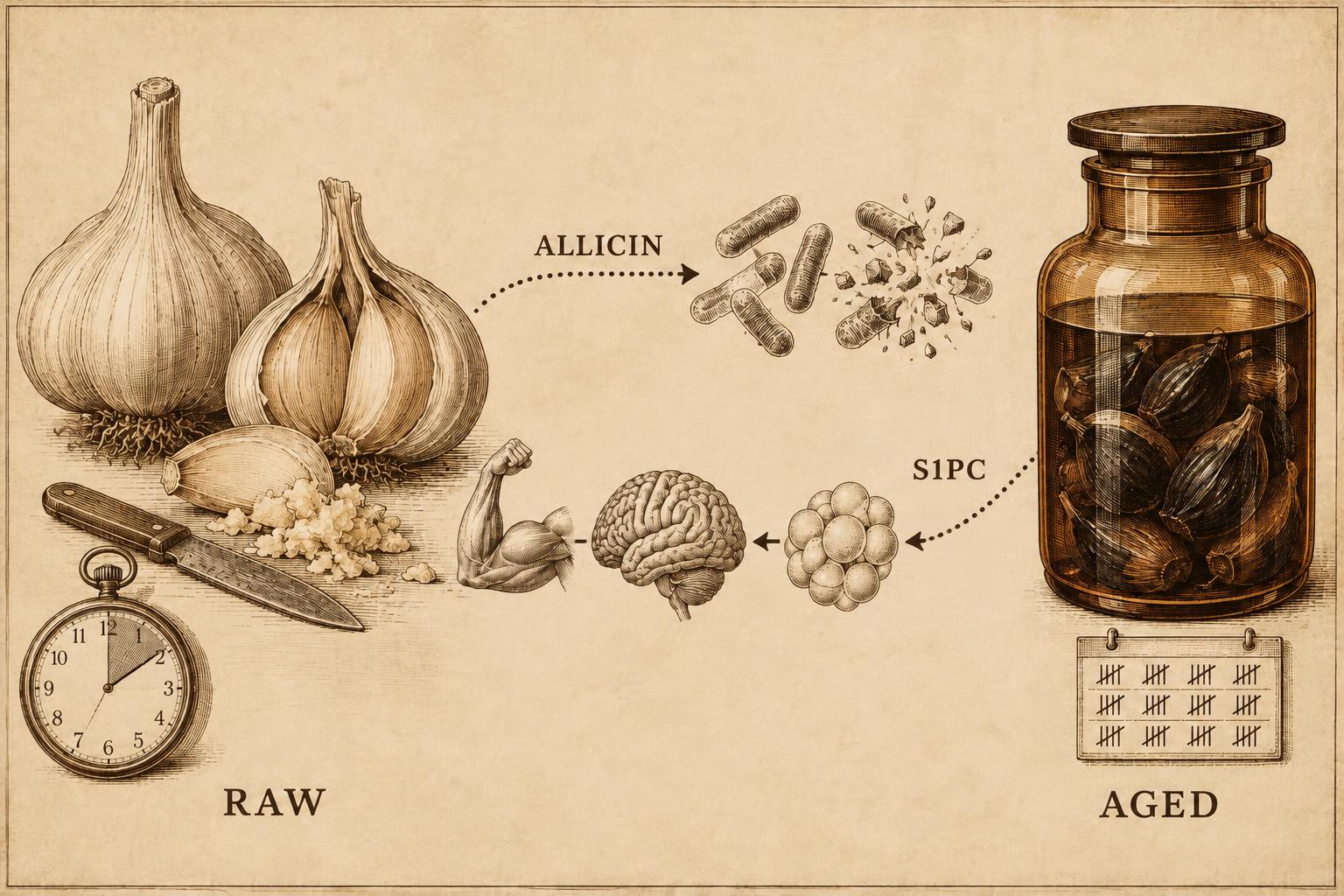
Garlic is a multi-target antimicrobial and a long-term vascular and longevity ally, depending on how it is prepared. Crushing a raw clove forms allicin, which disables microbial enzymes, breaches cell membranes, jams bacterial communication and breaks up biofilms at the same time. Aged garlic extract converts allicin into stable compounds — S-allylcysteine and S-1-propenyl-L-cysteine (S1PC) — that lower blood pressure, sharpen immune cells and, according to a 2026 Cell Metabolism study, start a fat-to-brain-to-muscle signal that restores muscle force in aged mice.
Contents(16 sections)
Key takeaways
One in six laboratory-confirmed bacterial infections worldwide was resistant to antibiotics in 2023, according to the WHO's 2025 surveillance report.
Raw garlic attacks microbes on four fronts at once — enzyme inhibition, membrane disruption, quorum-sensing interference and biofilm breakdown — which makes resistance far harder to evolve.
In laboratory tests, allicin inhibited all 30 clinical MRSA strains tested at 32 µg/mL, including mupirocin-resistant strains.
Crush, then wait 10 minutes: heat inactivates the enzyme that makes allicin, and crushed garlic rested before cooking keeps far more of its activity.
Aged garlic extract is a different medicine: it lowered systolic blood pressure by about 5 mmHg more than placebo in uncontrolled hypertension and improved immune-cell function and cold and flu severity.
The 2026 S1PC discovery: an aged-garlic compound activates LKB1 in fat tissue, which releases eNAMPT that targets the hypothalamus and strengthens aged muscle.
Interactions matter: garlic adds to blood thinners, should be stopped 7–10 days before surgery, and garlic supplements halved blood levels of the HIV drug saquinavir in one study.
The Primer
The crisis that brought an old remedy back into focus
Here's something that should make you think twice the next time you're handed a prescription: the World Health Organization's 2025 antibiotic resistance surveillance report — drawing on more than 23 million confirmed cases from 110 countries — found that one in six laboratory-confirmed bacterial infections in 2023 was already resistant to antibiotic treatment. Between 2018 and 2023, resistance rose in over 40% of the antibiotics WHO monitors, by an average of 5–15% a year, across common infections of the bloodstream, gut, urinary tract and sexually transmitted infections. A 2024 forecast in The Lancet projects that deaths caused directly by resistant infections will rise by about 70% by 2050, to 1.91 million a year — and today's 1.14 million deaths a year already exceed HIV/AIDS and malaria combined.
Meanwhile, sitting quietly in your pantry — as it has for the last ten thousand years — is a small, papery bulb that bacteria have never managed to fully outsmart. And in 2026, science revealed it does something even more extraordinary than fighting infections. It talks to your fat cells, which then talk to your brain, which then tells your muscles to stay strong. But we'll get to that.
First, let's understand what makes garlic so remarkable as a medicine.
Why garlic works differently than any drug
Understanding garlic as medicine starts with its chemistry. When you crush or chop a garlic clove, a near-instant biochemical reaction takes place: an enzyme called alliinase (stored in the cell vacuoles) suddenly contacts its substrate alliin (stored in the cytosol). Within seconds, this collision produces allicin — a highly reactive thiosulfinate compound responsible for that sharp, pungent smell and the plant's extraordinary antimicrobial power.
But allicin doesn't work alone. It rapidly decomposes into a cascade of organosulfur compounds — ajoene, diallyl sulfide (DAS), diallyl disulfide (DADS), and diallyl trisulfide (DATS) — each with overlapping and distinct biological activities. A comprehensive review in Frontiers in Immunology documented how this chemical complexity attacks bacterial cells through four simultaneous mechanisms:
- Enzyme inhibition — Allicin and thiosulfinates form disulfide bonds with bacterial enzymes' sulfhydryl (–SH) groups, disabling essential metabolic pathways
- Membrane disruption — Organosulfur compounds increase bacterial membrane permeability, causing leakage of intracellular contents and eventual cell death
- Quorum sensing inhibition — Ajoene and DADS interfere with how bacteria "communicate" to coordinate biofilm formation and collective virulence
- Antibiofilm activity — Garlic extracts break down and prevent the protective biofilms that shield pathogens from antibiotics
This multi-target approach is the key difference between garlic and a pharmaceutical antibiotic. Conventional antibiotics hit a single molecular target — which is exactly why bacteria can evolve around them with a single genetic mutation. To escape garlic's effects, a pathogen would need to simultaneously modify four distinct molecular targets, a burden most pathogens simply cannot sustain.
The clinical evidence is stronger than you think
Garlic vs. metronidazole for bacterial vaginosis. A randomized controlled trial of 120 women with bacterial vaginosis (BV) compared garlic tablets directly against metronidazole, the standard pharmaceutical treatment. Women took two 500 mg garlic tablets (each standardized to 8.9 mg alliin) or two 250 mg metronidazole tablets, twice daily for seven days. Clinical symptoms improved in 70% of the garlic group versus 48.3% on metronidazole, and side effects were less than half as common with garlic (15% versus 33%). On the combined clinical-and-laboratory cure measure, garlic reached 63% against 48% for metronidazole.
What makes this even more remarkable: metronidazole, the drug garlic matched, is listed by the U.S. National Toxicology Program as "reasonably anticipated to be a human carcinogen" and rated "possibly carcinogenic" (Group 2B) by the WHO's International Agency for Research on Cancer, both on the strength of animal studies. Women who require repeated treatment for recurrent BV are repeatedly exposed to that risk — a fact rarely raised in clinical settings.
Garlic against MRSA. Methicillin-resistant Staphylococcus aureus (MRSA) is one of the most feared organisms in modern medicine. A study published in the British Journal of Biomedical Science tested a stable aqueous allicin extract in the laboratory against 30 clinical MRSA isolates — including strains resistant to mupirocin, the front-line topical antibiotic for MRSA decolonization. All 30 strains were inhibited at 32 µg/mL allicin, and 88% were inhibited at just 16 µg/mL. Intermediate or full mupirocin resistance was present in 82% of those same isolates — yet not one escaped allicin.
A 2026 systematic review of 50 studies. A PRISMA-compliant systematic review published in April 2026 analyzed 50 studies conducted between 2000 and 2025. It confirmed garlic's significant antimicrobial activity against a wide spectrum of multidrug-resistant bacteria including S. aureus, Pseudomonas aeruginosa, E. coli, Klebsiella pneumoniae, and others. The authors also documented garlic's role as a potential adjuvant — enhancing the efficacy of conventional antibiotics when used in combination.
Garlic and gastric cancer prevention — a 22-year story. In the Shandong Intervention Trial, 7.3 years of garlic supplementation was followed by a significantly reduced risk of death from gastric cancer over 22 years of follow-up (hazard ratio 0.66). In a separate meta-analysis of 18 studies covering 142,921 subjects, high garlic consumption was associated with a 51% reduced gastric cancer risk, an association driven mainly by case-control studies. Multiple garlic compounds — allicin, DADS, DATS, and ajoene — have been shown in cell and animal studies to induce apoptosis (cancer cell death), cause cell cycle arrest, and in some models, help overcome chemotherapy resistance.
Aged garlic extract: a different kind of power
Fresh garlic and aged garlic are not the same thing — and knowing the difference is essential for targeted therapeutic use.
Aged Garlic Extract (AGE) is produced by soaking sliced raw garlic in 15–20% aqueous ethanol at room temperature for up to 20 months. During this slow transformation — not cooking, not fermenting, but a specific long-term metabolic conversion — the unstable allicin is converted into stable, water-soluble organosulfur compounds. The most well-known of these are S-allylcysteine (SAC) and S-allylmercaptocysteine (SAMC). But as 2026 research revealed, there's a third compound forming quietly in the aging process that nobody had paid much attention to — until now.
The aging process also concentrates S-allylcysteine (SAC): standardized extracts used in clinical trials deliver about 1 mg of SAC per gram of extract, a stable dose that raw garlic cannot provide. AGE is odorless, stomach-friendly, and carries a fundamentally different — and in many ways deeper — therapeutic profile than fresh garlic.
| Property | Raw/Fresh Garlic | Aged Garlic Extract (AGE) |
|---|---|---|
| Primary active compound | Allicin (unstable) | SAC, SAMC, S1PC (stable) |
| Antimicrobial activity | Strong, fast-acting | Moderate, broad-spectrum |
| Antioxidant protection | Effective but short-lived | High, long-lasting |
| Gut-friendliness | May irritate stomach | Gentle, stomach-friendly |
| Odor | Strong | Essentially odorless |
| Anti-glycation | Modest | Significantly stronger |
| Muscle & aging support | Minimal evidence | Groundbreaking 2026 data |
| Best use case | Acute antimicrobial action | Chronic disease prevention, cardiovascular, muscle longevity |
The 10-minute rule: getting the most from fresh garlic
One of the most actionable pieces of garlic science is also one of the least known. Inside an intact garlic clove, alliin and alliinase are stored in separate cellular compartments. Only when the cell walls are crushed does the enzymatic reaction begin. Allicin forms within seconds to a few minutes of crushing — and heat destroys the alliinase enzyme before it can complete its work.
The protocol for maximum allicin:
- Crush, chop, or press fresh garlic cloves
- Let them rest at room temperature for 10 minutes
- Then add to food, eat raw, or take therapeutically
- If cooking, add the pre-activated garlic to your dish after removing from heat
The research behind the rest is clear. In laboratory work, crushing garlic and letting it stand for 10 minutes before brief heating preserved anticancer activity that heating the uncrushed cloves wiped out. Crushed garlic also kept its antiplatelet activity through six minutes of cooking that abolished the activity of uncrushed garlic, while cooking for more than about 10 minutes destroyed it either way. Adding freshly crushed garlic straight to a hot pan sacrifices much of its medicinal potential before you even consume it.
Important safety considerations
Garlic carries an excellent overall safety profile. A few points deserve attention:
- Anticoagulant interactions — Garlic has antithrombotic effects. Anyone on blood thinners (warfarin, aspirin, clopidogrel) should use high-dose garlic cautiously and consult their practitioner first
- HIV medicines — Garlic supplements cut blood levels of the HIV protease inhibitor saquinavir by about half in a pharmacokinetic study. Anyone on HIV treatment should not take garlic supplements without their prescriber's agreement
- Pre-surgery caution — Stop high-dose garlic 7–10 days before any surgical procedure, as garlic can prolong bleeding time
- Digestive sensitivity — Some people experience bloating, gas, or heartburn with raw garlic, particularly on an empty stomach. AGE is far gentler in this regard
- FODMAP sensitivity — People with fructan intolerance may react to raw garlic; AGE is generally much better tolerated
- The adipose threshold — The S1PC muscle pathway requires healthy fat mass. Individuals with very low body fat may see limited benefit from this specific mechanism
For a step-by-step routine — the raw-garlic and aged-garlic tracks, doses, timeframes and guardrails — see Cellular Mastery Protocol 17: The Sovereign Garlic Stack. Its sources are entries 131–141 of the Cellular Mastery Evidence Repository.
The Deep Dive
The 2026 breakthrough: garlic, your fat, your brain, and your muscles
Cell Metabolism, May 2026 — one of the most prestigious journals in biomedical science — published a study that rewrites how we understand aged garlic extract's role in aging.
The research team, led by Dr. Shin-ichiro Imai at the Institute for Research on Productive Aging (IRPA) in Tokyo, together with scientists from Wakunaga Pharmaceutical, focused on S-1-propenyl-L-cysteine (S1PC) — a sulfur-containing amino acid that exists only in trace amounts in raw garlic but accumulates during the long aging process used to produce AGE, rising to levels similar to SAC.
Tier II · Members only · Free
Join Vital Codex free
Unlock every Tier II deep dive, save your reading, and open the member knowledge modules. Free, no card, no paywall.
The Dispatch is a separate weekly email. Your membership works with or without it.
Frequently asked
Is garlic really an antibiotic?
Garlic is a broad antimicrobial rather than a drug antibiotic. Crushed raw garlic forms allicin, which in laboratory studies inhibits drug-resistant bacteria such as MRSA by disabling enzymes, breaching membranes, blocking bacterial communication and breaking up biofilms. In a randomized trial, garlic tablets matched metronidazole for bacterial vaginosis with half the side effects.
What is the 10-minute rule for garlic?
Crush or chop garlic, then let it rest at room temperature for 10 minutes before eating or cooking it. Allicin forms quickly once the clove is crushed, but heat inactivates the enzyme that makes it; resting first lets the reaction finish, and studies show crushed, rested garlic keeps far more of its anticancer and antiplatelet activity through brief cooking.
What is the difference between raw garlic and aged garlic extract?
Raw garlic is allicin-dominant and best for acute antimicrobial use. Aged garlic extract is made by soaking sliced garlic in aqueous ethanol for up to 20 months, which converts allicin into stable compounds such as S-allylcysteine and S1PC. It is odorless, gentle on the stomach, and has the stronger evidence for blood pressure, immune function and long-term vascular health.
What did the 2026 Cell Metabolism garlic study find?
It found that S1PC, a compound that builds up in aged garlic, activates the enzyme LKB1 in fat tissue. Fat then releases eNAMPT, which travels to the hypothalamus and strengthens skeletal muscle force and frailty scores in aged mice. A single dose also raised circulating eNAMPT in healthy people who maintain healthy fat mass.
How much garlic should I take?
For raw garlic, 2–5 g a day (about one to two cloves), crushed and rested 10 minutes, taken with food. For aged garlic extract, 600–1,200 mg daily for blood pressure and immune support and 1,200–2,400 mg daily for cardiovascular prevention. For the S1PC muscle pathway, the inferred effective dose is about 25 mg of S1PC a day, split across two meals — roughly 6–12 mL (1¼–2½ teaspoons) of liquid aged garlic extract such as Kyolic Aged Garlic Extract Liquid — which matches the blood level of the dose that restored muscle force in aged mice.
Who should be careful with garlic?
People on blood thinners such as warfarin, aspirin or clopidogrel, anyone scheduled for surgery (stop high-dose garlic 7–10 days before), people on HIV medicines such as saquinavir, and people with fructan (FODMAP) intolerance, who usually tolerate aged garlic extract better than raw garlic.
Research Notes & Sources(expand)
- World Health Organization. *Global antibiotic resistance surveillance report 2025* (GLASS). Geneva: WHO; 2025.
- GBD 2021 Antimicrobial Resistance Collaborators. Global burden of bacterial antimicrobial resistance 1990–2021: a systematic analysis with forecasts to 205001867-1). The Lancet. 2024;404(10459):1199–1226.
- Balasegaram M, Outterson K, Røttingen JA. The time to address the antibiotic pipeline and access crisis is now01940-8). The Lancet. 2024.
- El-Saadony MT, et al. Garlic bioactive substances and their therapeutic applications for improving human health: a comprehensive review. Frontiers in Immunology. 2024;15:1277074.
- Mohammadzadeh F, et al. Comparing the therapeutic effects of garlic tablet and oral metronidazole on bacterial vaginosis: a randomized controlled clinical trial. Iranian Red Crescent Medical Journal. 2014;16(7):e19118.
- National Toxicology Program. Metronidazole. Report on Carcinogens, 15th ed. 2021; and IARC Monographs Supplement 7 (1987), Group 2B.
- Cutler RR, Wilson P. Antibacterial activity of a new, stable, aqueous extract of allicin against methicillin-resistant *Staphylococcus aureus*. British Journal of Biomedical Science. 2004;61(2):71–74.
- de Morais JL, Barbosa LN, Gomes LA. Antimicrobial potential of *Allium sativum* in the era of antibiotic resistance: gaps and future perspectives. International Journal of Research in Pharmacy and Allied Science. 2026;5(4):16–26.
- Li WQ, et al. Effects of *Helicobacter pylori* treatment and vitamin and garlic supplementation on gastric cancer incidence and mortality: follow-up of a randomized intervention trial. BMJ. 2019;366:l5016.
- Li Z, Ying X, Shan F, Ji J. The association of garlic with *Helicobacter pylori* infection and gastric cancer risk: a systematic review and meta-analysis. Helicobacter. 2018;23:e12532.
- Kodera Y, et al. Chemical and biological properties of S-1-propenyl-L-cysteine in aged garlic extract. Molecules. 2017;22(4):570.
- Suzuki J, Yoshioka K, et al., Imai S. Garlic-derived metabolite activates LKB1, promotes adipose eNAMPT secretion, and improves age-related muscle function via hypothalamic signaling. Cell Metabolism. 2026;38(6):1218–1228.
- Ried K, Travica N, Sali A. The effect of aged garlic extract on blood pressure and other cardiovascular risk factors in uncontrolled hypertensives: the AGE at Heart trial. Integrated Blood Pressure Control. 2016;9:9–21.
- Bashiri S, et al. The effect of aged garlic supplementation on blood pressure and lipid profile: a dose-response GRADE-assessed systematic review and meta-analysis. Phytotherapy Research. 2025;39:5669–5694.
- Matsumoto S, et al. Aged garlic extract reduces low attenuation plaque in coronary arteries of patients with metabolic syndrome. Journal of Nutrition. 2016;146:427S–432S.
- Elosta A, Slevin M, Rahman K, Ahmed N. Aged garlic has more potent antiglycation and antioxidant properties compared to fresh garlic extract in vitro. Scientific Reports. 2017;7:39613.
- Nantz MP, et al. Supplementation with aged garlic extract improves both NK and γδ-T cell function and reduces the severity of cold and flu symptoms. Clinical Nutrition. 2012;31:337–344.
- Ishikawa H, et al. Aged garlic extract prevents a decline of NK cell number and activity in patients with advanced cancer. Journal of Nutrition. 2006;136:816S–820S.
- Ried K, Travica N, Sali A. The effect of Kyolic aged garlic extract on gut microbiota, inflammation, and cardiovascular markers in hypertensives: the GarGIC trial. Frontiers in Nutrition. 2018;5:122.
- Ohishi K, et al. Effects of aged garlic extract on aging-related changes in gastrointestinal function and enteric nervous system cells. Experimental and Therapeutic Medicine. 2025;29:103.
- Zini A, Mann J, Mazor S, Vered Y. Beneficial effect of aged garlic extract on periodontitis: a randomized controlled double-blind clinical study. Journal of Clinical Biochemistry and Nutrition. 2020;67:297–301.
- Sunil M, et al. Antimicrobial, antibiofilm, cytotoxicity, and substantivity of aged garlic extract against oral bacteria: an in-vitro study. BMC Complementary Medicine and Therapies. 2025.
- Rouf R, et al. Antiviral potential of garlic (*Allium sativum*) and its organosulfur compounds: a systematic update of pre-clinical and clinical data. Trends in Food Science & Technology. 2020;104:219–234.
- Hannan A, et al. Anti-mycobacterial activity of garlic against multi-drug resistant and non-multi-drug resistant *Mycobacterium tuberculosis*. Pakistan Journal of Pharmaceutical Sciences. 2011;24:81–85.
- Song K, Milner JA. The influence of heating on the anticancer properties of garlic. Journal of Nutrition. 2001;131:1054S–1057S.
- Cavagnaro PF, et al. Effect of cooking on garlic (*Allium sativum* L.) antiplatelet activity and thiosulfinates content. Journal of Agricultural and Food Chemistry. 2007;55:1280–1288.
- Piscitelli SC, et al. The effect of garlic supplements on the pharmacokinetics of saquinavir. Clinical Infectious Diseases. 2002;34(2):234–238.
- Steiner M, Khan AH, Holbert D, Lin RI. A double-blind crossover study in moderately hypercholesterolemic men that compared the effect of aged garlic extract and placebo administration on blood lipids. American Journal of Clinical Nutrition. 1996;64(6):866–870.
- Yi L, Maier AB, et al. The efficacy and safety of β-nicotinamide mononucleotide (NMN) supplementation in healthy middle-aged adults. GeroScience. 2023;45(1):29–43.
Continue exploring: Nutrition — Protein sufficiency, micronutrient density, and food quality.
Explore NutritionThe Codex Dispatch
More on Nutrition, one email a week
One considered email each Sunday: research translation, no hype, no supplement pitches. Separate from membership — unsubscribe anytime.