Urinary tract infections are usually treated as simple bacterial invasions requiring immediate antibiotics. Antibiotics have their place in acute crises — but recurring UTIs are rarely just bad luck. They are a biological signal that the internal "terrain" of the urinary tract and gut has become imbalanced, allowing opportunistic bacteria to thrive. The most durable strategy is not to attack each infection harder, but to restore an environment in which pathogens cannot gain a foothold.
Contents(11 sections)
Key takeaways
Recurrent UTIs usually reflect a disrupted urinary and gut microbiome, not simply repeated exposure to bacteria.
D-mannose works by competitive anti-adhesion: E. coli binds the free sugar in urine instead of the bladder wall and is flushed out.
Low-dose, pharmaceutical-grade methylene blue is an emerging antimicrobial and mitochondrial support agent — but it is a potent drug with real contraindications, not a casual supplement.
Remineralized water and non-toxic surface hygiene support the mucosal barriers that form the first line of defense.
Fever, flank pain, blood in the urine, or symptoms in pregnancy require prompt medical care — natural support is not a substitute for treatment of an acute or ascending infection.
The Primer
The signal, not just the infection
A first UTI may be chance. A third or fourth in a year is a pattern. The urinary tract is not a sterile pipe — it hosts its own microbial community, and its lining depends on intact mucosal barriers, adequate hydration, and a healthy gut reservoir. When that terrain is disturbed — by repeated antibiotic courses, systemic inflammation, blood-sugar swings, or a degraded gut microbiome — opportunistic bacteria such as E. coli find it easy to adhere and multiply.
Diet plays a role here. Meat from concentrated animal feeding operations (CAFOs) is produced with routine sub-therapeutic antibiotic use, and residual exposure plus the inflammatory profile of ultra-processed diets can erode the gut flora that trains and supports immune defenses. Choosing cleaner protein sources is one quiet way to reduce the background pressure on the terrain.
Four practical levers
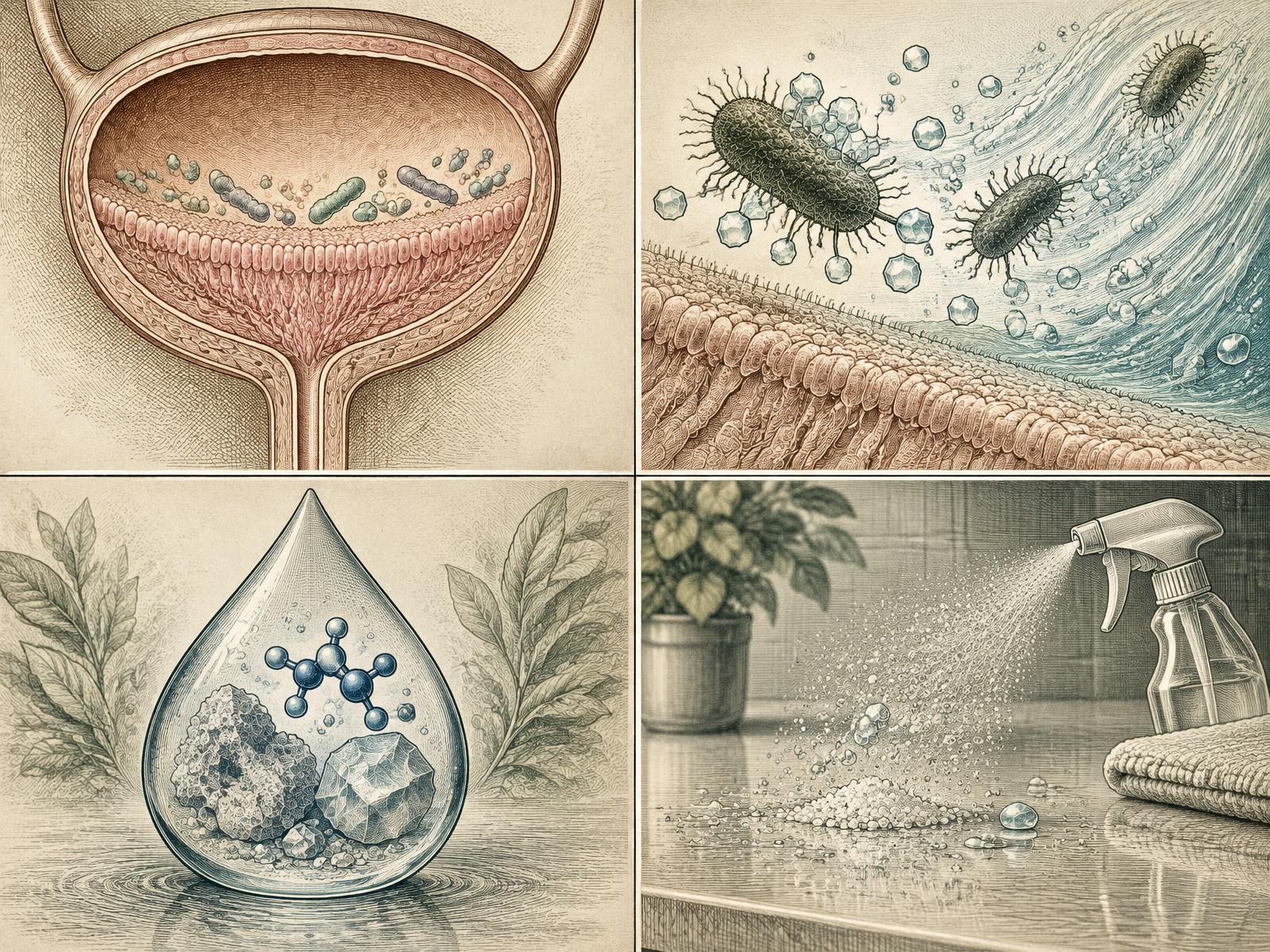
D-mannose. A simple sugar, structurally related to glucose, that passes into the urine largely unchanged. E. coli — responsible for up to 90% of uncomplicated UTIs — uses hair-like fimbriae to grip the bladder wall. Free D-mannose in the urine occupies those binding sites, so the bacteria attach to the sugar instead and are washed out with urination. Typical use is 1.5–2 g once or twice daily for prevention, and more frequently at the first hint of symptoms.
Methylene blue (pharmaceutical grade only). At low doses this old compound acts as an alternative electron carrier in mitochondria and shows antimicrobial and biofilm-disrupting activity, including against some antibiotic-resistant uropathogens. It is also a prescription-strength drug: it is contraindicated with SSRIs and other serotonergic medications (risk of serotonin syndrome), in G6PD deficiency, and in pregnancy, and it turns urine blue-green. It belongs in a clinician-guided protocol, not a self-experiment.
Remineralized water. Purified or reverse-osmosis water is free of contaminants but also of electrolytes. Adding a high-quality liquid trace mineral concentrate restores magnesium, zinc, and selenium — cofactors for immune function and for the mucosal barriers lining the urinary tract — and supports the steady hydration that keeps urine dilute and flowing.
Non-toxic environmental hygiene. For people prone to recurrence, the household environment matters. Stabilized chlorine dioxide solution (CDS), properly generated from sodium chlorite with a food-grade acid activator, is a broad-spectrum surface disinfectant that breaks down into salt and water — no harsh residues, and no pressure toward resistant organisms. It is for surfaces, never for ingestion or internal use.
The Deep Dive
The terrain theory of recurrent UTI
The conventional model is purely pathogenic: bacteria enter the urethra, multiply, and cause infection. Frontier urological research increasingly complicates that picture. Sequencing studies have shown the bladder harbors a resident microbiome, and recurrent infection correlates with a depleted, dysbiotic urinary community and a compromised local immune environment — often downstream of gut dysbiosis, systemic inflammation, or environmental exposures. In this frame, antibiotics treat the episode while sometimes deepening the underlying vulnerability by stripping protective flora.
Tier II · Members only · Free
Join Vital Codex free
Unlock every Tier II deep dive, save your reading, and open the member knowledge modules. Free, no card, no paywall.
The Dispatch is a separate weekly email. Your membership works with or without it.
Frequently asked
Can D-mannose replace antibiotics for a UTI?
For prevention and very early, mild symptoms in otherwise healthy adults, D-mannose is a reasonable first-line support and many people resolve early episodes with it plus hydration. It is not a treatment for an established, worsening, or upper-tract infection — fever, flank pain, vomiting, or blood in the urine need medical care, and antibiotics may be entirely appropriate.
Is methylene blue safe to take on my own?
No. It interacts dangerously with SSRIs and other serotonergic drugs, is unsafe in G6PD deficiency and pregnancy, and only USP/pharmaceutical-grade material should ever be considered. It should be used, if at all, under the guidance of a clinician who knows your medication list.
Does drinking more water actually help?
Yes — urine flow is the urinary tract's mechanical cleaning system. Consistent hydration keeps urine dilute and flushes the bladder regularly. Remineralizing purified water adds the electrolytes that support kidney function and the mucosal barrier, which plain distilled or RO water lacks.
Why do my UTIs keep coming back after antibiotics?
Antibiotics clear the acute infection but also strip protective flora in the gut and urinary tract, and they do nothing to repair the mucosal barrier or the conditions that allowed adhesion in the first place. Without rebuilding the terrain, the same opportunists recolonize the same vulnerable environment.
Is chlorine dioxide solution safe?
As a surface disinfectant, properly diluted CDS is a well-established oxidizer that degrades to salt and water. It must never be ingested or used internally — internal use of chlorine dioxide is dangerous and has caused serious harm. Its role in this protocol is strictly environmental hygiene.
Continue exploring: Inflammation — Cytokine signaling and chronic low-grade systemic stress.
Explore InflammationThe Codex Dispatch
More on Inflammation, one email a week
One considered email each Sunday: research translation, no hype, no supplement pitches. Separate from membership — unsubscribe anytime.