Pathological clotting is not caused by blood that is simply "too thick." Since Rudolf Virchow's nineteenth-century formulation, thrombosis has been understood as the product of three interacting forces: injury to the endothelial lining, stasis of flow, and a hypercoagulable state of the blood itself. A prevention strategy that targets only one of the three — the usual reading of "take a blood thinner" — leaves the other two intact.
A more complete approach works on all three at once. It supports the body's own fibrinolytic system so stray fibrin is cleared, protects the endothelium so clotting is not triggered in the first place, modulates platelet stickiness without the bleeding penalty of daily NSAIDs, and restores the mechanical pumping that keeps venous blood from pooling. Nothing here substitutes for prescription anticoagulation where it is indicated, and the two should never be combined without physician supervision.
Blood does not clot because it is too thick. It clots because the surface it touches has been injured, or because it stopped moving.
Contents(12 sections)
The essentials at a glance
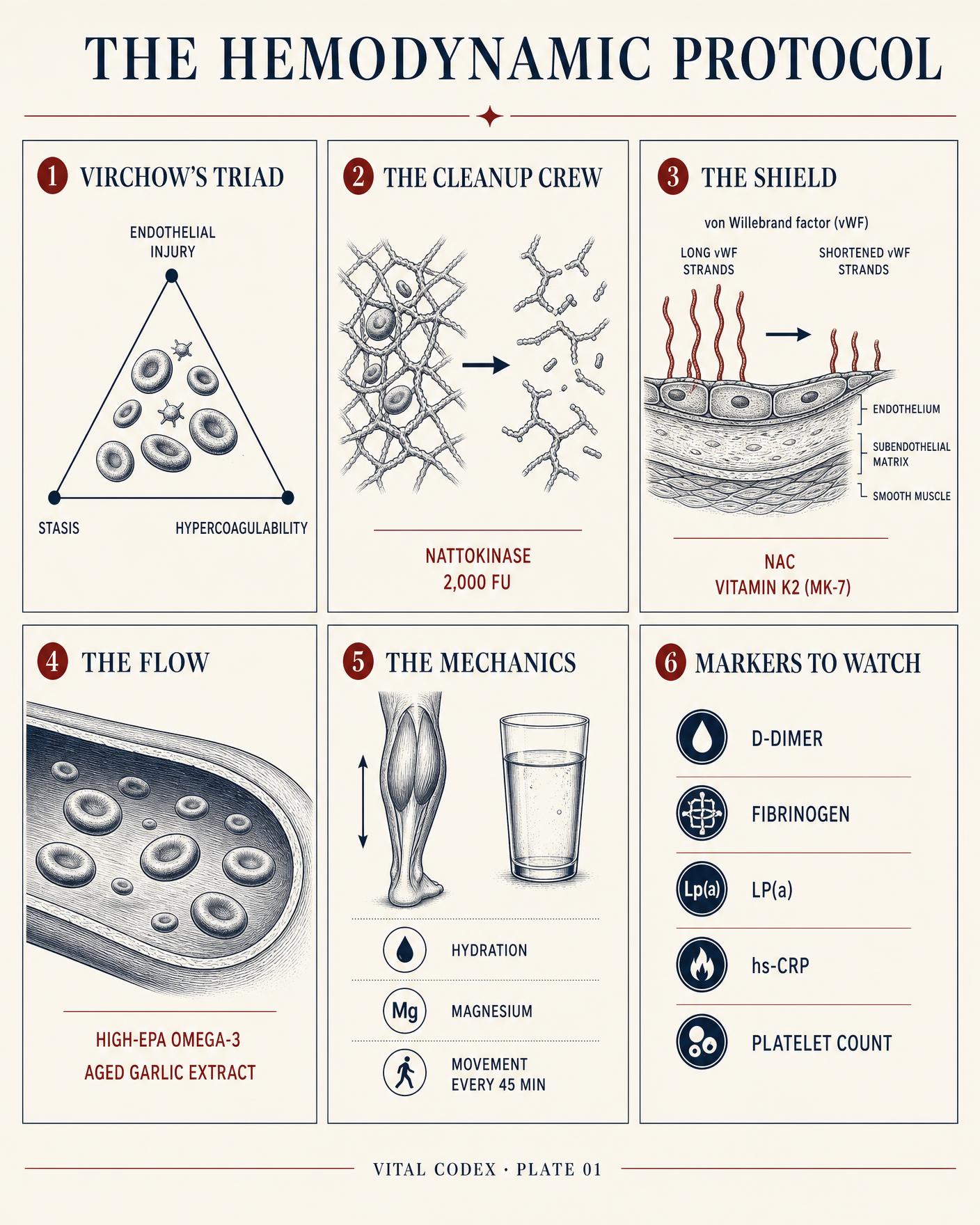
Thrombosis risk is best modeled as Virchow's triad: endothelial injury, stasis, and hypercoagulability. Each requires a different intervention.
Nattokinase, a serine protease from fermented soy, has been shown in human trials to enhance fibrinolytic activity and lower fibrinogen and factor VIII (Hsia et al., Nutrition Research, 2009).
N-acetylcysteine reduces the size of ultra-large von Willebrand factor multimers — the sticky strands that recruit platelets to injured endothelium (Chen et al., Journal of Clinical Investigation, 2011).
High-EPA omega-3 and aged garlic extract modulate platelet aggregation gradually, without the gastrointestinal bleeding risk of chronic aspirin or NSAID use.
Dietary nitrate from beetroot feeds the nitrate–nitrite–nitric oxide pathway, lowering systolic blood pressure and platelet aggregation within hours (Webb et al., Hypertension, 2008) — an effect antibacterial mouthwash abolishes.
Mechanics matter as much as biochemistry: hydration, adequate magnesium, and calf-muscle activation every 45 minutes address the stasis leg of the triad, which no supplement can reach.
Introduce one pillar at a time over two to three weeks, and track D-dimer, fibrinogen, hs-CRP, Lp(a), and platelet count rather than guessing.
The Primer
The essential idea
Blood is designed to clot. The clinical problem is not clotting but clotting in the wrong place, at the wrong time, on a vessel wall that should have been smooth. That means prevention has two distinct halves: keeping the vessel surface healthy, and keeping the blood moving over it.
Think of a river. Sediment accumulates where the bank is damaged and where the current slows. Dredging the channel — the usual "thinner" model — does nothing about either cause.
The four pillars
- The cleanup crew — fibrinolytics. The body dissolves small fibrin deposits continuously through plasmin. Nattokinase supports that process directly and is the best-studied nutraceutical in this category.
- The shield — endothelial protection. NAC helps shorten the long von Willebrand factor strands that make an injured wall sticky, while vitamin K2 (MK-7) activates matrix Gla protein, which keeps calcium out of arterial walls.
- The flow — platelet modulation and vasodilation. High-EPA fish oil shifts eicosanoid balance toward less aggregation-prone signaling; aged garlic extract has a modest, well-tolerated antiplatelet effect; and dietary nitrate from beetroot raises nitric oxide availability, widening vessels and lowering platelet reactivity within hours.
- The mechanics — lifestyle. Water, sodium and magnesium status, and simple movement. Venous return from the legs depends almost entirely on calf-muscle contraction; several uninterrupted hours of sitting is a genuine risk exposure, not a metaphor.
What to do about it
Build slowly. Add one pillar every two to three weeks so any response — bruising, nosebleeds, gastrointestinal upset — is attributable. Baseline labs before starting make the whole exercise legible. And the hard rule: if you take warfarin, a DOAC, clopidogrel, or aspirin therapy, none of this is added without your physician's explicit, monitored approval, because the effects stack.
The Deep Dive
Pillar one: fibrinolytic support
Fibrin cross-linking is the final step of the coagulation cascade, and plasmin is the enzyme that reverses it. Nattokinase, isolated from Bacillus subtilis natto, is a 275-amino-acid serine protease with direct fibrinolytic activity and an indirect effect through cleavage of plasminogen activator inhibitor-1 (PAI-1). In a randomized crossover trial in 12 healthy volunteers, a single 2,000 FU dose lowered factor VIII activity and shortened euglobulin lysis time, indicating enhanced fibrinolysis (Kurosawa et al., Scientific Reports, 2015). A four-week open-label study in 45 subjects found reductions in fibrinogen, factor VII, and factor VIII (Hsia et al., 2009).
Dosing in the literature clusters around 2,000 FU (roughly 100 mg) daily, usually taken away from food. Standardization is by fibrinolytic units, not milligrams — a product listing only milligrams is not comparable. Vitamin K1 content varies by preparation; K-depleted nattokinase is the version used where interaction with vitamin K antagonists is a concern, but that scenario belongs to a prescriber, not a protocol.
Tier II · Members only · Free
Continue into the deep dive
Tier I is free and always open. Tier II — the full mechanisms, dosing detail, nuance, and citations — unlocks with a free Vital Codex membership.
- Every Tier II deep dive across all hubs
- Saved reading progress across articles
- Member knowledge modules and their quizzes
- The Dispatch, if you opt in
Frequently asked
Can this replace a prescription blood thinner?
No. Anticoagulants are prescribed for defined indications — atrial fibrillation, mechanical valves, prior venous thromboembolism, thrombophilia — where the trial evidence for stroke and mortality reduction is large and unambiguous. Nothing in this stack has comparable outcome data. Its role is prevention in people not already on therapy, and it should never be substituted for or silently added to prescribed therapy.
How is nattokinase different from taking aspirin?
Aspirin irreversibly blocks platelet cyclooxygenase, reducing aggregation for the platelet's 8–10 day lifespan, with a corresponding gastrointestinal bleeding risk. Nattokinase acts on the fibrin side of the system — supporting the breakdown of fibrin already formed and reducing PAI-1 — rather than blunting platelet function outright. They are complementary in mechanism, which is also why combining them without supervision compounds bleeding risk.
Which markers tell me whether the stack is doing anything?
D-dimer and fibrinogen reflect fibrin formation and turnover, and are the most responsive to fibrinolytic support. hs-CRP tracks the inflammatory drive behind endothelial injury. Lp(a) is largely fixed but defines baseline risk. A CBC catches hematocrit and platelet changes. Test before starting and again at three months.
Do I need all four pillars?
Not necessarily, and the mechanics pillar is the one nobody should skip. If you sit for long stretches, are chronically underhydrated, or are magnesium-insufficient, addressing those will do more for stasis than any capsule. The supplement pillars matter most where there is a known inflammatory or lipoprotein risk load.
Is aged garlic the same as raw garlic or garlic oil?
No. Aged garlic extract is produced by extended aqueous ageing, which converts allicin into stable S-allylcysteine — this is the form used in the coronary plaque and blood pressure trials. Raw garlic supplies allicin, which is potent but unstable, and garlic oil has a different compound profile again. The clinical literature is not interchangeable across the three.
Does beetroot juice actually do anything, or is it a sports fad?
It does something specific and measurable: dietary nitrate is reduced to nitrite by oral bacteria and then to nitric oxide in tissue, which lowers blood pressure by roughly 3–5 mmHg systolic and reduces platelet aggregation in controlled human studies. It is the gentlest entry point in the flow pillar and the one with the clearest same-day effect. Two caveats: antibacterial mouthwash blocks the first conversion step, and the effect fades within 24 hours, so it is a daily practice rather than a course.
Research Notes & Sources(expand)
- Hsia CH, et al. Nattokinase decreases plasma levels of fibrinogen, factor VII, and factor VIII in human subjects. Nutrition Research. 2009;29(3):190-196.
- Kurosawa Y, et al. A single-dose of oral nattokinase potentiates thrombolysis and anti-coagulation profiles. Scientific Reports. 2015;5:11601.
- Chen J, et al. N-acetylcysteine reduces the size and activity of von Willebrand factor in human plasma and mice. Journal of Clinical Investigation. 2011;121(2):593-603.
- Knapen MHJ, et al. Menaquinone-7 supplementation improves arterial stiffness in healthy postmenopausal women. Thrombosis and Haemostasis. 2015;113(5):1135-1144.
- Bhatt DL, et al. Cardiovascular risk reduction with icosapent ethyl for hypertriglyceridemia (REDUCE-IT). New England Journal of Medicine. 2019;380(1):11-22.
- Matsumoto S, et al. Aged garlic extract reduces low attenuation plaque in coronary arteries of patients with metabolic syndrome. Journal of Nutrition. 2016;146(2):427S-432S.
- McNeil JJ, et al. Effect of aspirin on cardiovascular events and bleeding in the healthy elderly (ASPREE). New England Journal of Medicine. 2018;379:1509-1518.
- Webb AJ, et al. Acute blood pressure lowering, vasoprotective, and antiplatelet properties of dietary nitrate via bioconversion to nitrite. Hypertension. 2008;51(3):784-790.
- Velmurugan S, et al. Dietary nitrate improves vascular function in patients with hypercholesterolemia: a randomized, double-blind, placebo-controlled study. American Journal of Clinical Nutrition. 2016;103(1):25-38.
- Bhagat S, et al. Serratiopeptidase: a systematic review of the existing evidence. International Journal of Surgery. 2013;11(3):209-217.
Educational content only. Not medical advice. Discuss any change affecting coagulation with your physician, particularly if you take anticoagulant or antiplatelet medication or have surgery scheduled.
Continue exploring: The Vital Codex library on circulation, endothelial health, and the minerals that keep blood moving.
Explore Inflammation