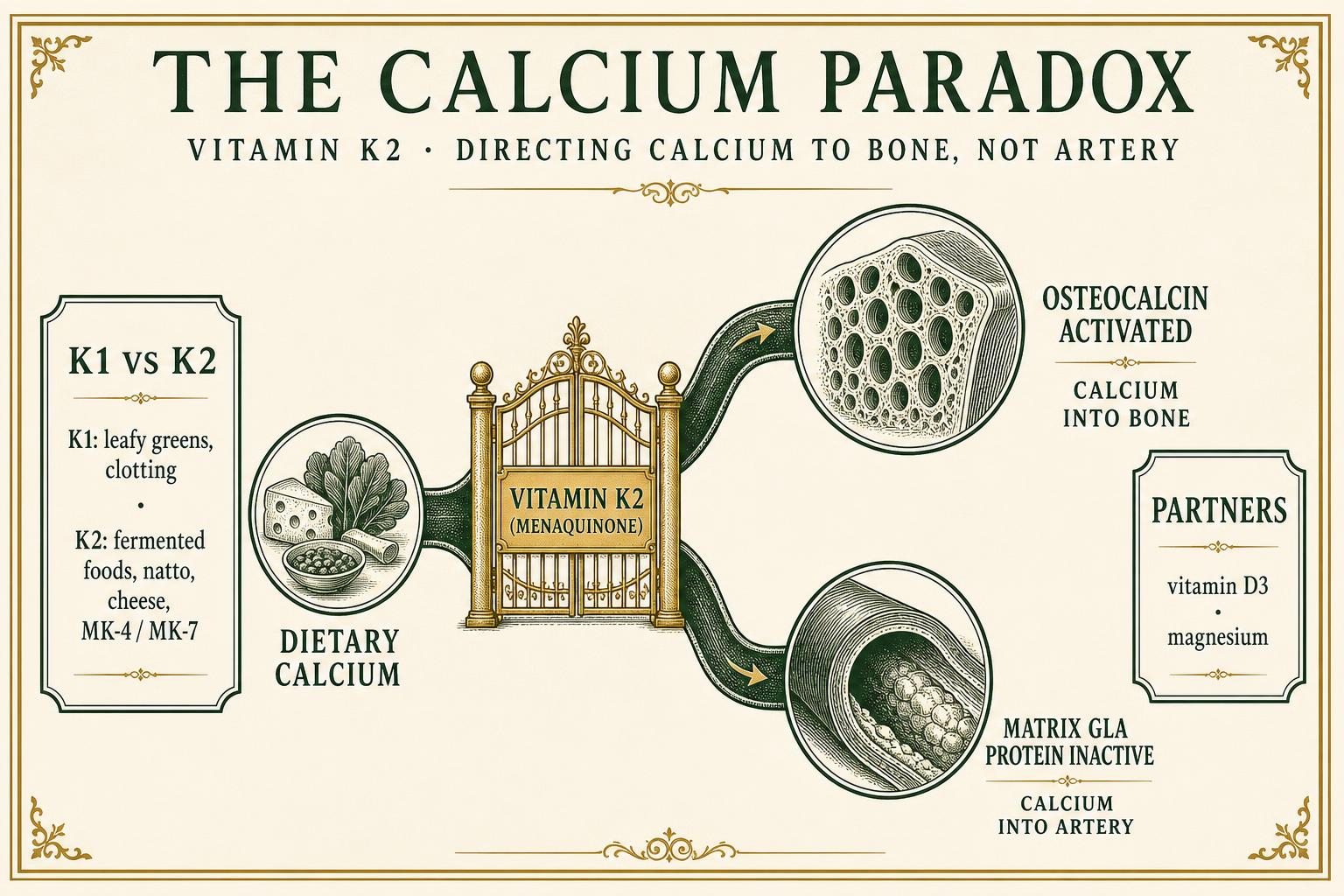
The calcium paradox is the observation that the same person can lose bone mineral and gain arterial mineral at once. Calcium intake alone does not determine where the mineral lands. Two vitamin-K-dependent proteins — osteocalcin in bone and matrix Gla protein in vessel walls — do, and both are inactive until vitamin K2 carboxylates them.
Contents(12 sections)
Key takeaways
Calcium deposition is directed by proteins, not by intake volume alone.
Vitamin K2 activates osteocalcin (binds calcium into bone) and matrix Gla protein (inhibits vascular calcification).
MK-7 has a much longer half-life than MK-4; 90–200 µg daily of MK-7 is the common supplemental range.
Anyone on warfarin must not change vitamin K intake without clinical supervision.
The Primer
What the paradox looks like
Osteoporosis and arterial calcification tend to travel together, not apart. On a plain calcium-intake model that makes no sense: more calcium should mean more bone. In practice, high-dose isolated calcium supplementation has shown little consistent fracture benefit and, in some trials, a signal toward vascular events.
The missing variable is traffic control. Calcium needs to be escorted into bone matrix and actively kept out of soft tissue.
The two proteins that do the escorting
Osteocalcin, made by bone-building cells, binds calcium into the bone matrix. Matrix Gla protein, made in vessel walls, binds calcium and prevents it from crystallizing there. Both are produced in an inactive form. Vitamin K2 is the cofactor that switches them on.
Without enough K2, both jobs go partly undone: less mineral fixed into bone, less inhibition of mineral in arteries.
Where K2 comes from
Fermented foods are the richest sources — natto by a wide margin, then hard and aged cheeses, and to a smaller degree egg yolk from free-range hens, liver, and butter from pasture-fed animals. Vitamin K1, abundant in leafy greens, is mostly used by the liver for clotting factors and converts to K2 only modestly in humans.
Vitamin D raises calcium absorption; K2 determines its destination. Pairing them is more sensible than taking either at high dose alone.
The Deep Dive
Carboxylation, the actual mechanism
Vitamin K functions as a cofactor for gamma-glutamyl carboxylase, which converts glutamate residues to gamma-carboxyglutamate (Gla) residues on vitamin-K-dependent proteins. Gla residues create the calcium-binding sites. The reaction consumes reduced vitamin K, which vitamin K epoxide reductase (VKORC1) regenerates — the same enzyme warfarin inhibits.
Two circulating markers make status measurable: undercarboxylated osteocalcin (ucOC) and dephospho-uncarboxylated matrix Gla protein (dp-ucMGP). Elevated dp-ucMGP tracks with vascular stiffness, coronary calcium score, and all-cause mortality in cohort data, and falls in response to K2 supplementation in randomized trials.
Tier II · Members only · Free
Continue into the deep dive
Tier I is free and always open. Tier II — the full mechanisms, dosing detail, nuance, and citations — unlocks with a free Vital Codex membership.
- Every Tier II deep dive across all hubs
- Saved reading progress across articles
- Member knowledge modules and their quizzes
- The Dispatch, if you opt in
Frequently asked
Is K1 from greens enough?
For clotting, yes. Conversion of K1 to K2 in humans is limited and variable, so K1 intake does not reliably carboxylate osteocalcin or matrix Gla protein.
Should I take K2 if I take vitamin D?
It is the more coherent pairing. Vitamin D increases calcium absorption and increases the demand for K2-dependent proteins that direct where that calcium goes.
Can K2 reverse existing arterial calcification?
Trials show reduced progression of stiffness and improved dp-ucMGP, not reversal of established calcified plaque. It is best understood as slowing the process, not undoing it.
How much MK-7 is too much?
No upper limit is established. Trials have run 180–360 µg daily without safety signals; there is little reason to exceed that range.
Continue exploring: Nutrition — Protein sufficiency, micronutrient density, and food quality.
Explore Nutrition