The most useful thing you can put in your stomach in the first hour after waking is water — ideally with a little sodium — followed by a first meal built around protein and fermentable fiber rather than fast carbohydrate. Not because warm lemon water is magic, but because waking sets off a fixed hormonal and mechanical sequence, and those inputs cooperate with it.
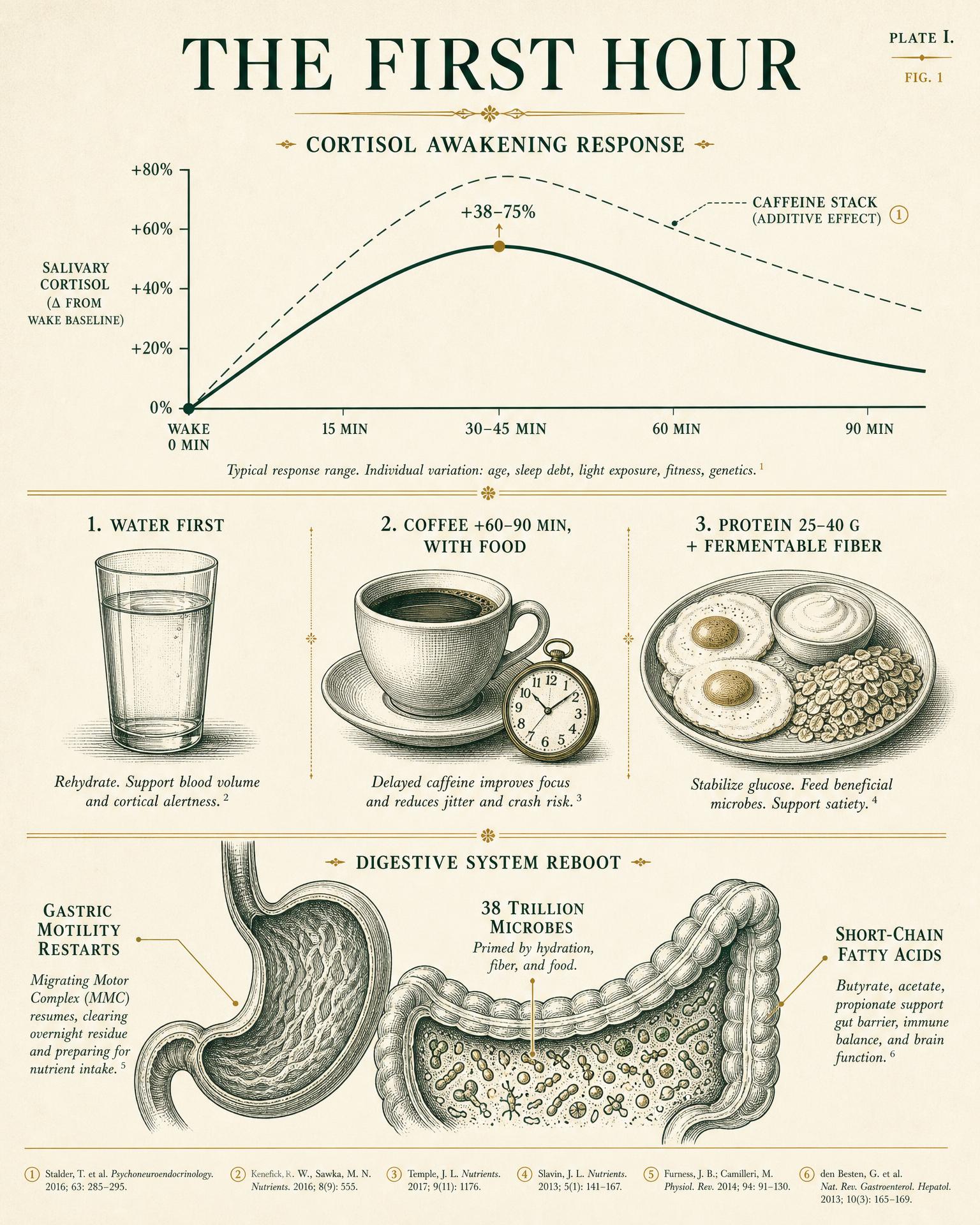
Cortisol climbs sharply. Body water is at its daily low after six to eight hours of respiratory and urinary losses. Gastric secretion and motility are restarting. And roughly 38 trillion resident microbes are entering the window in which what you eat shapes what they produce for the rest of the day. The question is not which superfood to reach for. It is which of those systems you are helping.
Contents(15 sections)
Key takeaways
Cortisol rises roughly 38–75% within 30–45 minutes of waking — the cortisol awakening response — and stacking caffeine on top of the peak amplifies it (Wüst & Kirschbaum, 2000; Lovallo et al., 2005).
Water first is the highest-value, lowest-risk input: overnight losses are real, and rehydration supports gastric emptying and motility.
Delaying coffee by roughly 60–90 minutes after waking, and taking it with food rather than on an empty stomach, blunts the cortisol stack and the reflux risk without giving anything up.
A first meal with 25–40 g of protein plus fermentable fiber feeds both muscle protein synthesis and short-chain-fatty-acid-producing bacteria; the second-meal effect means it also improves glucose control at lunch (Jenkins et al., 1988).
Eating in daylight-aligned windows matters more than fasting heroics: circadian misalignment worsens glucose and lipid handling independently of what is eaten (Scheer et al., 2009).
The Primer
What is already happening before you decide anything
Waking is not a neutral event. Within minutes, heart rate and core temperature rise, the sympathetic nervous system comes online, and the adrenal glands release a sharp pulse of cortisol. This cortisol awakening response is one of the most reproducible hormonal events in the 24-hour cycle, and it is useful — cortisol mobilizes glucose, sharpens alertness, and sets the timing signal that the rest of the body's clocks read.
At the same time, the gut is coming out of its overnight housekeeping pattern. During the fasted night, the stomach and small intestine run slow sweeping contractions that clear residue. On waking, secretion and motility shift toward handling food. Your stomach is, in a literal sense, ready before you are.
Water before anything else
Six to eight hours of breathing and urine output cost most adults between 300 mL and a liter of body water. You wake mildly hypohydrated, which is why morning urine is concentrated and why headaches and sluggishness are common before the first glass.
Plain water is enough. Room temperature or warm water is easier on an empty stomach than very cold water for some people, and a pinch of salt or a mineral-containing water helps if you sweat at night, train early, drink a lot of coffee, or eat a low-carbohydrate diet. Lemon is optional and cosmetic — it does not "alkalize" anything.
Coffee: not wrong, just early
Coffee is one of the best-studied compounds in the human diet and its long-term associations are largely favorable. The problem is timing, not the drink. Caffeine raises cortisol; when it lands on top of the natural morning peak, the two stack, which for sensitive people shows up as jitteriness at 8 a.m. and a hard crash at 11.
Two adjustments cover almost everyone: wait about 60–90 minutes after waking, and drink it with or after food rather than on a completely empty stomach. Coffee on an empty stomach also relaxes the lower esophageal sphincter and increases acid secretion, which is the common mechanism behind morning reflux.
What the first meal should contain
Three components do most of the work.
Protein, 25–40 g. Enough to clear the per-meal threshold that triggers muscle protein synthesis, and enough to keep appetite steady through the morning. Free-range eggs, Greek yogurt, cottage cheese, fish, or a whey shake all reach it. This is the meal most people under-protein by a wide margin.
On eggs specifically: choose free-range or pasture-raised. Protein and leucine are effectively identical to cage eggs, but yolks from hens with outdoor access and a varied diet carry more omega-3 fat, vitamin D, vitamin E, and carotenoids, with a lower omega-6 to omega-3 ratio. For a meal whose job is protein plus anti-inflammatory fat, that is a free upgrade.
Fermentable fiber. Oats, chia, ground flax, berries, legumes, or vegetables. Fiber is not primarily about bulk; it is the substrate that gut bacteria ferment into short-chain fatty acids like butyrate, which feed the colon lining and influence appetite and glucose signaling.
Fermented food, if it suits you. Yogurt, kefir, sauerkraut, kimchi, or miso. A high-fermented-food diet measurably increased microbial diversity and reduced inflammatory markers in a controlled Stanford trial (Wastyk et al., 2021).
What to keep small: a first meal that is only fast carbohydrate — juice, sweetened cereal, a pastry — produces the largest glucose excursion of the day, because cortisol has already raised hepatic glucose output. The same food later in the day is handled better.
The honest version of the answer
Water first. Coffee an hour in, with food. A first meal anchored on protein plus fiber, in a window that starts after morning light rather than in the dark. That is the whole protocol, and it is unglamorous on purpose — the effect comes from doing it repeatedly, not from any single ingredient.
The Deep Dive
The cortisol awakening response as a timing signal
The CAR is distinct from ordinary diurnal cortisol decline. It is a discrete 30–45 minute surge of 38–75% above waking levels, characterized across decades of salivary sampling work (Wüst, Kirschbaum and colleagues), and it is driven partly by the suprachiasmatic nucleus and partly by the act of waking itself — light exposure amplifies it, disrupted sleep flattens it.
Its functional role is anticipatory: it mobilizes glucose via hepatic gluconeogenesis and glycogenolysis before any food arrives, which is why fasting glucose is often at its daily high in the early morning even in metabolically healthy people. Two practical consequences follow. First, a large refined-carbohydrate load lands on an already elevated glucose baseline. Second, a blunted or flattened CAR is a repeatedly observed correlate of burnout, chronic fatigue states, and poor sleep quality — it is a signal worth protecting, not suppressing.
Tier II · Members only · Free
Continue into the deep dive
Tier I is free and always open. Tier II — the full mechanisms, dosing detail, nuance, and citations — unlocks with a free Vital Codex membership.
- Every Tier II deep dive across all hubs
- Saved reading progress across articles
- Member knowledge modules and their quizzes
- The Dispatch, if you opt in
Frequently asked
What is the single best thing to drink first thing in the morning?
Water. Overnight losses of 300 mL to a liter are typical, and rehydration supports gastric emptying, motility, and cognitive performance. Adding a small amount of sodium helps if you sweat at night, train early, or eat low-carbohydrate. Lemon is optional and does not change body pH.
Should I really wait an hour to drink coffee?
If you get jittery or crash mid-morning, yes — waiting 60–90 minutes keeps caffeine from stacking on the cortisol awakening peak, and having it with food reduces reflux. If you have neither symptom, the timing matters less than the total dose and how late in the day you stop.
Is skipping breakfast bad for you?
Not inherently. Trials of time-restricted eating that skip breakfast show metabolic benefit, largely by ending intake earlier in the evening. The costs are specific: one fewer opportunity to clear the per-meal protein threshold, which matters most for older adults and anyone trying to preserve lean mass.
How much protein should the first meal have?
Roughly 25–40 g of high-quality protein — three free-range eggs, two cups of Greek yogurt, cottage cheese, fish, or a whey scoop in oats. Most people's breakfast lands nearer 10 g, which is the largest single gap in the average day's protein distribution.
Do fermented foods in the morning actually do anything?
A controlled trial of a high-fermented-food diet increased microbial diversity and lowered several inflammatory markers over 10 weeks (Wastyk et al., 2021). Timing was not the variable tested — regularity was. Morning is simply a convenient slot for yogurt, kefir, or kimchi.
Does warm water work better than cold?
Modestly, and for a mechanical reason: warm water empties from the stomach and stimulates colonic motility somewhat faster than cold. That is the entire claim the evidence supports. It does not detoxify, alkalize, or burn fat.
Continue exploring: Nutrition — Protein sufficiency, micronutrient density, and food quality.
Explore Nutrition