You spend hundreds of dollars a year on supplements, then store them next to the stove, in a steam-filled bathroom cabinet, or in a clear bottle on a sunlit shelf. Every label offers the same instruction — "store in a cool, dry place" — and that phrase names no temperature, no relative humidity, no light condition, and, most importantly, says nothing at all about oxygen. It is not a protocol. It is a legal shield.
Degradation is chemistry, not superstition. Four forces do essentially all of the damage: heat, moisture, light and oxygen. They are not independent — heat accelerates the reactions the other three begin. Once you know which force dominates for which class of compound, storage becomes a small, cheap, solvable engineering problem.
A label that names no temperature, no humidity, no light condition and no oxygen limit has told you nothing. It has only made itself unfalsifiable.
Contents(12 sections)
The matrix at a glance
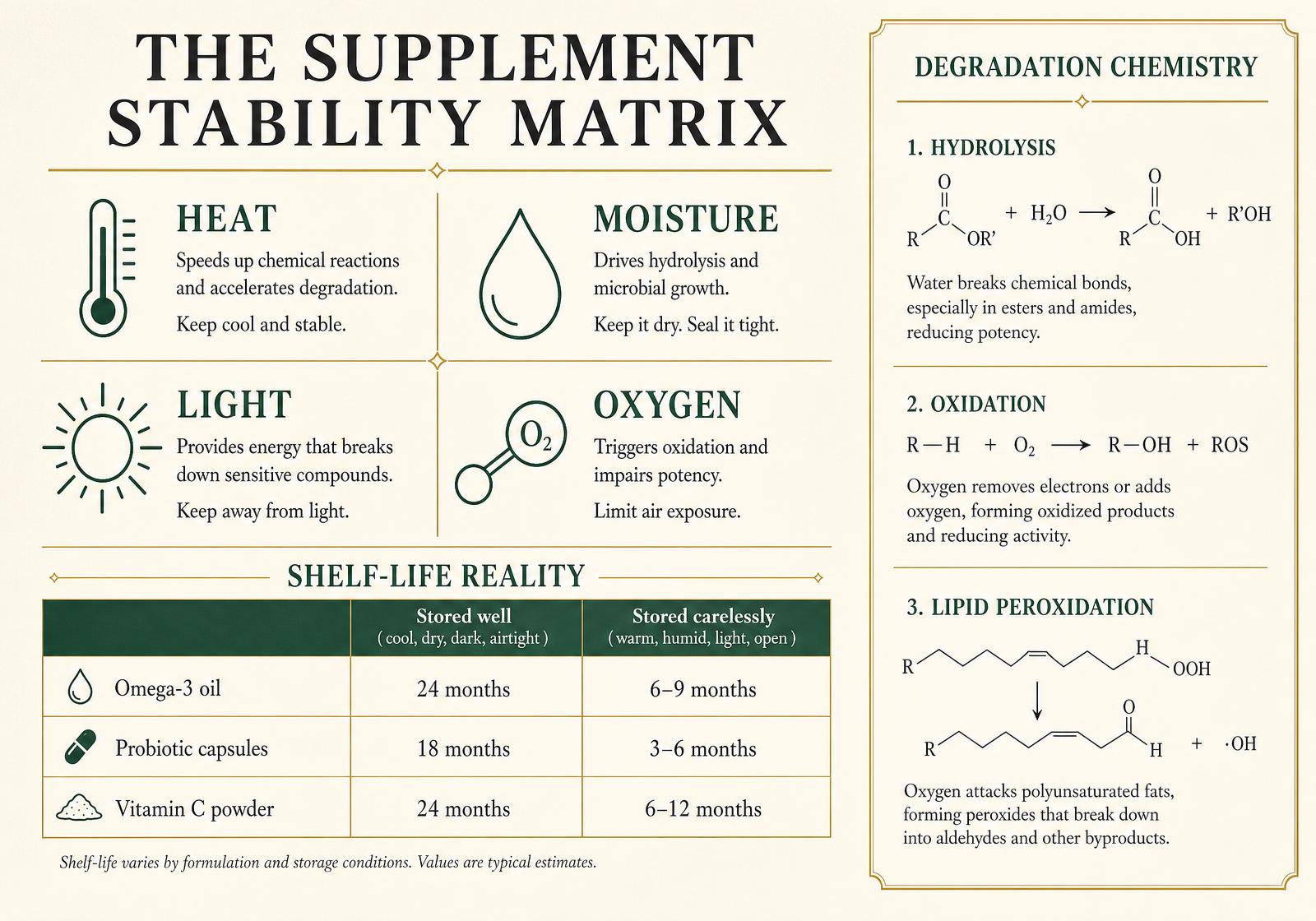
Four forces degrade supplements: heat (accelerates every reaction), moisture (drives hydrolysis and kills spore-free probiotics), light (drives photo-oxidation of riboflavin, retinol and B12), and oxygen (turns fatty acids into peroxides and then aldehydes).
Reaction rates roughly double for every 10 °C rise. A cabinet above a stove at 35 °C is not "cool" — it is running your supplements at several times their intended shelf-life clock.
Fish and algal oils fail by oxidation first; probiotics by moisture; vitamin C and protein powders by moisture; fat-soluble vitamins and B-complex by light.
The countermeasures are cheap and specific: colour-indicating silica desiccant, amber glass, PTFE-lined dropper caps, minimal headspace, refrigeration for oils and live cultures, and dividing bulk powders into small working supplies.
Printed expiry dates assume ideal storage in an unopened container. The clock changes the moment you break the seal.
The Primer
The four enemies
Heat. Every chemical reaction that destroys a supplement runs faster when it is warm. As a rule of thumb from the Arrhenius relationship, rates roughly double for each 10 °C increase. Room temperature is around 21 °C; a kitchen cabinet above a stove or beside a refrigerator's exhaust coil can sit at 32–38 °C for hours a day. That is not a rounding error — it is a multiple.
Moisture. Water is a reagent, not just an environment. It hydrolyses ester and amide bonds, dissolves and recrystallises hygroscopic powders into clumps, and — critically — reactivates the metabolism of freeze-dried probiotic organisms so they exhaust themselves and die inside the bottle. Bathroom cabinets, which see repeated humidity spikes from showers, are the single worst location in most homes.
Light. Ultraviolet and even bright visible light supply the activation energy for photo-degradation. Riboflavin (B2) is famously light-sensitive; methylcobalamin (B12), retinol (A) and folate follow. Light also initiates lipid peroxidation in oils. This is why serious products ship in amber or opaque containers — and why decanting into a pretty clear jar is a measurable downgrade.
Oxygen. The one the label never mentions. Oxygen attacks the double bonds in polyunsaturated fats, producing hydroperoxides that decompose into aldehydes — the compounds responsible for the "fishy" smell of a spoiled omega-3 capsule. By the time you can smell it, oxidation is far advanced. Headspace in a half-empty bottle is a reservoir of the reactant.
Shelf-life reality by class
Printed dates describe an unopened container held at ideal conditions. In real homes:
- Fish or algal omega-3 oil — the least forgiving item most people own. Oxidation begins as soon as the seal is broken. Buy small bottles, refrigerate after opening, and finish within weeks, not months.
- Probiotics — the label's CFU count is at manufacture (or, in better products, at end of shelf life; check which). Moisture and heat both reduce it. Refrigerated, sealed, desiccated storage preserves far more of it.
- Vitamin C powder — pure ascorbic acid is intensely hygroscopic. It pulls water from the air, clumps, and oxidises to dehydroascorbic acid.
- Fat-soluble vitamins (A, D, E, K) — relatively stable, but light and oxygen sensitive. Amber glass and low headspace matter more than refrigeration.
- B-complex — mostly a light problem. Keep it in the dark.
- Collagen and protein powders — moisture drives clumping and Maillard browning between amino groups and any residual sugars. A clumped tub is a chemistry report, not a texture complaint.
- Alcohol tinctures — chemically robust for years, but the cap is the failure point. Standard metal-lined dropper caps corrode; solvent evaporates; the dose concentration drifts.
What to actually do
- Map your home first. Buy a cheap digital hygrometer and leave it in each candidate location for a day. Do not guess: the "cool" cupboard beside a dishwasher is often the warmest and wettest place in the kitchen.
- Add desiccant to every powder. Colour-indicating silica gel packets tell you when they are saturated. Replace them then.
- Move to amber glass. For anything decanted, and for anything you bought in clear plastic.
- Upgrade tincture caps to PTFE-lined. Especially in humid climates.
- Divide bulk purchases. Keep a small working jar and leave the rest sealed and desiccated. Every opening of the main container is an oxygen and humidity event.
- Refrigerate oils and live cultures — and in tropical or coastal climates use a double seal: the product's own container inside an airtight glass box, so condensation on the outer surface never reaches the powder.
The Deep Dive
Hydrolysis: why water is a reagent
Hydrolysis cleaves a covalent bond by inserting water across it. Esters, amides, glycosidic bonds and lactones are all vulnerable, and the rate depends on water activity — the availability of free water — rather than total water content. This is the reason a desiccant works: it lowers water activity in the container's headspace, and the powder equilibrates downward with it.
Ascorbic acid illustrates the compounding problem. It is hygroscopic enough to deliquesce — to absorb sufficient atmospheric water to form a saturated solution on its own surface. Once dissolved, it oxidises rapidly through the ascorbate radical to dehydroascorbic acid, which then hydrolyses irreversibly to 2,3-diketogulonic acid. The first step is partially recoverable in the body; the last is not. Clumping is therefore a leading indicator, not a cosmetic issue.
Tier II · Members only · Free
Continue into the deep dive
Tier I is free and always open. Tier II — the full mechanisms, dosing detail, nuance, and citations — unlocks with a free Vital Codex membership.
- Every Tier II deep dive across all hubs
- Saved reading progress across articles
- Member knowledge modules and their quizzes
- The Dispatch, if you opt in
Frequently asked
Does refrigeration help every supplement?
No. It is clearly beneficial for fish and algal oils and for live probiotics. For hygroscopic powders it can be actively harmful, because every removal from the refrigerator condenses atmospheric water onto a cold surface. If you must refrigerate a powder, use a genuinely airtight outer container and let it reach room temperature before opening.
Are printed expiry dates meaningful?
They are meaningful only for an unopened container stored under the manufacturer's assumed conditions. Once the seal is broken, the relevant clock is set by your own environment. An omega-3 bottle with eighteen months on the label can be substantially oxidised within weeks in a warm kitchen.
Should I keep the desiccant packet that came in the bottle?
Yes — and consider adding a fresh colour-indicating one. The packet included at manufacture may already be saturated by the time the bottle reaches you, and it gives no signal either way.
Is a clumped powder still safe to take?
Clumping signals that water has entered and hydrolysis or Maillard chemistry has begun. It is usually not a safety hazard, but potency is no longer what the label states, and for vitamin C or protein powders the loss can be substantial. Treat clumping as a prompt to replace and to fix the storage condition that caused it.
What is the single highest-value change to make today?
Move fish oil and probiotics into the refrigerator, and put a colour-indicating silica packet in every powder container. Those two actions address the two least forgiving categories and cost almost nothing.
Continue exploring: The Vital Codex library on supplement quality, bioavailability, and getting what you paid for.
Explore Nutrition