Consumption of industrial seed oils in the United States rose from a negligible share of calories in 1900 to roughly 8–10% of total energy today, driven overwhelmingly by soybean oil. Coronary heart disease mortality rose sharply over roughly the same century before falling again after the 1960s.
That timing has made seed oils one of the most contested topics in nutrition. This piece separates what randomized trials actually show from what mechanism suggests, and states plainly where the evidence runs out.
Contents(12 sections)
Key takeaways
Linoleic acid intake in the US rose roughly threefold across the twentieth century; adipose tissue linoleic acid content rose from about 9% to about 21%.
Replacing saturated fat with polyunsaturated fat lowers LDL cholesterol; this is one of the most consistent findings in nutrition science.
Randomized trials of that replacement show a modest reduction in coronary events but no clear reduction in total mortality (Hooper et al., Cochrane, 2020).
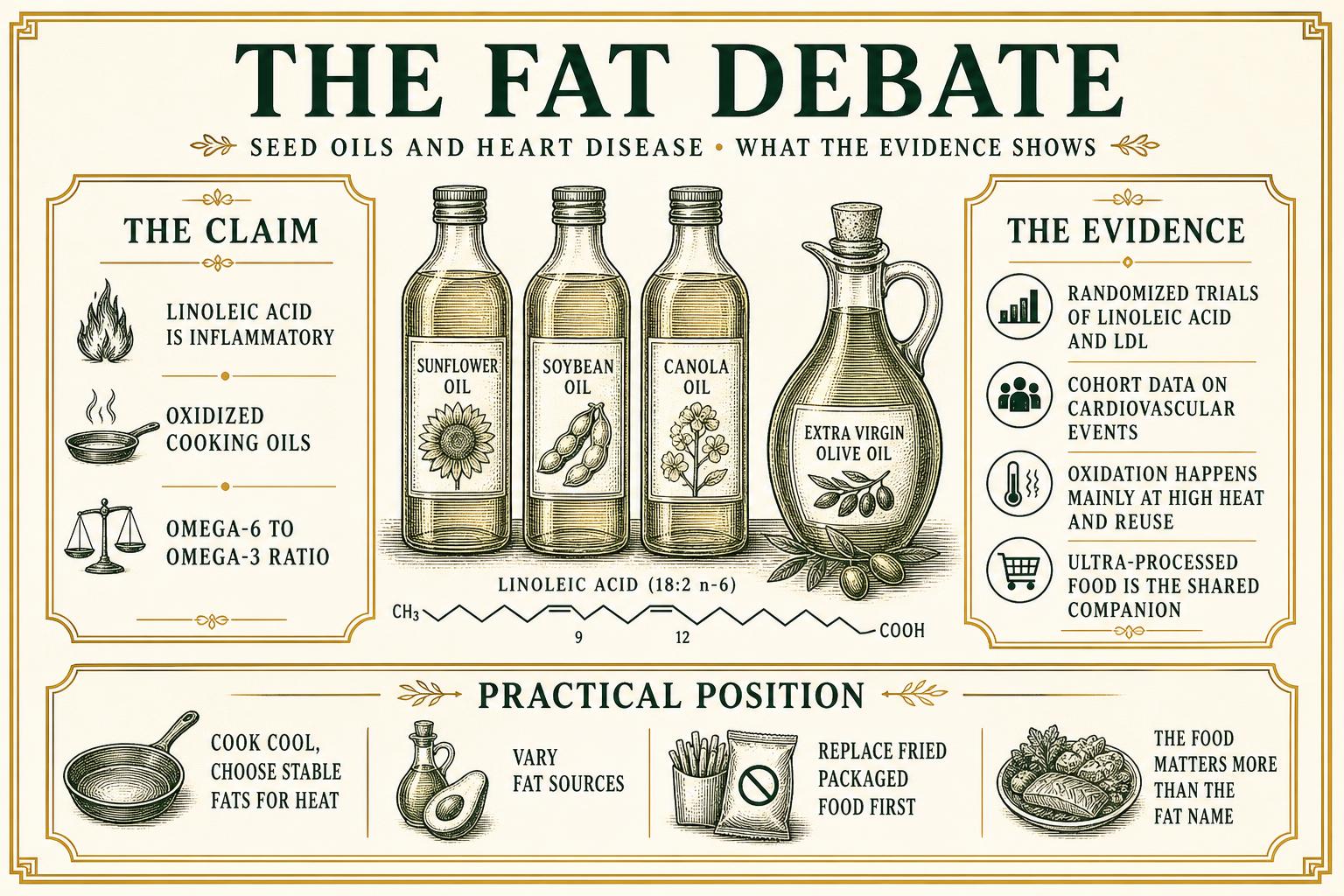
Mechanistic concern centers on oxidized linoleic acid metabolites (OXLAMs) and repeatedly heated oils, not on linoleic acid per se.
The strongest defensible position: reduce fried and repeatedly heated oils and ultra-processed foods; choose olive oil, and do not treat seed-oil avoidance as the primary lever in cardiovascular prevention.
The Primer
What changed
Before industrial extraction, dietary fat came from animal fats, butter, olive oil, and tropical oils. Solvent extraction and hydrogenation made soybean, corn, cottonseed, canola, sunflower, and safflower oils inexpensive and shelf-stable. They now dominate restaurant frying, packaged snacks, dressings, and sauces.
The main fatty acid in most of them is linoleic acid, an omega-6 polyunsaturated fat. It is an essential nutrient — humans cannot make it — and requirements are met at roughly 1–2% of calories. Typical modern intakes are five to ten times that.
Why polyunsaturated fats are fragile
Every double bond in a fatty acid is a site vulnerable to oxidation. Linoleic acid has two; saturated fats have none. Heat, light, oxygen, and time therefore degrade seed oils far faster than they degrade butter, tallow, or coconut oil. Oil reused in a commercial fryer accumulates aldehydes and other oxidation products that are not present in fresh oil.
This is where the concern is best grounded. The question is less "is linoleic acid harmful" and more "what happens to it in industrial food processing and repeated frying."
The honest summary
Seed oils lower LDL cholesterol when they replace saturated fat, which is a benefit. They are also the signature fat of ultra-processed and deep-fried food, which is a liability that has little to do with the fatty acid itself. Both statements are true, and most public arguments pick one and ignore the other.
The Deep Dive
The trial evidence
The Cochrane review of omega-6 intake found that increasing omega-6 fats produced little or no effect on cardiovascular mortality or events, with low-certainty evidence overall (Hooper et al., 2020). The companion review on replacing saturated with polyunsaturated fat found a roughly 17% relative reduction in cardiovascular events, driven by trials with the largest LDL reductions, and no significant effect on all-cause mortality.
Individual trials complicate the picture. The Sydney Diet Heart Study and the recovered Minnesota Coronary Experiment data both found that substituting linoleic-acid-rich oils lowered cholesterol yet showed higher mortality in the intervention arms (Ramsden et al., BMJ, 2013 and 2016) — though both used partially hydrogenated products with trans fat, confounding interpretation. The Los Angeles Veterans and Oslo Diet-Heart trials pointed the other way.
Tier II · Members only · Free
Continue into the deep dive
Tier I is free and always open. Tier II — the full mechanisms, dosing detail, nuance, and citations — unlocks with a free Vital Codex membership.
- Every Tier II deep dive across all hubs
- Saved reading progress across articles
- Member knowledge modules and their quizzes
- The Dispatch, if you opt in
Frequently asked
Are seed oils the main cause of modern heart disease?
The evidence does not support a single-cause claim. Coronary disease rose alongside seed oil consumption but also alongside cigarette smoking, obesity, sedentary work, refined sugar, and — importantly — better diagnosis and longer lifespans. Trials that isolate the fat substitution show modest, mixed effects.
Is olive oil actually better?
It has the most consistent human outcome evidence of any dietary fat, from PREDIMED and large cohorts. It is largely monounsaturated, therefore more oxidatively stable than seed oils, and extra-virgin olive oil carries polyphenols with independent effects.
What about high-oleic sunflower or safflower oil?
Those cultivars are predominantly monounsaturated and much more heat-stable than their conventional linoleic-rich counterparts. They are a reasonable neutral cooking fat, though quality and processing vary.
Should I throw out my canola oil?
Occasional home use of fresh oil at moderate temperature is a small exposure. The bigger levers are fried restaurant food, packaged snacks, and total diet quality.
Continue exploring: Nutrition — Protein sufficiency, micronutrient density, and food quality.
Explore Nutrition