Peripheral circulation is one of the earliest places a slowly declining vascular system announces itself. Cold hands, cold feet, leg heaviness, and slow rebound after long sitting are worth reading as data.
Contents(12 sections)
Key takeaways
Daily walking and interrupting prolonged sitting are the highest-yield interventions.
Hydration, sleep, and glucose stability influence vascular tone as much as any supplement.
Sudden one-sided leg swelling, chest symptoms, or non-healing sores are not lifestyle issues — they need evaluation.
The Primer
Why it changes after 40
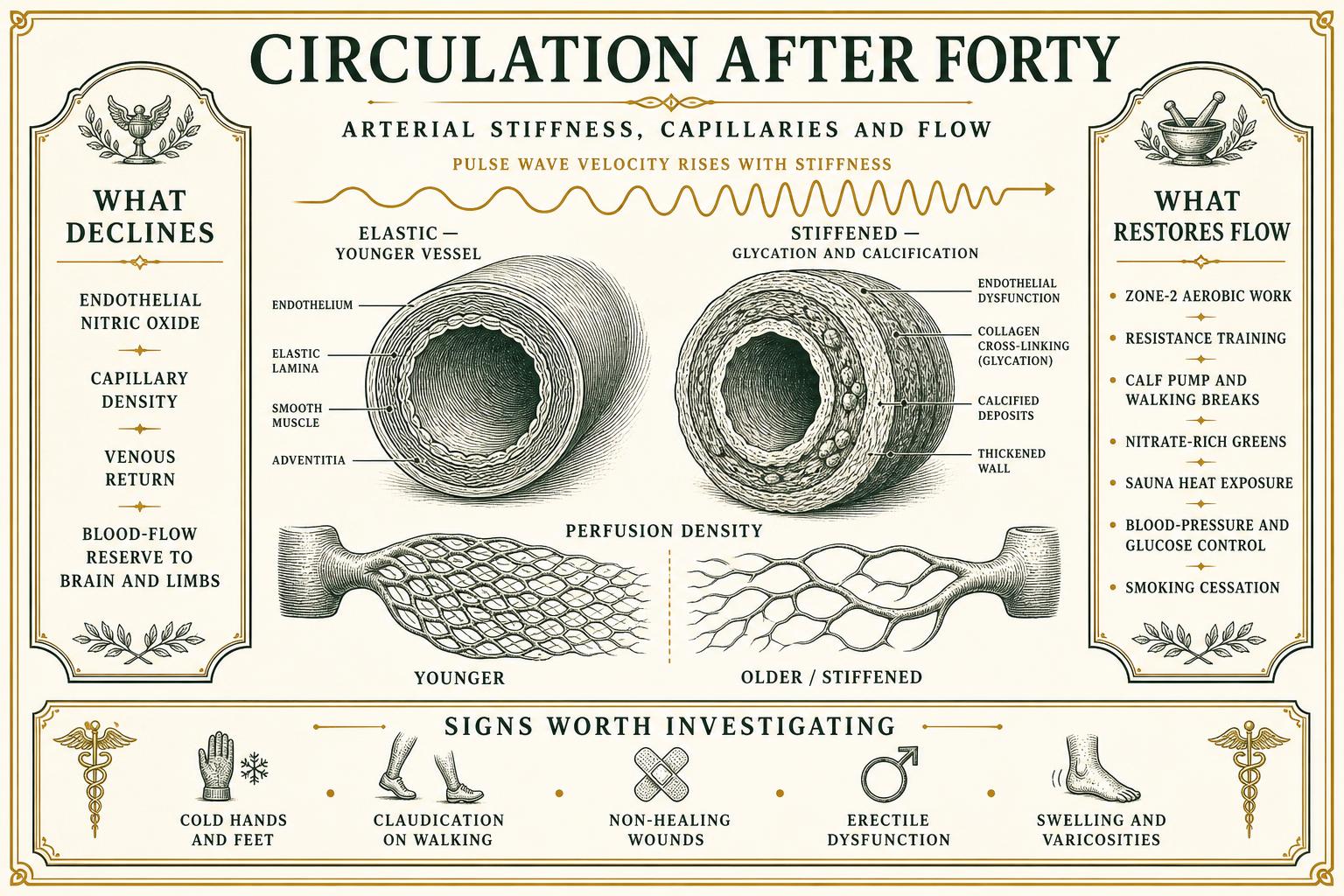
By the fifth decade, endothelial nitric oxide production drops, arterial stiffness rises, and any drift in glucose regulation begins to show in the smallest vessels first. That is why peripheral symptoms often precede any clear finding on a resting ECG or standard lipid panel.
The daily inputs that matter most
Walking is unreasonably effective. Ten to twenty minutes at a time, several times per day, does more for peripheral circulation than any single supplement. Interrupt prolonged sitting every 30–45 minutes; the venous return system depends on the calf pump.
Hydration, adequate sleep, and controlling postprandial glucose all support vascular tone. Body weight, when elevated, sits upstream of most of these levers.
When symptoms aren't a wellness issue
Chest pain, shortness of breath at rest, sudden one-sided leg swelling, severe leg pain, dramatic skin-color changes, or non-healing sores are not lifestyle-support situations. Get evaluated, then return to the long-term work.
The Deep Dive
Endothelial nitric oxide and shear stress
Vascular tone is governed largely by endothelial nitric oxide synthase (eNOS), which is activated by laminar shear stress against the endothelium. Movement is therefore not incidental to vascular health — it is the primary physiological stimulus for NO production. Prolonged sitting reduces shear stress in the lower limbs and measurably impairs flow-mediated dilation within one to three hours, an effect reversed by brief walking breaks.
With age, eNOS uncoupling increases: in the presence of oxidized LDL, hyperglycemia, or reduced tetrahydrobiopterin availability, the enzyme shifts toward superoxide production instead of NO. The result is less vasodilation and more oxidative stress in the same tissue.
Tier II · Members only · Free
Continue into the deep dive
Tier I is free and always open. Tier II — the full mechanisms, dosing detail, nuance, and citations — unlocks with a free Vital Codex membership.
- Every Tier II deep dive across all hubs
- Saved reading progress across articles
- Member knowledge modules and their quizzes
- The Dispatch, if you opt in
Frequently asked
Are cold hands and feet always a circulation issue?
Not always — thyroid, iron status, autonomic tone, and Raynaud's can all contribute. But persistent peripheral coldness paired with metabolic risk factors is worth reading as a circulation signal.
Do I need a supplement stack?
Usually no. Walking, hydration, sleep, and glucose stability outperform most stacks. Botanicals like ginger and hawthorn have traditional use, but they layer onto habits — they don't replace them.
Continue exploring: Metabolism — Glucose variability, insulin sensitivity, and substrate flexibility.
Explore Metabolism