Nitric oxide (NO) is a short-lived gaseous signaling molecule made continuously inside the body. Its central job is to relax vascular smooth muscle so that arteries widen and deliver more blood, oxygen, and nutrients to the tissue that needs them.
Because nitric oxide bioavailability falls with age, inactivity, oxidative stress, and metabolic dysfunction, its decline is one of the earliest measurable features of vascular aging — and one of the most responsive to daily inputs.
Contents(15 sections)
Key takeaways
Nitric oxide relaxes blood vessels by activating soluble guanylate cyclase and raising cyclic GMP in vascular smooth muscle.
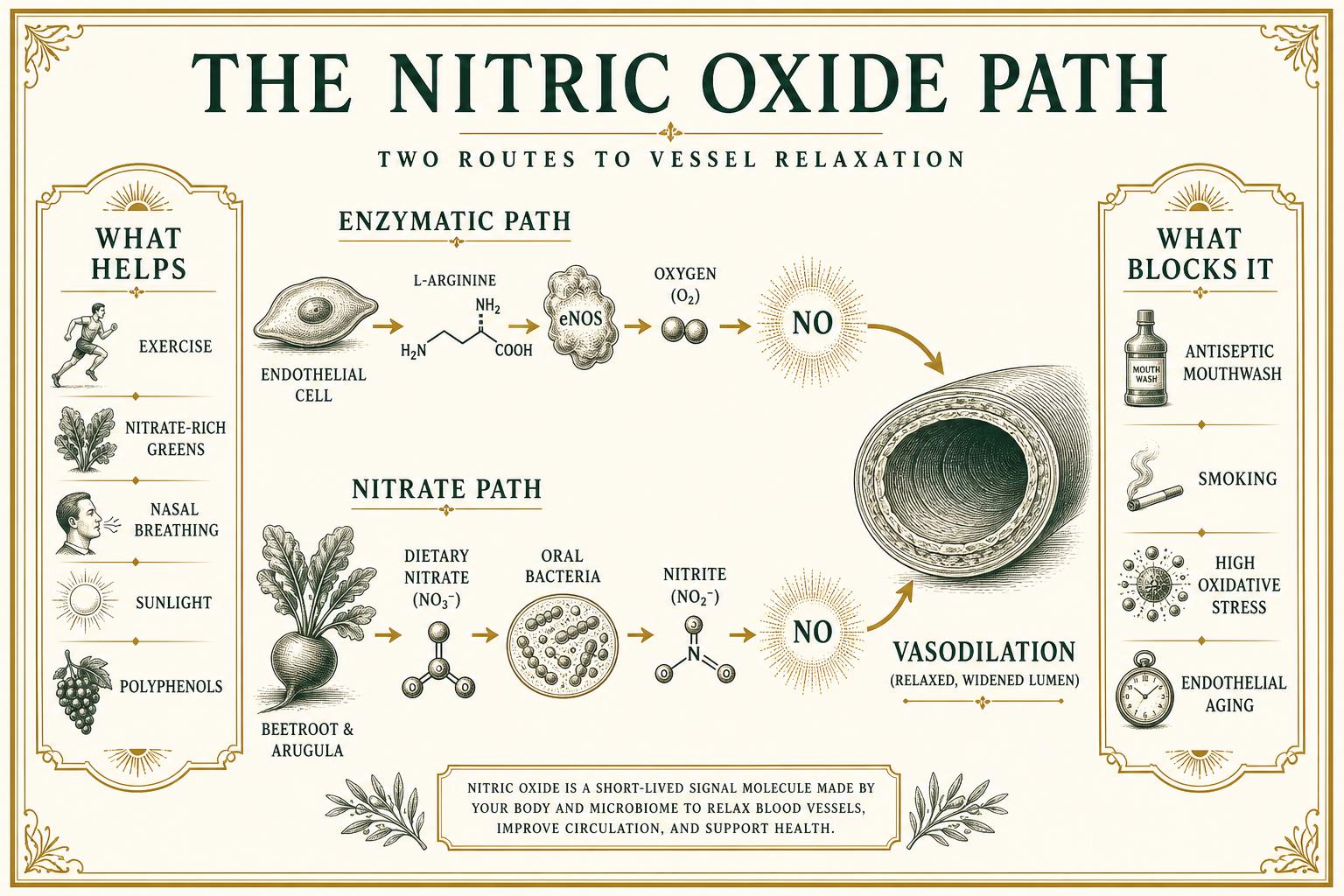
The body makes it through two pathways: the L-arginine–NOS enzymatic route and the dietary nitrate–nitrite–NO route that depends on oral bacteria.
Antiseptic mouthwash can suppress nitric oxide production by killing the nitrate-reducing bacteria on the tongue.
Nitrate-rich vegetables, regular movement, sunlight, and oral-microbiome care are the highest-yield levers.
More nitric oxide is not universally better: inflammatory iNOS-driven output is a different biological event from healthy endothelial signaling.
The Primer
What nitric oxide does
Nitric oxide diffuses rapidly across cell membranes and signals nearby tissue. In blood vessels it triggers vasodilation; elsewhere it helps regulate platelet activity, immune defense, mitochondrial respiration, insulin sensitivity, and neurotransmission.
In practical terms, healthy nitric oxide status supports cardiovascular function, cognitive performance, exercise tolerance, recovery, and sexual function — all of which depend on flow.
The two ways your body makes it
The first pathway is enzymatic: nitric oxide synthase converts L-arginine into nitric oxide and L-citrulline. It requires oxygen and cofactors, and it is sensitive to oxidative stress.
The second pathway starts with food. Nitrates from vegetables — beets, arugula, spinach, chard — are reduced to nitrite by bacteria on the tongue, then converted to nitric oxide in the stomach and circulation. This is why oral-microbiome health is a circulation variable, and why routine antiseptic mouthwash use can measurably blunt nitric oxide production.
Why it declines
Production and bioavailability drop with aging, sedentary behavior, insulin resistance, chronic inflammation, and low vegetable intake. Oxidative stress is a double hit: it both reduces synthesis and destroys nitric oxide after it is made.
The daily inputs that work
Eat nitrate-dense leafy greens and beets regularly. Move most days — shear stress against the vessel wall is the primary physiological stimulus for endothelial nitric oxide. Get morning sunlight. Care for the oral microbiome. Sleep enough to allow overnight vascular recovery.
The Deep Dive
eNOS, nNOS, iNOS: three enzymes, three biologies
eNOS (endothelial) produces low, pulsatile nitric oxide in vessel linings and governs vascular tone, endothelial health, and blood pressure regulation. nNOS (neuronal) supports neurotransmission, synaptic plasticity, and neurovascular coupling. iNOS (inducible) is switched on during inflammation and can generate large quantities for host defense — useful acutely, damaging when chronically expressed.
This distinction matters clinically. "Boosting nitric oxide" is only desirable when it means restoring eNOS-derived signaling. Chronic iNOS activation combined with oxidative stress produces peroxynitrite and other reactive nitrogen species, which damage the same tissue nitric oxide is supposed to protect.
Tier II · Members only · Free
Continue into the deep dive
Tier I is free and always open. Tier II — the full mechanisms, dosing detail, nuance, and citations — unlocks with a free Vital Codex membership.
- Every Tier II deep dive across all hubs
- Saved reading progress across articles
- Member knowledge modules and their quizzes
- The Dispatch, if you opt in
Frequently asked
Does mouthwash really lower nitric oxide?
Antiseptic mouthwash reduces the nitrate-reducing bacteria on the tongue that convert dietary nitrate to nitrite. Controlled studies have shown reduced salivary nitrite and modest blood pressure increases with regular use. Occasional use is unlikely to matter; twice-daily antiseptic rinsing is worth reconsidering.
Is beetroot juice better than a supplement?
For the nitrate pathway, what matters is the nitrate dose — typically 300–600 mg to produce measurable effects. Concentrated beetroot shots standardize that dose; whole vegetables deliver it alongside polyphenols and potassium. Both work.
Can nitric oxide be too high?
Endothelial nitric oxide is self-limiting. The problematic pattern is chronic inflammatory iNOS activation, which generates reactive nitrogen species. That is an inflammation problem, not an argument against supporting endothelial function.
How fast do changes show up?
Dietary nitrate raises plasma nitrite within hours. Endothelial function measured by flow-mediated dilation typically improves over two to six weeks of consistent dietary and activity change.
Continue exploring: Metabolism — Glucose variability, insulin sensitivity, and substrate flexibility.
Explore Metabolism