Protein is necessary for muscle, immune function, enzymes, tissue repair, and healthy aging. Low intake is genuinely harmful — especially for older adults, people with low appetite, anyone losing weight unintentionally, and those recovering from illness.
But protein is also a growth signal. Amino acids help activate the pathways involved in building and repair, including insulin/IGF-1 and mTOR nutrient sensing. Those pathways are valuable. What is not supported is the cultural assumption that everyone, at every age, should keep adding shakes, bars, and oversized portions.
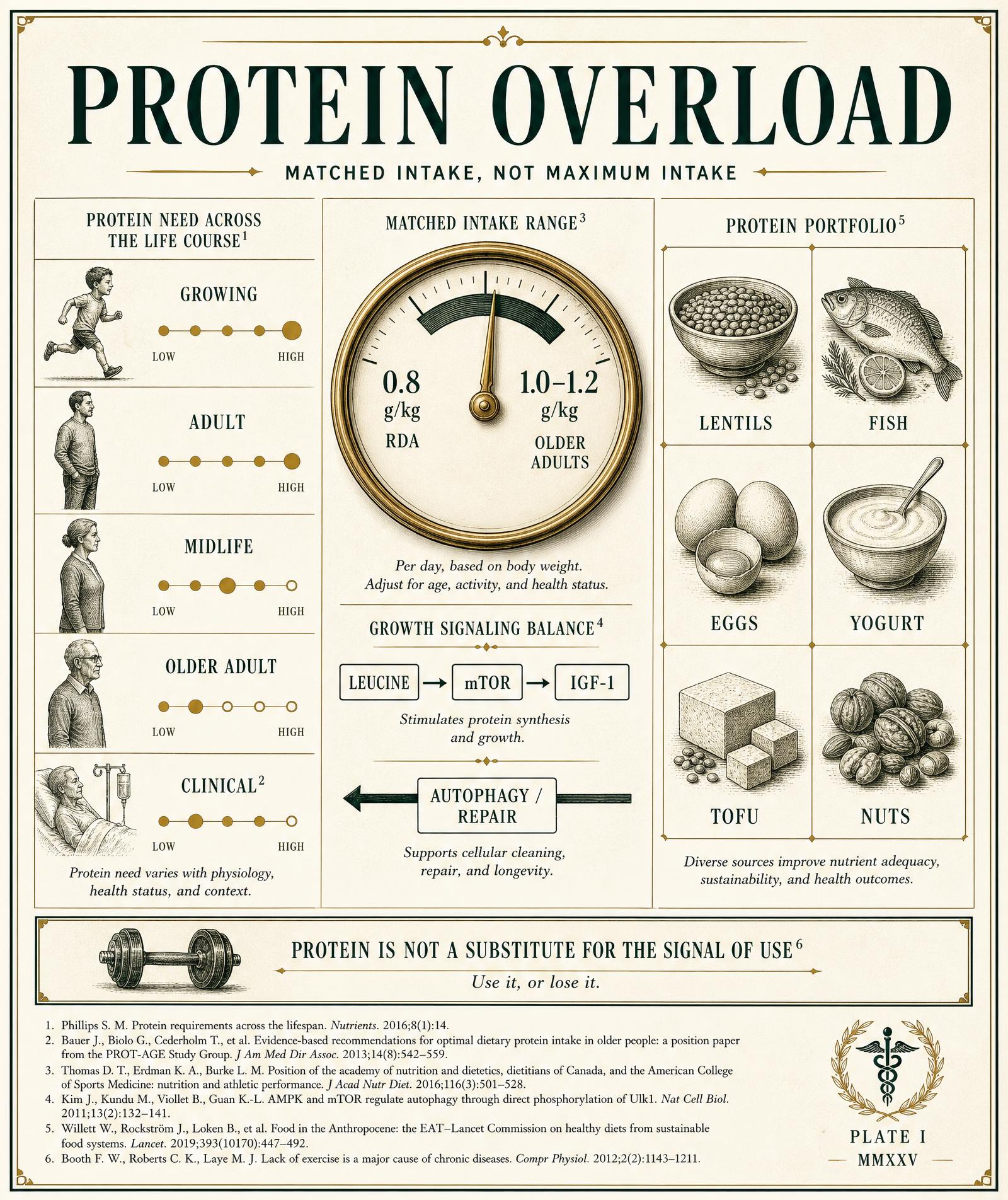
Protein is not a substitute for the signal of use.
Contents(17 sections)
Key takeaways
The adult RDA of 0.8 g/kg/day is designed to prevent deficiency, not to optimize strength or aging.
Many healthy older adults do better near 1.0–1.2 g/kg/day, and frailty, illness, or rehabilitation may justify more under clinical guidance.
Protein never arrives alone: lentils bring fiber, fish brings a different fat profile, yogurt brings a fermented food matrix, processed meat brings sodium and preservatives.
Cohort studies generally associate higher plant-protein intake with lower mortality and cardiovascular risk, particularly when plant protein replaces red meat.
A widely discussed analysis linked high protein intake in adults aged 50–65 with higher mortality — a warning against protein maximalism, not proof that protein causes disease.
Protein powder is a tool for a specific problem — low appetite, a calorie deficit, high training load, recovery — not a nutritional foundation.
Resistance training is what gives dietary amino acids a destination. Without it, extra grams have nowhere useful to go.
Kidney disease, unintentional weight loss, frailty, and complex illness all require individualized medical nutrition guidance rather than internet targets.
The Primer
Protein needs change with life stage
Different life contexts have genuinely different priorities:
| Life context | Main priority |
|---|---|
| Growing, pregnant, healing, or highly active | Sufficient nourishment, recovery, and repair |
| Healthy adult with ordinary activity | Adequate protein within an overall high-quality diet |
| Midlife with excess calories, inactivity, or metabolic risk | Food quality, strength training, plant diversity, and avoiding reflexive excess |
| Older adult | Preserving muscle, strength, recovery capacity, and independence |
| Kidney disease, frailty, unintentional weight loss, complex illness | Individualized clinical guidance |
The standard adult RDA is 0.8 g/kg/day, set to prevent deficiency rather than to optimize function. Many healthy older adults appear to benefit from roughly 1.0–1.2 g/kg/day when preserving muscle and independence is the priority. People with frailty, acute illness, or rehabilitation needs often require more, guided by a clinician.
Food source matters as much as grams
Protein does not arrive alone. Lentils bring fiber and potassium. Fish brings a different fat profile. Yogurt has a distinct fermented matrix. Processed meat brings sodium, preservatives, and a dietary pattern that behaves very differently from a legume- and vegetable-rich diet.
Large prospective cohorts generally associate higher plant-protein intake with lower all-cause mortality and cardiovascular risk, especially where plant protein replaces red meat or, in some analyses, eggs.
For most people, a varied mix of legumes, nuts, seeds, soy foods if desired, whole grains, fish, free-range eggs, cultured dairy, and poultry is more useful than building the whole diet around powders or large meat servings. Where eggs are part of the pattern, free-range or pasture-raised is the better default: the protein is identical, but the yolks carry more omega-3s, vitamin D, vitamin E, and carotenoids.
High protein is not automatically dangerous — or necessary
A research line associated higher protein intake in adults aged 50–65 with higher all-cause and cancer mortality across long follow-up, with the association weaker when protein came mainly from plants.
That is an important warning against protein maximalism. It does not prove that protein causes cancer. Observational data cannot fully separate protein intake from food source, total calories, smoking, activity, body weight, existing disease, and the wider dietary pattern.
The responsible reading is not "fear protein." It is: stop assuming bodybuilding-level targets are automatically appropriate in midlife, particularly when training, energy balance, and food quality do not support the goal.
Protein powder is a tool, not a foundation
A powder can genuinely help an athlete, an older adult with low appetite, someone recovering from illness, or a person in a calorie deficit trying to protect lean mass. It helps much less when it is added simply because more sounds better.
Before adding a shake, ask: what problem is this solving that a whole-food meal pattern is not?
The missing partner: resistance training
Protein does far more for muscle when muscle has a reason to adapt. Resistance training gives amino acids a meaningful destination — the repair and maintenance of tissue you actually use. Without that signal, grams are just calories with a nitrogen load.
The essential Vital Codex position
- Do not under-eat protein when muscle, recovery, or nutrition is at risk.
- Do not treat high protein as a universal health requirement.
- Match intake to life stage, activity, strength, appetite, energy balance, and medical context.
- Favor varied, minimally processed sources, including more plant protein.
- Use powder strategically rather than automatically.
- Protect muscle with regular resistance training appropriate to your ability.
Better matched is better — not simply more.
The Deep Dive
Protein is material and message
Calling protein "building material" is incomplete. Dietary amino acids are also information. They tell the body that nutrients are abundant and that growth, repair, and synthesis can proceed.
Leucine is a prominent trigger for muscle protein synthesis. Protein intake also interacts with insulin/IGF-1 signaling and mTOR-related nutrient sensing. These pathways are necessary — they support development, immune activity, wound healing, tissue renewal, and muscle preservation.
Tier II · Members only · Free
Continue into the deep dive
Tier I is free and always open. Tier II — the full mechanisms, dosing detail, nuance, and citations — unlocks with a free Vital Codex membership.
- Every Tier II deep dive across all hubs
- Saved reading progress across articles
- Member knowledge modules and their quizzes
- The Dispatch, if you opt in
Frequently asked
How much protein do I actually need per day?
The adult RDA is 0.8 grams per kilogram of body weight per day, which is the amount set to prevent deficiency in healthy adults. Many healthy older adults appear to do better at roughly 1.0–1.2 g/kg/day to preserve muscle and function, and athletes, people in a calorie deficit, and those recovering from illness may need more. There is no single optimal number that applies to everyone.
Is high protein bad for you?
High protein is not automatically harmful in healthy adults, and short-term trials have not shown consistent kidney damage. The evidence-based caution is narrower: in midlife, especially with excess calories, low activity, and heavy reliance on red or processed meat, habitually maximizing protein has not been shown to improve long-term health outcomes and has been associated in cohort data with higher mortality.
Does protein cause cancer?
No study has shown that dietary protein causes cancer. The frequently cited analysis found an association between high protein intake in adults aged 50–65 and higher cancer mortality, weaker when protein came from plants. Associations of this kind cannot separate protein from food source, total calories, body weight, smoking, and activity, so the result is a caution against protein maximalism rather than evidence of causation.
Is plant protein better than animal protein?
Population studies generally associate higher plant-protein intake with lower mortality and cardiovascular risk, particularly when plant protein replaces red meat. That likely reflects the whole package — more fiber, potassium, and magnesium, less processed meat — rather than the amino acids alone. Both categories vary enormously in quality, so the useful comparison is between specific foods, not between plant and animal as blocs.
Do I need protein powder?
Most people eating adequate whole-food meals do not. Powder is genuinely useful when it solves a defined problem: low appetite, a high training load, a calorie deficit where lean mass must be protected, or recovery from illness. If a shake is added only because more protein sounds better, a fiber-rich whole-food meal is usually the better choice.
Do older adults need more protein than younger adults?
Generally yes. Sarcopenia — the age-related loss of muscle mass, strength, and function — threatens independence, fall risk, and recovery, and the muscle-building response to a given dose of protein is blunted with age. Expert guidance commonly supports intakes above the RDA for healthy older adults, with total calories and resistance training mattering just as much as grams.
Is protein hard on the kidneys?
In healthy kidneys, higher protein raises filtration rate — an adaptation to a larger nitrogen load rather than demonstrated injury, and short-term trials have not shown consistent biochemical harm. In established kidney disease the calculus changes completely, and protein, phosphorus, potassium, and sodium should all be set with a nephrologist or renal dietitian.
Research Notes & Sources(expand)
Protein requirements across the lifespan and the basis of the 0.8 g/kg/day RDA; Institute of Medicine Dietary Reference Intakes for macronutrients.
Protein needs, sarcopenia, and function in older adults, including the PROT-AGE Study Group position paper (Bauer J et al., J Am Med Dir Assoc, 2013) and subsequent ESPEN guidance supporting 1.0–1.2 g/kg/day for healthy older adults.
Midlife protein intake, IGF-1, and mortality: Levine ME et al., Cell Metabolism, 2014 — higher protein intake in adults aged 50–65 associated with greater all-cause and cancer mortality, with attenuation for plant-derived protein.
Plant versus animal protein and mortality: Song M et al., JAMA Internal Medicine, 2016; Huang J et al., JAMA Internal Medicine, 2020; Naghshi S et al., BMJ, 2020 — substitution analyses favoring plant protein over red and processed meat.
Higher-protein diets and kidney outcomes in healthy adults, including systematic reviews of glomerular filtration rate responses (Devries MC et al., Journal of Nutrition, 2018) and clinical guidance for chronic kidney disease (KDIGO).
Protein and methionine restriction, mTOR/IGF-1 signaling, and lifespan in animal models; reviews of amino-acid-specific restriction and the translational limits of rodent lifespan data.
Resistance training as the determinant of protein utilization: Morton RW et al., British Journal of Sports Medicine, 2018 — meta-analysis of protein supplementation and resistance-training adaptations, with a plateau near 1.6 g/kg/day.
Continue exploring: The Vital Codex library on nutrition, muscle, and metabolic signaling.
Explore Nutrition