Protein is the only macronutrient currently enjoying a moral reputation. It is added to cereal, cookies, water, coffee creamer, and candy bars, and the addition is treated as self-evidently healthy. Meanwhile the actual measured problem — clinical protein deficiency in an adult eating enough calories in a developed country — is close to nonexistent. Physicians who have practised for decades, including those with substantial vegetarian and vegan caseloads, report never having diagnosed a case.
That does not make protein unimportant, and it does not make the higher targets used by strength athletes and older adults wrong. It means two separate questions have been collapsed into one. The first is how much protein does a body require — a question with reasonably firm answers. The second is what is the food supply doing with that question — a question with a commercial answer, not a physiological one. This piece separates them.
Protein deficiency is the rarest nutritional problem in the developed world and the most heavily marketed one.
Contents(17 sections)
Key takeaways
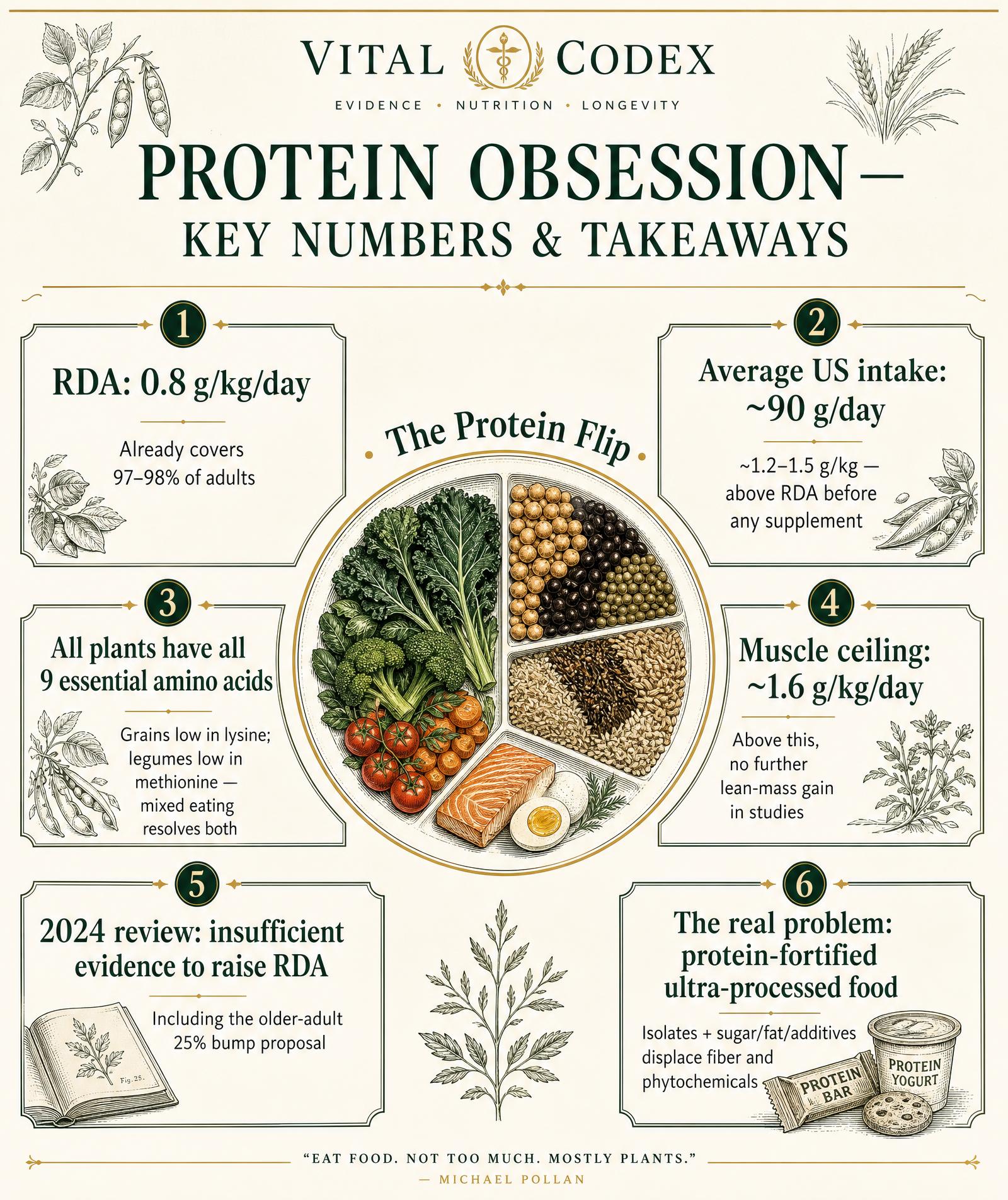
The adult RDA is 0.8 g/kg/day, and it is not an average requirement — it is already set roughly two standard deviations above the estimated average requirement, so meeting it covers about 97–98% of the population.
Average intake in the United States runs near 90 g/day, or roughly 1.2–1.5 g/kg for most adults — well above the RDA before any bar, shake, or fortified cereal is added.
Every plant food contains all nine essential amino acids. The proportional patterns of plant and animal foods are far more similar than the "incomplete protein" framing implies; grains are relatively lower in lysine, legumes relatively lower in methionine, and mixed eating resolves both.
Above roughly 1.6 g/kg/day, additional protein produces no further measurable gain in lean mass or strength — and trained people eating 2,500–3,000 kcal typically reach that from food alone.
A 2024 systematic review of protein and amino acid requirements found insufficient evidence to raise the recommendations, including for older adults, despite a widely repeated proposal to bump them 25%.
The defensible concern is not protein quantity. It is that protein has become the marketing vehicle for ultra-processed food: isolates that taste poor, corrected with sugar, fat, sweeteners, and novel additives, displacing fibre and phytochemicals.
The Primer
What the requirement number actually means
The adult Recommended Dietary Allowance for protein is 0.8 grams per kilogram of bodyweight per day. Almost every argument about protein starts by misreading that figure.
The RDA is not the average requirement. Nutrition science calculates an Estimated Average Requirement first — the intake that meets the needs of half the population — and then sets the RDA about two standard deviations higher. If everyone consumed exactly the RDA, roughly 97–98% of people would be met or exceeded. The safety buffer is already inside the number.
For a 70 kg adult, the RDA is about 56 g/day. National intake surveys put average American consumption near 90 g/day, and dietary recall tends to under-report. So the typical adult is not scraping a minimum; they are running about 50% above a figure that already includes a margin.
The "incomplete protein" myth
The most durable piece of nutrition folklore is that plant foods are missing essential amino acids and must be carefully combined at the same meal.
They are not missing. Rice, beans, broccoli, oats, potatoes — every one contains all twenty amino acids, including all nine essential ones. When you plot the proportions of essential amino acids in animal foods, the shape is remarkably consistent from chicken to fish to eggs. When you plot plant foods on the same axes, the shape is nearly the same curve.
There are two real differences, and both are proportional rather than absolute:
- Grains are relatively low in lysine.
- Legumes are relatively low in methionine — and methionine is such a small fraction of total amino acid requirement that the shortfall is hard to see on the graph at all.
Grains and legumes eaten across the same day cover each other. This is why every traditional cuisine on earth independently arrived at rice and beans, wheat and lentils, corn and pinto beans, or miso and rice. No same-meal timing rule is required; the amino acid pool in the body is not emptied between meals.
Protein is not stored
Fat has a storage depot. Carbohydrate has a small one in liver and muscle glycogen. Protein has neither. There is no protein reserve tank.
The functional consequence is that surplus dietary protein is not banked for later. Excess amino acids are deaminated, the nitrogen is excreted as urea, and the carbon skeleton is used for energy or converted to fat. The popular claim that you "simply pee out" excess protein is a distortion — you excrete the nitrogen, not the calories. A 300-calorie protein bar is 300 calories whether or not you needed the protein in it.
This matters for the central irony of the protein boom: protein is genuinely satiating per gram, but protein-fortified snack foods are engineered to be palatable, and palatable food is easy to add on top of a diet rather than substitute into it.
Where the extra grams come from now
Look at the ingredient list of a high-protein bar or cereal and the pattern is consistent: protein isolates first, then the correction layer. Isolates — pea protein isolate, milk protein isolate, whey concentrate, collagen — do not taste like food, because they are not food. To make them palatable, manufacturers add sugars, sugar alcohols, rare sugars, starches, fats, flavourings, and increasingly novel engineered ingredients.
Two things get lost in that translation. The first is fibre. The second is the enormous class of plant compounds — polyphenols, carotenoids, glucosinolates, and hundreds of others — for which no RDA exists because the dose-response work has never been done, but which travel with whole plant foods and not with isolates.
This is the same structural mistake as the 1980s–90s low-fat era. Fat was removed, palatability collapsed, sugar filled the gap, and the resulting food was worse than what it replaced. The nutrient of concern changed; the mechanism did not.
Where higher protein genuinely helps
None of the above argues for eating less protein. There are real situations where higher intakes are justified:
- Resistance training with the goal of adding lean mass. Roughly 1.6 g/kg/day is the point past which studies stop finding additional benefit.
- Older adults with sarcopenia risk, where anabolic resistance means a larger per-meal dose is needed to trigger muscle protein synthesis — see Protein, Leucine, and the Anabolic Threshold After 40 and Muscle Optimization After 60.
- Deliberate weight loss, where higher protein preserves lean mass during a calorie deficit.
- Illness recovery, surgery, burns, and hospitalisation, where requirements genuinely rise.
The honest framing is that these are higher targets from food, not arguments for supplementation. An athlete eating 3,000 kcal reaches 1.6 g/kg without a single scoop of powder.
The practical version
- Anchor meals on real protein foods: legumes, fish, free-range eggs, plain yoghurt, tofu and tempeh, poultry, nuts and seeds. Free-range eggs are worth specifying — pasture access measurably improves the omega-3, vitamin D, vitamin E, and carotenoid content of the yolk relative to caged production, and the protein is identical either way, so the pasture version is a free upgrade.
- If you are older or training hard, concentrate protein into 30–40 g doses at two or three meals rather than grazing.
- Treat bars and powders as convenience, not nutrition. Read the list; if isolates come before recognisable foods, price it as a snack.
- Fill the rest of the plate the way every country that has successfully bent its obesity curve teaches its children to: half fruit and vegetables, whole grains, legumes, olive oil, and animal foods in supporting roles.
The Deep Dive
The requirement literature, in detail
Protein requirements were historically established by nitrogen balance studies — measuring nitrogen in versus nitrogen out and finding the intake at which an adult neither gains nor loses body nitrogen. The method has known limitations: it tends to underestimate requirement at low intakes and overestimate adaptation, and it says nothing about functional outcomes such as strength or immune competence.
The Indicator Amino Acid Oxidation (IAAO) method, developed later, produces somewhat higher estimates — typically around 0.9–1.0 g/kg/day for the population-safe intake in healthy adults, compared with the nitrogen-balance-derived 0.8. This is the strongest technical argument for a modest upward revision, and it is the argument the higher-protein position ought to be making rather than the "the RDA is a joke" framing that circulates online.
Tier II · Members only · Free
Continue into the deep dive
Tier I is free and always open. Tier II — the full mechanisms, dosing detail, nuance, and citations — unlocks with a free Vital Codex membership.
- Every Tier II deep dive across all hubs
- Saved reading progress across articles
- Member knowledge modules and their quizzes
- The Dispatch, if you opt in
Frequently asked
How much protein do I actually need per day?
The adult RDA is 0.8 g per kg of bodyweight, which already includes a safety margin covering about 97–98% of the population. For a 70 kg adult that is roughly 56 g. If you strength train, are over 60, are losing weight deliberately, or are recovering from illness, a target of 1.2–1.6 g/kg is reasonable. Above 1.6 g/kg there is no measured additional benefit for lean mass or strength.
Are plant proteins incomplete?
No. Every plant food contains all nine essential amino acids. Grains are proportionally lower in lysine and legumes proportionally lower in methionine, and eating both across a day resolves it. Same-meal "protein combining" is unnecessary. The legitimate refinement is digestibility: plant protein is somewhat less digestible, so a plant-based diet benefits from a modestly higher total intake, and from soaking, sprouting, or fermenting.
Do I need a protein powder or protein bar?
Almost certainly not for adequacy. Average intakes already exceed the RDA by roughly 50% before supplements. Powders and bars are convenience products; their nutritional cost is that they deliver isolates plus a palatability correction layer of sugars, sweeteners, starches, and fats, while contributing no fibre or phytochemicals. If one solves a genuine logistical problem — a frail older adult who cannot eat enough volume, or a training day with no meal window — use it deliberately rather than habitually.
Does excess protein just get excreted?
Only the nitrogen does. Surplus amino acids are deaminated, the nitrogen leaves as urea, and the remaining carbon is oxidised for energy or stored as fat. There is no protein storage depot in the body. A high-protein snack still contributes its full calorie load, which is the central reason protein fortification can coexist with weight gain.
Is more protein better for preventing muscle loss with age?
Higher per-meal doses do help, because aging muscle shows anabolic resistance and needs a larger stimulus — roughly 30–40 g of quality protein per meal. But the 2024 requirement review found insufficient evidence to formally raise the older-adult recommendation, and sarcopenia is multifactorial: hormonal change, dentition, appetite, depression, isolation, and above all inactivity. Protein without resistance training does very little.
Should protein come from animal or plant sources?
For muscle-building outcomes at adequate intake, matched-protein trials increasingly show no meaningful difference. For cardiometabolic and longevity endpoints, the observational and trial evidence favours shifting the portfolio toward plant protein — legumes, nuts, whole grains — without necessarily eliminating animal foods. The "protein flip," where plants occupy the centre of the plate and animal protein a supporting role, captures the practical version.
Why do eggs need to be free-range?
The protein is identical, but the rest of the yolk is not. Pasture access consistently raises omega-3 fatty acids, vitamin D, vitamin E, and carotenoids such as lutein and zeaxanthin relative to caged production. Since you are eating the egg for more than its amino acids, the pasture version delivers a better nutrient package at the same protein cost.
Is high protein intake bad for the kidneys?
In people with normal kidney function, sustained intakes in the 1.2–2.0 g/kg range have not been shown to cause kidney disease. In people with existing chronic kidney disease, protein load is a genuine clinical variable and intake should be set with a nephrologist. The distinction between "harmful to damaged kidneys" and "causes kidney damage" is where most of the confusion on this question lives.
Continue exploring: Nutrition — Protein sufficiency, micronutrient density, and food quality.
Explore Nutrition