The protein requirement that keeps a 25-year-old in balance does not keep a 55-year-old in balance. Aging muscle responds less to the same dose — a phenomenon called anabolic resistance — and the correction is not simply eating more total protein. It is reaching a per-meal threshold, often enough, alongside a training stimulus that makes the tissue receptive.
Contents(13 sections)
Key takeaways
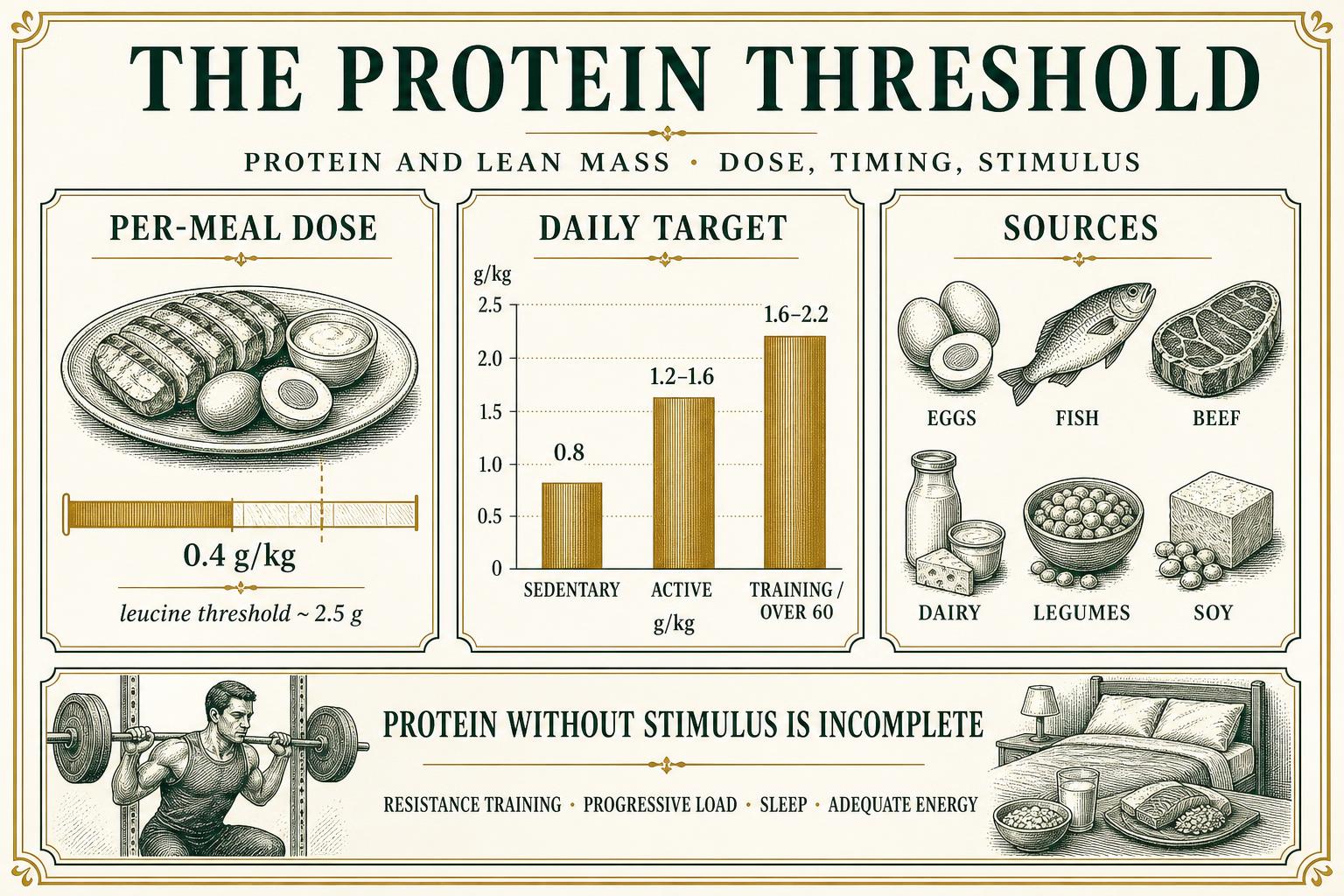
Target 1.2–1.6 g protein per kg bodyweight daily after 40; higher during weight loss or illness recovery.
Per-meal dose matters more than daily total: roughly 30–40 g of high-quality protein, or 2.5–3 g leucine, per meal.
Leucine is the primary trigger for muscle protein synthesis via mTORC1; the threshold rises with age.
Protein without resistance training produces a fraction of the benefit. The two are multiplicative.
The Primer
Why the requirement changes
Muscle is constantly being broken down and rebuilt. After a protein-containing meal, synthesis briefly exceeds breakdown, and that surplus is what maintains or builds tissue. With age, the size of that response to a given meal shrinks — the same 20 g of protein that produced a full response at 25 produces a partial one at 60.
The fix is a larger per-meal dose, not just a larger daily total. Spreading 100 g of protein across four meals of 25 g works less well after 50 than three meals of 35 g.
What a good day looks like
For a 75 kg adult, 1.2–1.6 g/kg means roughly 90–120 g daily. Anchoring three meals at 30–40 g each gets there without effort: free-range eggs and Greek yogurt at breakfast, fish or poultry at lunch, meat, legumes, or a whey shake at dinner.
Animal proteins, dairy, and whey reach the leucine threshold at smaller portion sizes. Plant proteins work but require larger servings or blending sources.
Protein alone is not enough
Protein supplies the material. Resistance training supplies the signal. Without training, extra protein largely gets oxidized; without protein, training produces a stimulus the body cannot fully act on. Two to three sessions a week is the practical minimum.
The Deep Dive
The leucine trigger and mTORC1
Muscle protein synthesis is initiated when leucine concentration rises sufficiently to activate mTORC1 via Sestrin2 and the Rag GTPase complex, driving phosphorylation of S6K1 and 4E-BP1 and increasing translation initiation. Leucine functions as the signal; the remaining essential amino acids serve as substrate. Both are required — leucine alone produces a transient signal without sustained synthesis.
Young muscle reaches maximal fractional synthetic rate at roughly 20–25 g of high-quality protein (~1.7–2 g leucine). Older muscle requires roughly 35–40 g (~2.5–3 g leucine) to reach the same peak, and the response is somewhat blunted even then.
Tier II · Members only · Free
Continue into the deep dive
Tier I is free and always open. Tier II — the full mechanisms, dosing detail, nuance, and citations — unlocks with a free Vital Codex membership.
- Every Tier II deep dive across all hubs
- Saved reading progress across articles
- Member knowledge modules and their quizzes
- The Dispatch, if you opt in
Frequently asked
Is there a maximum protein the body can use per meal?
For muscle protein synthesis specifically the response plateaus around 35–40 g in older adults. Protein beyond that is still used for other purposes; it just does not add to that meal's synthetic response.
Do I need protein powder?
No, but it is the easiest way to hit a per-meal threshold when appetite is low. Whey isolate and casein are the two most useful.
Does plant protein work?
Yes, with larger portions or blended sources to reach the leucine threshold. Soy and pea isolates are the most favorable single plant options.
Is high protein hard on the kidneys?
Not in people with normal kidney function, based on controlled trials up to 2 g/kg. Existing kidney disease is a different situation and needs clinical input.
Continue exploring: Muscle & Aging — Hypertrophy, sarcopenia prevention, and structural health.
Explore Muscle & Aging