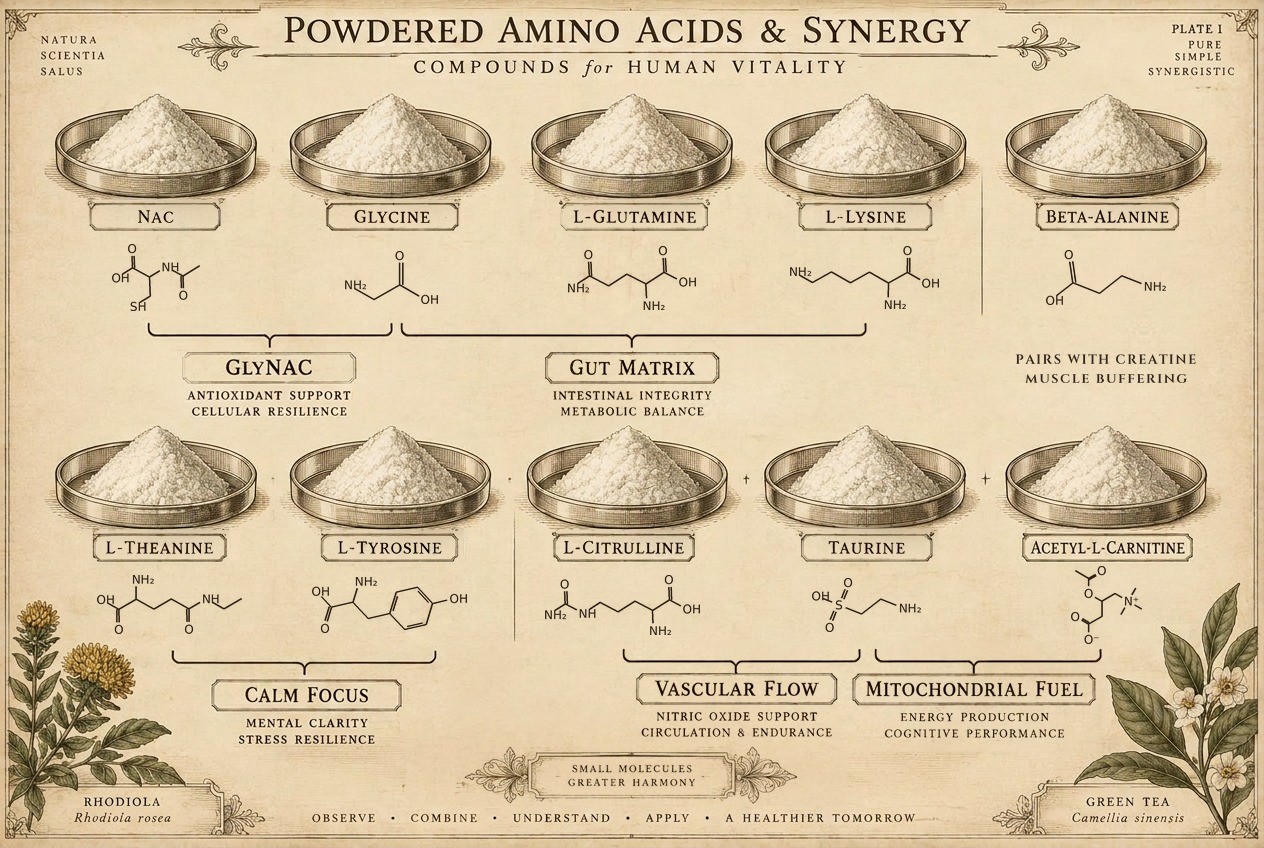
Free-form amino acids are single amino acids taken in isolation rather than bound inside food protein. Taken as powders, they reach the gram-level doses used in human research — 3 to 10 g at a time — without capsule shells, flow agents or binders, and they are absorbed quickly through dedicated transporters in the small intestine. Each of the ten covered here has a distinct job: building glutathione, fueling the gut lining, raising nitric oxide, buffering muscle acid, steadying brain chemistry, or carrying fat into mitochondria. Their real power shows in pairs.
Contents(20 sections)
Key takeaways
Glycine + NAC (GlyNAC) supplies the two building blocks that limit glutathione synthesis; in older adults, a 16-week trial raised glutathione and improved mitochondrial fat oxidation, insulin resistance and oxidative stress markers.
Taurine regulates cell volume, calcium handling and mitochondrial protein synthesis; a 2023 Science study linked falling taurine to aging across species.
L-glutamine is the preferred fuel of gut-lining cells and supports the tight junctions that seal the intestinal barrier.
L-citrulline raises blood arginine — and nitric oxide — more reliably than arginine itself, because it bypasses breakdown in the gut and liver.
Beta-alanine builds muscle carnosine, an internal acid buffer; the harmless tingling it causes is a sensory-receptor effect.
L-theanine + L-tyrosine pair calm with drive: theanine smooths stress arousal, tyrosine refills dopamine and noradrenaline under heavy load.
Acetyl-L-carnitine ferries fatty acids into mitochondria and donates acetyl groups for acetylcholine.
Powders permit therapeutic doses without fillers; interactions with nitrates, MAO inhibitors, levodopa, thyroid medication and blood-pressure drugs need attention.
The Primer
Why powder rather than capsules
A standard capsule holds 500–750 mg. A 5 g dose of glycine or glutamine would take seven to ten capsules, plus the magnesium stearate, silicon dioxide and shell material that come with them. Powders dissolve in water, mix into each other, and let you build a pairing in a single glass. Most are inexpensive per gram, and several — glycine, theanine, citrulline — taste mild or faintly sweet.
Free-form aminos also behave differently from food protein. A meal releases its amino acids slowly over hours; a dissolved free amino acid reaches blood within 30–60 minutes. That speed is useful when timing matters — glycine before sleep, citrulline before exercise, tyrosine before demanding work.
The ten powders at a glance
| Amino acid | Primary roles | Doses used in human studies |
|---|---|---|
| Glycine | Glutathione, collagen, calming neurotransmitter, sleep | 3 g at night; 1.3–7 g/day in GlyNAC work |
| NAC | Cysteine donor for glutathione, mucus thinning, glutamate balance | 600–1,800 mg/day |
| Taurine | Cell volume, calcium, bile, mitochondria, heart | 1–6 g/day |
| L-glutamine | Gut-lining fuel, tight junctions, immune cell fuel | 5–15 g/day |
| L-lysine | Collagen cross-linking, calcium absorption, arginine balance | 1–3 g/day |
| L-citrulline | Nitric oxide, blood flow, ammonia clearance | 3–6 g/day |
| Beta-alanine | Muscle carnosine, acid buffering | 3.2–6.4 g/day in split doses |
| L-theanine | Calm alertness, alpha brain rhythm | 100–400 mg |
| L-tyrosine | Dopamine, noradrenaline, thyroid hormone | 500 mg–2 g before stress |
| Acetyl-L-carnitine | Fat transport into mitochondria, acetylcholine | 1–3 g/day |
Glycine — the quiet multitasker
Glycine is the smallest amino acid and one of the most used. It makes up roughly every third position in collagen, forms one-third of glutathione, and acts as a calming neurotransmitter in the brainstem and spinal cord. Taken before bed, 3 g lowers core body temperature by widening blood vessels in the hands and feet, which helps the body enter deep sleep; Japanese trials reported better sleep quality and less next-day fatigue. Glycine also mops up excess methionine through the enzyme glycine N-methyltransferase, a methyl-balancing role relevant to diets heavy in muscle meat.
NAC — the glutathione gatekeeper
N-acetylcysteine supplies cysteine, the scarcest of glutathione's three building blocks. It thins mucus by breaking the sulfur bonds that hold mucus proteins together, which is why it has long been used in lung conditions. In the brain, NAC drives an exchanger (system xc⁻) that regulates glutamate outside nerve cells — the basis of research in compulsive behaviors, cravings and mood.
Taurine — the cell's volume and calcium manager
Taurine is technically an amino sulfonic acid and is not built into proteins, yet it is among the most abundant free amino acids in heart, muscle, retina and brain. It keeps cell volume steady, moderates calcium flow, conjugates bile acids for fat digestion, and modifies a mitochondrial transfer RNA needed to build respiratory proteins. In 2023, Singh and colleagues showed that blood taurine falls with age and that supplementing it extended healthy lifespan in mice and worms and improved health markers in middle-aged monkeys.
L-glutamine — fuel for the gut wall
The cells lining the small intestine burn glutamine as a preferred fuel. Glutamine supports the tight-junction proteins (occludin, claudins, ZO-1) that keep the barrier sealed, and it feeds rapidly dividing immune cells. In a randomized trial in people with post-infectious irritable bowel syndrome and increased permeability, 15 g/day for eight weeks reduced symptoms and normalized permeability markers.
L-lysine — collagen's cross-linker
Lysine is essential — you must eat it. Lysyl oxidase, a copper-dependent enzyme, links lysine residues to lock collagen and elastin fibers together; vitamin C is needed to hydroxylate them first. Lysine also improves intestinal calcium absorption and competes with arginine, a balance long used by people managing recurring cold sores.
L-citrulline — the nitric oxide booster
Arginine taken by mouth is largely broken down in the gut and liver before it reaches blood vessels. Citrulline slips past that breakdown, is converted to arginine in the kidneys, and raises plasma arginine more effectively than arginine itself. The result is more substrate for endothelial nitric oxide synthase — wider vessels, better tissue oxygen delivery, and in studies, modest drops in blood pressure and better exercise tolerance. Citrulline also helps the urea cycle clear ammonia produced during hard exercise.
Beta-alanine — the muscle buffer
Beta-alanine combines with histidine to form carnosine inside muscle. Carnosine soaks up hydrogen ions during intense effort, delaying the burn that ends a hard set or sprint. Four weeks of 4–6 g/day raises muscle carnosine by roughly 40–60%. It also quenches reactive aldehydes and slows the formation of advanced glycation end-products. The tingling some people feel is a harmless activation of a skin sensory receptor (MrgprD); splitting the dose prevents it.
L-theanine — calm without sedation
Theanine, the amino acid of tea leaves, crosses into the brain within an hour, increases alpha rhythms (8–12 Hz) associated with relaxed attention, and dampens stress-driven heart-rate and cortisol responses. Paired with caffeine, it keeps focus while trimming jitteriness.
L-tyrosine — reserve fuel for drive
Tyrosine is the raw material for dopamine, noradrenaline and adrenaline, and for thyroid hormones. Under acute demand — sleep loss, cold, multitasking, high-pressure work — catecholamines can run low; trials show tyrosine preserves working memory and mental flexibility in those conditions. It does little in the well-rested, unstressed brain.
Acetyl-L-carnitine — the mitochondrial shuttle
Carnitine carries long-chain fatty acids across the inner mitochondrial membrane through the CPT-1 system so they can be burned for energy. The acetyl form crosses into the brain and donates its acetyl group to acetylcholine synthesis. Human research covers fatigue in older adults, diabetic neuropathy and mild cognitive decline.
The Deep Dive
Five synergy stacks
1. GlyNAC — redox and mitochondrial renewal. Glutathione synthesis is limited by both cysteine and glycine in older adults. Sekhar's group at Baylor gave combined glycine and NAC (about 100 mg/kg glycine and 133 mg/kg cysteine equivalents per day) and reported, in a 16-week randomized placebo-controlled trial, restored red-cell glutathione, lower oxidative stress, improved mitochondrial fat oxidation, better insulin sensitivity, lower inflammation, and gains in gait speed and strength. Supplementing either alone did not reproduce the effect — the pair is the point.
2. Gut matrix — glutamine + glycine + lysine. Glutamine fuels the enterocyte and tightens junctions; glycine calms intestinal macrophage inflammation and feeds collagen in the gut's supporting matrix; lysine with vitamin C and copper completes the cross-links. This trio mirrors the composition of bone broth, concentrated.
Tier II · Members only · Free
Join Vital Codex free
Unlock every Tier II deep dive, save your reading, and open the member knowledge modules. Free, no card, no paywall.
The Dispatch is a separate weekly email. Your membership works with or without it.
Frequently asked
Are powdered amino acids better than capsules?
For doses above about 1 g, yes in practice: powders reach study doses without fillers or a handful of capsules, and they dissolve quickly. Low-dose aminos such as theanine work fine in either form.
Can I mix several amino acid powders together?
Yes. Many combinations are complementary, such as glycine with NAC or citrulline with taurine. Keep tyrosine separate from protein meals, since it competes with other amino acids for entry into the brain.
What is GlyNAC?
GlyNAC is the combination of glycine and N-acetylcysteine. It supplies both building blocks that limit glutathione production in older adults, and a 16-week randomized trial reported improvements in glutathione, oxidative stress, mitochondrial function and insulin sensitivity.
Is citrulline better than arginine for nitric oxide?
Usually. Oral arginine is heavily broken down in the gut and liver, while citrulline bypasses that step and raises blood arginine more effectively.
Why does beta-alanine make my skin tingle?
It activates a skin sensory receptor called MrgprD. The tingling is harmless and fades within an hour; smaller, split doses or sustained-release forms prevent it.
Continue exploring: Muscle & Aging — Hypertrophy, sarcopenia prevention, and structural health.
Explore Muscle & AgingThe Codex Dispatch
More on Muscle & Aging, one email a week
One considered email each Sunday: research translation, no hype, no supplement pitches. Separate from membership — unsubscribe anytime.