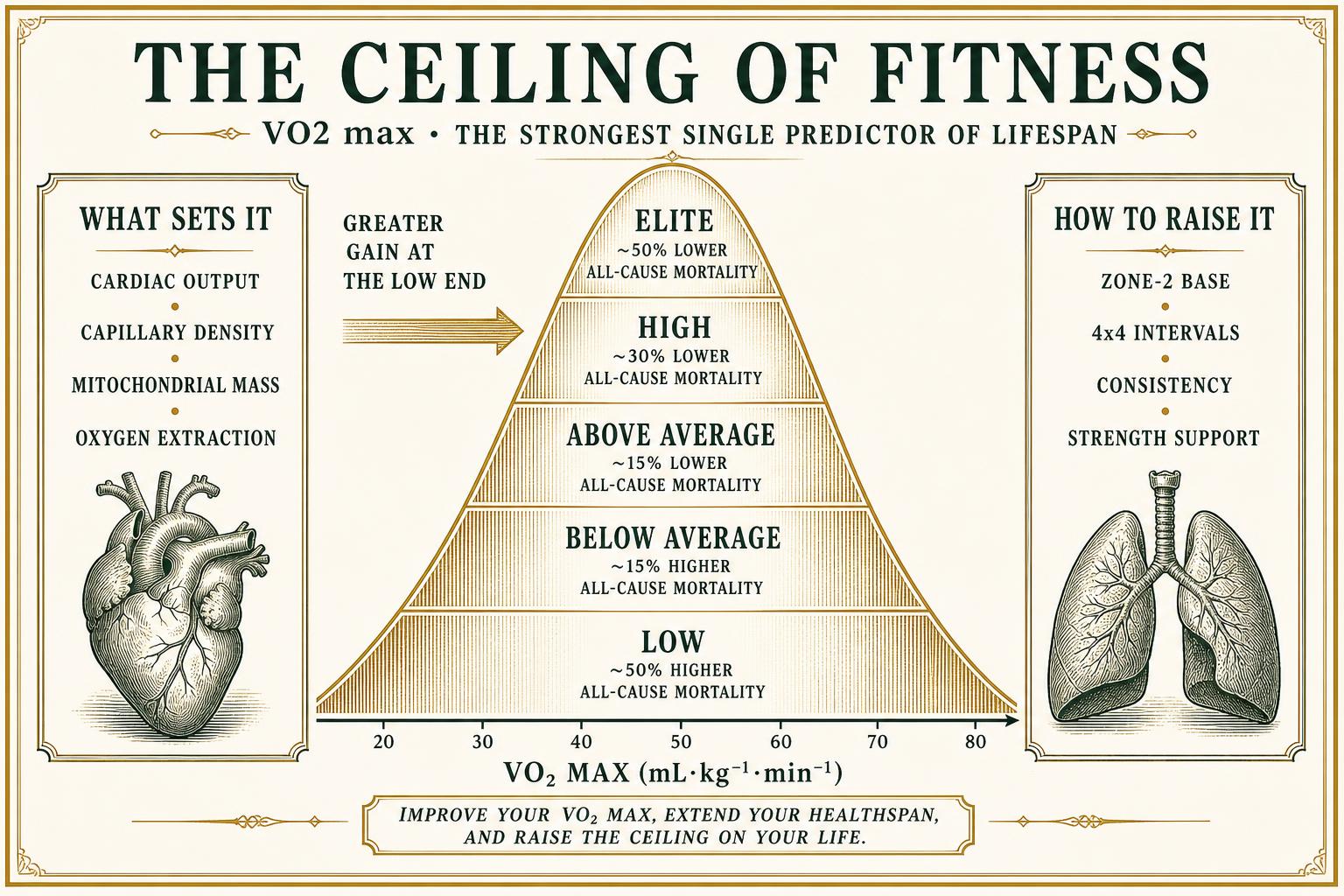
Of all the modifiable variables studied in long-term cohort research, cardiorespiratory fitness — measured as VO₂ max — carries the strongest association with all-cause mortality. In the Cleveland Clinic's analysis of more than 120,000 treadmill tests, moving from the bottom fitness quartile to merely above average was associated with a larger reduction in mortality risk than eliminating smoking, coronary artery disease, or type 2 diabetes.
The distinctive feature is that it is trainable. Most risk factors are things to avoid; this is a capacity to build.
Contents(13 sections)
Key takeaways
VO₂ max is the maximum rate of oxygen the body can take in, transport, and use during intense exercise, expressed in mL/kg/min.
Low fitness carries mortality risk comparable to or exceeding smoking in large cohort analyses.
The largest survival gains come from moving out of the lowest fitness quintile, not from reaching elite values.
The effective training structure is a base of low-intensity aerobic volume plus a small dose of near-maximal intervals.
VO₂ max declines roughly 10% per decade after 30, and about half of that decline is attributable to inactivity rather than aging.
The Primer
What the number means
VO₂ max reflects the whole oxygen chain working together: lungs bringing oxygen in, heart pumping blood, hemoglobin carrying oxygen, capillaries delivering it, and mitochondria consuming it. Because it integrates so many systems, it functions as a summary measure of physiological reserve.
Practical reference points: below about 18 mL/kg/min in older adults approaches the threshold where independent living becomes difficult. Average midlife values sit around 30–40. Trained recreational athletes reach 45–60.
Why reserve matters more than performance
The reason fitness predicts survival is not athletic capability. It is margin. Illness, surgery, injury, and hospitalization all impose an acute metabolic demand. Someone operating near their ceiling in daily life has nothing to draw on; someone with substantial reserve absorbs the hit and recovers.
The training that raises it
Two components, in this proportion: roughly 80% of weekly aerobic time at an easy, conversational intensity — enough volume to build capillary density and mitochondrial mass — and roughly 20% at hard intervals near maximum effort, which drives the cardiac output side of the equation.
For most people that looks like three to four easy sessions of 45–60 minutes plus one interval session per week. Adding a hard session to no aerobic base produces much less than adding base to hard sessions.
Where to start if fitness is low
Walking, daily, uphill if available. The gains from the bottom quintile upward are the largest in the entire dose-response curve, and they do not require a gym, a heart-rate strap, or an interval protocol.
The Deep Dive
The mortality data
The Cleveland Clinic cohort (Mandsager et al., JAMA Network Open, 2018) followed 122,007 patients after treadmill testing and found an inverse, graded relationship between cardiorespiratory fitness and all-cause mortality with no observed upper threshold of benefit — elite performers had lower mortality than high performers. The adjusted hazard ratio comparing the lowest fitness quintile to the elite group approached 5.
Comparative framing: in that analysis and similar cohorts, the mortality risk attributable to being in the least-fit quintile exceeded the risk attributable to smoking, hypertension, diabetes, and coronary artery disease individually. The steepest portion of the survival curve lies between the lowest and second-lowest quintiles, which is where the returns on training are largest and the required work is smallest.
Tier II · Members only · Free
Continue into the deep dive
Tier I is free and always open. Tier II — the full mechanisms, dosing detail, nuance, and citations — unlocks with a free Vital Codex membership.
- Every Tier II deep dive across all hubs
- Saved reading progress across articles
- Member knowledge modules and their quizzes
- The Dispatch, if you opt in
Frequently asked
How fast can VO₂ max improve?
Untrained individuals commonly gain 10–20% within eight to twelve weeks of structured training. Gains slow substantially after the first year, and trained athletes may improve performance without improving VO₂ max further.
Do I need intervals, or is walking enough?
Walking is enough to move out of the highest-risk fitness category, which is where most of the survival benefit sits. Intervals are what raise the ceiling beyond that.
Is a wearable VO₂ max estimate trustworthy?
Not as an absolute number — individual error is often 10–15%. It is useful for tracking whether your own value is rising or falling over months.
Does strength training raise VO₂ max?
Minimally on its own, but it supports it indirectly by preserving lean mass, which is part of the denominator and the oxygen-consuming tissue. The two are complementary, not interchangeable.
Continue exploring: Muscle & Aging — Hypertrophy, sarcopenia prevention, and structural health.
Explore Muscle & Aging