Anti-nutrients are plant compounds that reduce the absorption of minerals or, in the case of oxalates, can crystallize in tissue. The relevant question is almost never whether a food contains them, but how much a person consumes daily, how well their kidneys and gut are functioning, and whether the food was soaked, boiled, fermented, or eaten raw.
For most people eating a varied diet with adequate calcium and fluid, anti-nutrients are a non-issue. The exceptions are specific and identifiable: high-oxalate daily habits (spinach smoothies, almond flour, large tea intake), reduced kidney function, fat malabsorption, and very low calcium intake.
Contents(11 sections)
Key takeaways
Oxalates are the one class with a well-documented clinical endpoint: calcium oxalate kidney stones, which account for roughly 70–80% of stones.
Spinach, Swiss chard, beet greens, and rhubarb are the highest-oxalate vegetables; almonds, cocoa, buckwheat, and black tea are the highest non-vegetable contributors.
Eating calcium with high-oxalate meals lowers urinary oxalate by binding it in the gut — restricting calcium raises stone risk rather than lowering it.
Phytates, lectins, and goitrogens are largely managed by ordinary cooking, soaking, sprouting, and fermenting.
Rotation and preparation solve the practical problem; blanket elimination of vegetables does not improve outcomes.
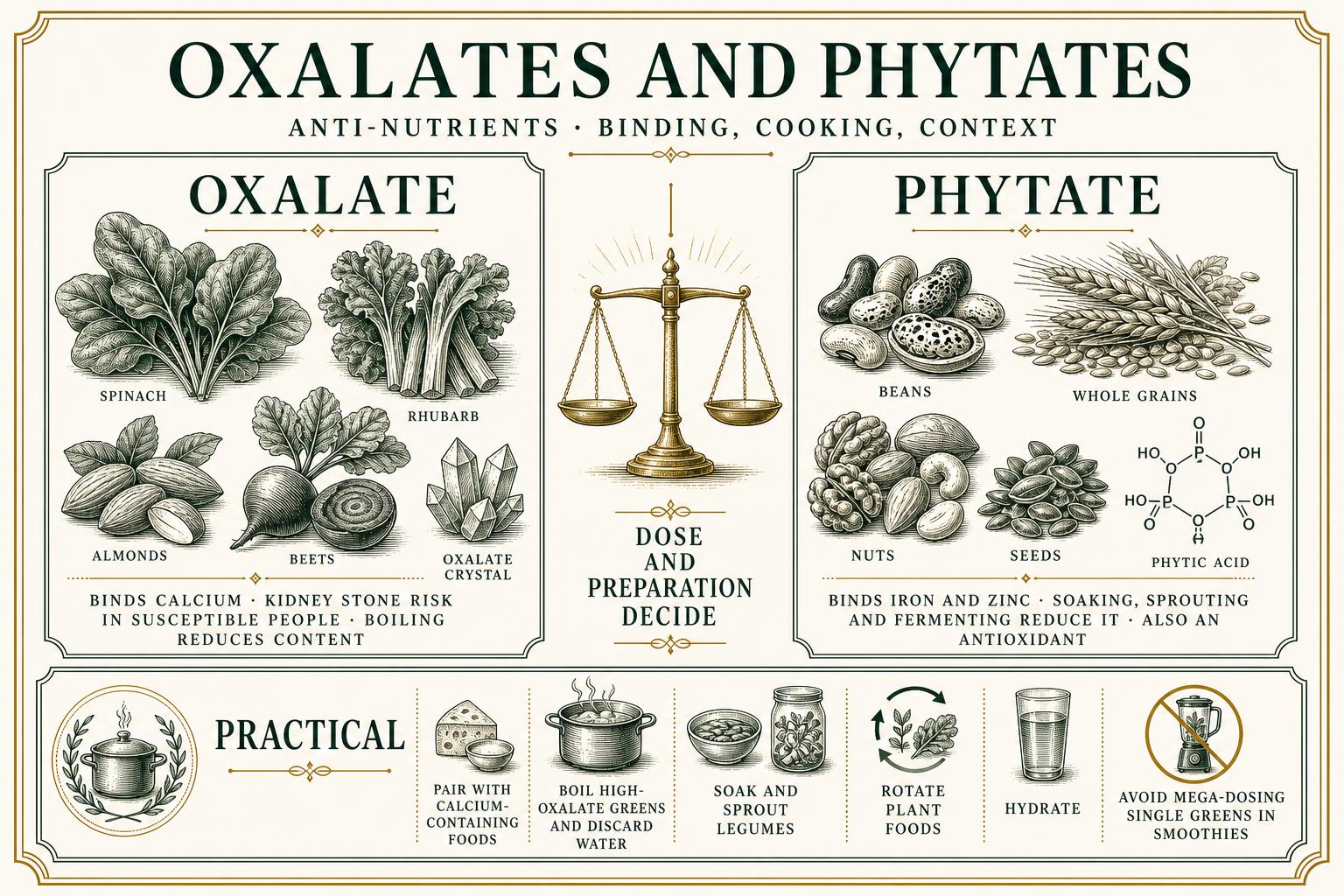
The Primer
What anti-nutrients are
Plants produce compounds that store minerals, deter pests, and manage their own chemistry. Several of these interact with human digestion:
- Oxalates bind calcium and other minerals and can form crystals.
- Phytates (phytic acid) reduce absorption of iron, zinc, and calcium.
- Lectins can irritate the gut lining when legumes are undercooked.
- Tannins lower non-heme iron absorption.
- Goitrogens in brassicas can mildly stress thyroid function when iodine intake is very low.
Most of these compounds also have measurable benefits — phytate is an antioxidant and mineral chelator studied in colon cancer prevention, and tannins are polyphenols. The framing that works is dose and preparation, not good versus bad.
Where the oxalate load actually comes from
Think in tiers rather than numbers. Very high: spinach, Swiss chard, beet greens, rhubarb. High: almonds, cashews, peanuts, chia, sesame, buckwheat, wheat bran, sweet potato, beets, cocoa, and black tea consumed by the pot. Lower-oxalate substitutions include romaine, cabbage, arugula, butter lettuce, bananas, strawberries, pecans, and hemp seeds.
The pattern that creates problems is repetition: the same three high-oxalate foods every day, often in raw or blended form, in someone who drinks little water.
The simple risk-reduction set
Rotate greens instead of defaulting to spinach. Boil high-oxalate greens and discard the water — boiling can remove 30–60% of soluble oxalate, while steaming removes considerably less. Soak and cook legumes and grains thoroughly. Pair high-oxalate foods with a calcium source in the same meal. Drink enough fluid that urine stays pale.
The Deep Dive
Why calcium timing matters more than oxalate avoidance
Dietary oxalate becomes a clinical problem only when it reaches the kidney. Calcium consumed in the same meal binds oxalate in the intestinal lumen, forming an insoluble complex that leaves in stool rather than urine. This is why low-calcium diets were shown to increase stone recurrence, while normal-calcium, lower-sodium, lower-animal-protein diets reduced it in randomized comparison (Borghi et al., NEJM, 2002).
The practical implication is counterintuitive: someone with a stone history is usually better served by keeping calcium at 1,000–1,200 mg per day from food and moving it into the same meals as oxalate-containing plants, rather than eliminating both.
Tier II · Members only · Free
Continue into the deep dive
Tier I is free and always open. Tier II — the full mechanisms, dosing detail, nuance, and citations — unlocks with a free Vital Codex membership.
- Every Tier II deep dive across all hubs
- Saved reading progress across articles
- Member knowledge modules and their quizzes
- The Dispatch, if you opt in
Frequently asked
Do I need to stop eating spinach?
No. Rotate it with lower-oxalate greens, favor cooked over raw and blended forms, and pair it with a calcium source. Daily large-volume raw spinach is the specific habit worth changing.
Does boiling really remove oxalate?
Boiling removes a meaningful share of soluble oxalate into the cooking water, which should be discarded. Steaming and sautéing remove far less because there is no water to leach into.
Should I take calcium supplements to block oxalate?
Food calcium eaten with the meal is the better-supported approach. Calcium supplements taken away from meals have been associated with higher stone risk, not lower.
Are phytates a reason to avoid whole grains and beans?
For anyone eating a mixed diet, no. Soak, sprout, ferment, or simply cook them well, and the mineral cost becomes small relative to the fiber and micronutrient gain.
Continue exploring: Nutrition — Protein sufficiency, micronutrient density, and food quality.
Explore Nutrition