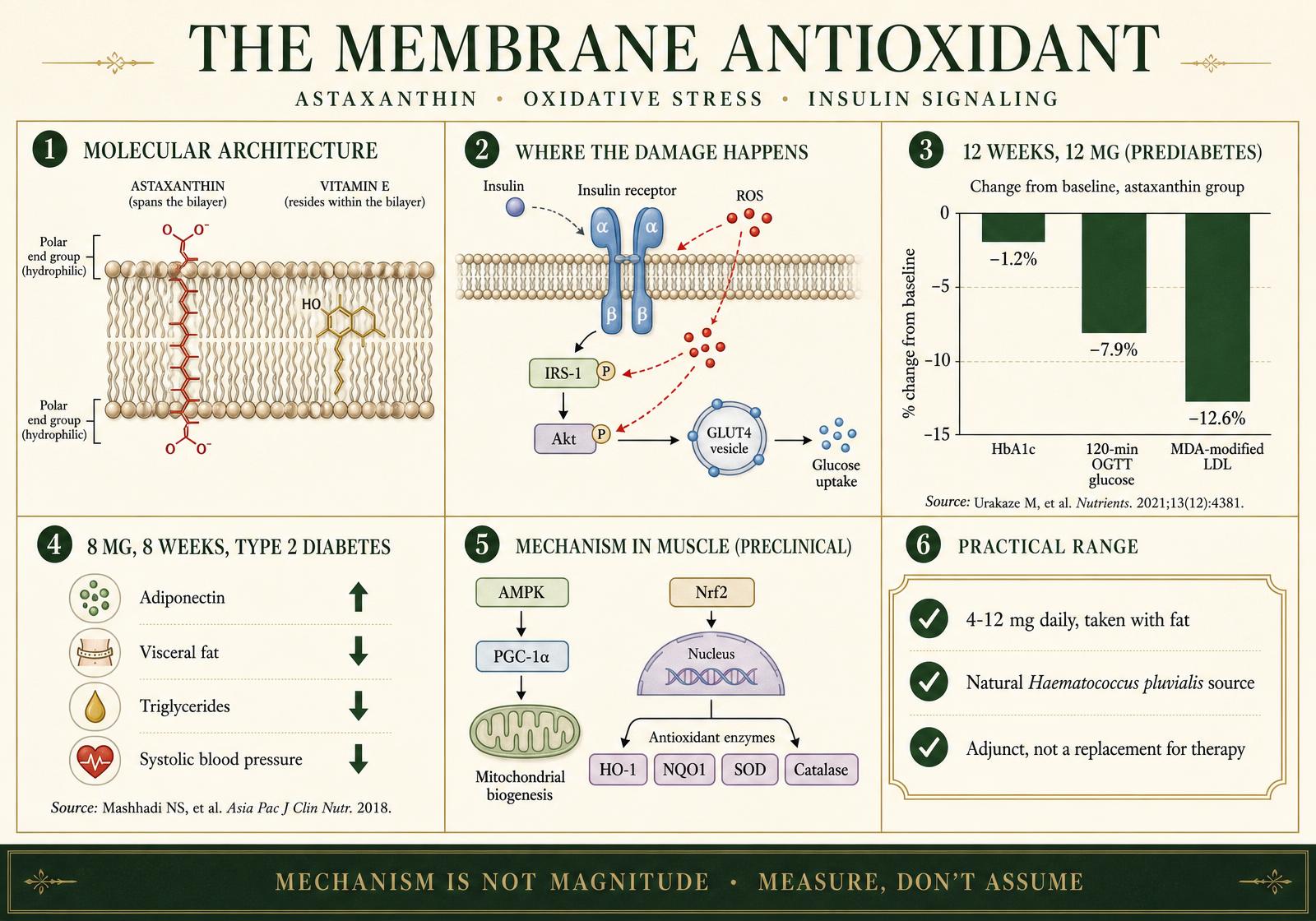
Astaxanthin is a reddish carotenoid made by the microalga Haematococcus pluvialis, and its molecular geometry is unusual: a long conjugated chain with polar hydroxyl-and-ketone end groups, which lets it sit transversely across a phospholipid bilayer with one end anchored at each membrane surface. Most antioxidants cannot do this — vitamin E stays buried in the hydrophobic interior, vitamin C stays in water.
That mechanism is real, and it matters, because insulin receptors and their downstream signaling machinery live in exactly that membrane. What the human evidence does not support is the claim circulating in supplement advertorials — that astaxanthin "repairs" insulin receptors, drops HbA1c by a full point in twelve weeks, or reverses established kidney dysfunction. In the best-designed trial at the commonly cited 12 mg dose, HbA1c fell from 5.64% to 5.57% over twelve weeks: statistically significant, clinically small (Urakaze et al., Nutrients, 2021).
Astaxanthin has a genuinely unusual mechanism and a genuinely ordinary effect size. Both facts have to survive the same article.
Contents(14 sections)
The evidence at a glance
Astaxanthin spans the entire lipid bilayer, protecting both membrane surfaces — a structural property vitamin E and vitamin C do not share.
In a randomized placebo-controlled trial (12 mg/day, 12 weeks) in healthy adults and people with prediabetes, HbA1c fell 0.07 percentage points, 120-minute OGTT glucose improved, and malondialdehyde-modified LDL dropped about 13%.
In type 2 diabetes (8 mg/day, 8 weeks), adiponectin rose while visceral fat, triglycerides, VLDL, systolic blood pressure, and fructosamine fell (Mashhadi et al., Asia Pac J Clin Nutr, 2018).
The frontier work is mechanistic: AMPK–PGC-1α–driven mitochondrial biogenesis in insulin-resistant muscle, Nrf2 activation, and adipose-tissue immune remodeling.
Bioavailability is genuinely formulation-dependent — astaxanthin is highly lipophilic and absorption improves with dietary fat and lipid-based delivery. That is not the same as any one brand being uniquely effective.
The Primer
What astaxanthin is
Astaxanthin is a xanthophyll carotenoid. Salmon, trout, shrimp, and flamingos get their pink pigment from it by eating algae or the animals that eat algae. Commercially, natural astaxanthin comes from Haematococcus pluvialis cultivation; a synthetic form derived from petrochemical precursors is also produced, largely for aquaculture feed.
Unlike beta-carotene, astaxanthin is not converted to vitamin A in humans, so it has no vitamin A toxicity ceiling. It also has no pro-oxidant tipping point at ordinary doses, which is one reason it has been studied more aggressively than older antioxidant candidates.
Why the membrane matters for blood sugar
Insulin does not enter your cells. It binds a receptor embedded in the cell membrane, and that binding triggers a phosphorylation cascade — receptor, IRS-1, PI3K, Akt — that ends with GLUT4 transporters moving to the surface so glucose can come in.
Every step of that early cascade happens in or immediately beneath a lipid membrane. Reactive oxygen species oxidize the polyunsaturated fatty acids of that membrane and activate stress kinases (JNK, IKKβ) that phosphorylate IRS-1 on serine residues instead of tyrosine — which silences the signal rather than transmitting it. This is a well-documented contributor to insulin resistance, not a fringe theory.
So an antioxidant that concentrates in membranes and stays there is, in principle, positioned at the right place. The open question was always whether that translates into measurable glycemic change in people. Partially — and modestly — is the honest answer.
What the human trials show
Two trials anchor the practical picture.
The Japanese randomized, placebo-controlled trial gave 12 mg of natural astaxanthin daily for 12 weeks to 53 participants including people with prediabetes. Post-supplementation, 120-minute glucose on a 75 g oral glucose tolerance test fell significantly, HbA1c fell from 5.64% to 5.57%, apolipoprotein E fell, and malondialdehyde-modified LDL — a direct marker of lipid oxidation — fell from 87.3 to 76.3 U/L. Total cholesterol, triglycerides, and HDL were unchanged (Urakaze et al., Nutrients, 2021;13(12):4381).
The Iranian trial in type 2 diabetes used 8 mg daily for 8 weeks. It reported increased serum adiponectin, reduced visceral fat mass, lower triglycerides and VLDL cholesterol, lower systolic blood pressure, and reduced fructosamine, with a smaller and less certain effect on fasting glucose and insulin resistance indices (Mashhadi et al., Asia Pac J Clin Nutr, 2018).
Read together: astaxanthin reliably improves oxidative and lipid-handling markers, plausibly nudges glycemic markers, and does not act like a glucose-lowering drug. Tolerability across trials has been good, with no consistent adverse-event signal at 4–12 mg.
What it does not do
It does not remit type 2 diabetes. It does not reverse chronic kidney disease. It does not replace metformin, GLP-1 receptor agonists, or SGLT2 inhibitors — the last of which have actual randomized outcome data for kidney protection. A single-person before-and-after spreadsheet, however sincerely kept, cannot distinguish a supplement effect from continued weight loss, seasonal variation, meter error, hydration status, or regression to the mean.
If your creatinine is rising, the intervention with evidence behind it is a clinician, not a carotenoid.
The Deep Dive
The transmembrane orientation, precisely
Astaxanthin's 3,3′-dihydroxy-β,β-carotene-4,4′-dione structure places a hydroxyl and a keto group at each terminal ring. Spectroscopic and molecular-dynamics work indicates the molecule aligns roughly perpendicular to the bilayer plane, with polar termini hydrogen-bonding at both aqueous interfaces and the polyene chain traversing the acyl region.
Functionally, this means a single molecule can intercept radicals at the outer surface, within the hydrophobic core, and at the inner surface — the three compartments where membrane lipid peroxidation propagates. It also stabilizes membrane order, which has downstream consequences for receptor conformation and lateral diffusion independent of any radical scavenging.
Tier II · Members only · Free
Continue into the deep dive
Tier I is free and always open. Tier II — the full mechanisms, dosing detail, nuance, and citations — unlocks with a free Vital Codex membership.
- Every Tier II deep dive across all hubs
- Saved reading progress across articles
- Member knowledge modules and their quizzes
- The Dispatch, if you opt in
Frequently asked
Does astaxanthin lower HbA1c?
Slightly, in the one well-controlled trial at 12 mg for 12 weeks: 5.64% to 5.57%. That is a real statistical signal and a clinically minor change. Claims of 0.5–1.0 point reductions are not supported by published human data.
How much should I take, and with what?
Human trials cluster at 4–12 mg daily. Take it with a meal containing fat, since absorption is lipid-dependent. Higher doses have not shown proportionally greater metabolic benefit.
Is natural astaxanthin actually different from synthetic?
Yes, chemically. Natural Haematococcus astaxanthin is esterified and almost entirely the 3S,3′S stereoisomer; synthetic is free and a stereoisomer mixture, and human trials have used the natural form. That justifies preferring natural sourcing. It does not justify any specific brand's claim of uniqueness.
Can it replace metformin or protect my kidneys?
No. There are no randomized outcome trials of astaxanthin for diabetic kidney disease, and rising creatinine is a reason to work with a clinician, not to substitute a supplement. SGLT2 inhibitors, by contrast, have hard renal outcome data.
Who is most likely to benefit?
People with prediabetes or early metabolic dysfunction who are already training and eating well, and whose remaining problem looks like oxidative load and mitochondrial capacity rather than pure caloric excess. Expect a small addition to a good foundation, not a rescue.
Research Notes & Sources(expand)
- Urakaze M, Kobashi C, Satou Y, et al. The beneficial effects of astaxanthin on glucose metabolism and modified low-density lipoprotein in healthy volunteers and subjects with prediabetes. Nutrients. 2021;13(12):4381.
- Mashhadi NS, Zakerkish M, Mohammadiasl J, et al. Astaxanthin improves glucose metabolism and reduces blood pressure in patients with type 2 diabetes mellitus. Asia Pac J Clin Nutr. 2018;27(2):341–346.
- Nishida Y, Nawaz A, Kado T, et al. Astaxanthin stimulates mitochondrial biogenesis in insulin resistant muscle via activation of AMPK pathway. J Cachexia Sarcopenia Muscle. 2020;11(1):241–258.
- Reviews of astaxanthin stereochemistry, esterification, and lipid-based bioavailability enhancement, including micellar solubilization pharmacokinetic crossover data.
Continue exploring: The Vital Codex library on insulin signaling, oxidative stress, and the supplements that actually move them.
Explore Metabolism