Alpha-lipoic acid is a small sulfur compound that works both as an essential mitochondrial cofactor and as a signal that switches on the body's own antioxidant defenses, including glutathione production. It dissolves in both water and fat, so it can act inside and outside cells. The natural form is R-lipoic acid; most supplements sell a 50/50 synthetic blend of R and S forms. Choosing stabilized R-lipoic acid, taking it on an empty stomach, and protecting biotin status are the practical keys.
Contents(14 sections)
Key takeaways
R-lipoic acid (R-ALA) is the form the body makes and uses as a cofactor for pyruvate dehydrogenase and alpha-ketoglutarate dehydrogenase in mitochondria.
Lipoic acid activates the Nrf2 pathway, which increases the cell's own glutathione synthesis.
Most "alpha-lipoic acid" supplements are racemic (50% R, 50% S); stabilized R-ALA or Na-R-ALA delivers only the natural form.
Typical doses are 100–300 mg of R-ALA daily, taken at least 30 minutes before food.
In clinical trials, lipoic acid modestly improves insulin sensitivity and reduces diabetic nerve pain.
Liver-recovery reports from Dr. Burton Berkson are case series, not controlled trials — promising, but not proof.
Lipoic acid shares an intestinal transporter with biotin; long-term use justifies biotin or B-complex support.
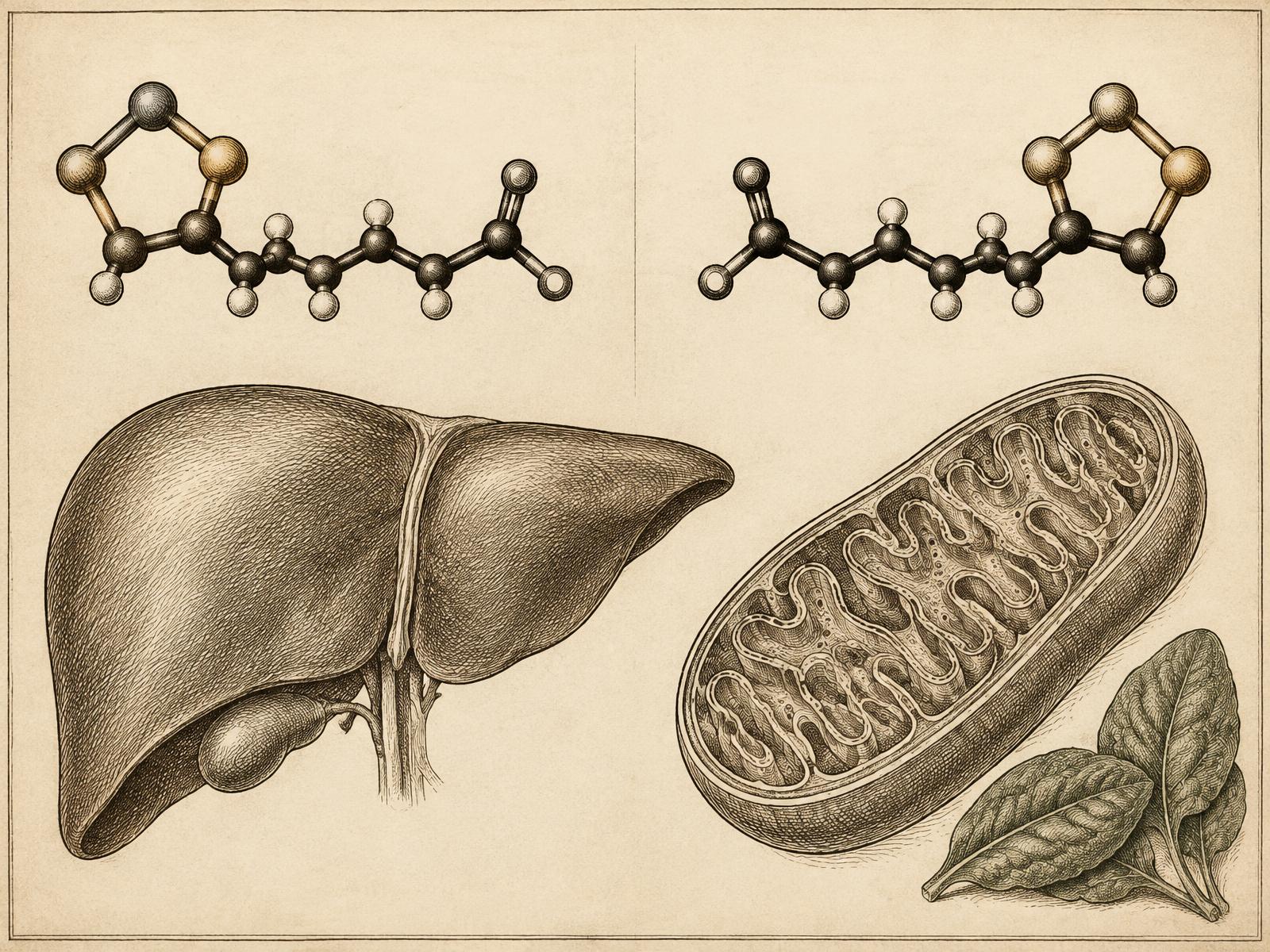
The Primer
The supplement trap
The body makes only small amounts of lipoic acid, and food — spinach, broccoli, organ meats — provides only trace amounts. Most supplements labeled "alpha-lipoic acid" are a cheap 50/50 blend of two mirror-image forms, "R" and "S." The R-form is the natural one your cells use. The S-form is a by-product of factory synthesis, and laboratory studies suggest it is less active and may interfere with the R-form.
The better choice
Look for stabilized R-lipoic acid (often listed as Na-R-ALA). When used well, it may help with:
- Your own antioxidant defenses. It switches on genes that help your cells make glutathione, which the liver uses for detoxification.
- Liver support. Some doctors have reported patients with severe liver damage recovering on high-dose lipoic acid protocols. These are individual case reports, not proof, and serious liver disease needs medical care.
- Energy and blood sugar. It is a required helper for the mitochondria that turn food into energy, and it can modestly improve blood sugar balance.
How to take it
- Choose the right form: "Stabilized R-lipoic acid" or "Na-R-ALA," not generic "alpha-lipoic acid" or "R/S" blends.
- Time it: 100 to 300 mg on an empty stomach, at least 30 minutes before food.
- Protect your biotin: Long-term use can compete with biotin (vitamin B7). Pair it with a B-complex or a modest biotin dose.
- Watch blood sugar: If you take diabetes medication, lipoic acid can lower blood sugar further — check with your clinician.
The Deep Dive
R vs. S: the enantiomer question
Lipoic acid has one chiral center, so it exists as two mirror-image enantiomers. R-lipoic acid is the endogenous form, covalently bound to lysine residues of mitochondrial enzyme complexes. S-lipoic acid does not occur in nature at meaningful levels; it appears when lipoic acid is made by chemical synthesis, which yields a racemic 50/50 mixture.
The evidence for R-form superiority is real but mostly preclinical. In rodent and cell studies, R-ALA more effectively restores mitochondrial enzyme activity and insulin-stimulated glucose uptake, and S-ALA showed weaker or partly opposing effects in some models. Pharmacokinetic studies in humans show higher peak plasma levels of R-ALA than S-ALA after racemic dosing. Free R-ALA is unstable and can polymerize; sodium salt forms (Na-R-ALA) improve stability and absorption. Most large human trials, however, used racemic ALA — so the clinical case for R-only is reasonable but not yet proven head to head.
Tier II · Members only · Free
Join Vital Codex free
Unlock every Tier II deep dive, save your reading, and open the member knowledge modules. Free, no card, no paywall.
The Dispatch is a separate weekly email. Your membership works with or without it.
Frequently asked
What is the difference between R-lipoic acid and alpha-lipoic acid?
"Alpha-lipoic acid" usually means a 50/50 synthetic mix of R and S forms. R-lipoic acid is the natural form the body makes and uses in mitochondria.
Does lipoic acid increase glutathione?
Yes. Lipoic acid activates the Nrf2 pathway, which increases expression of the enzymes that make glutathione, and its reduced form helps recycle vitamins C and E.
How much R-lipoic acid should I take?
Common doses are 100–300 mg of R-ALA daily, taken at least 30 minutes before food.
Can R-lipoic acid reverse liver disease?
Case reports describe striking recoveries, but they are not controlled trials. Lipoic acid may support liver health; serious liver disease needs medical treatment.
Why take biotin with lipoic acid?
They share an intestinal transporter, so long-term lipoic acid use may reduce biotin uptake. A B-complex or modest biotin dose is a reasonable safeguard.
Is lipoic acid safe with diabetes medication?
Use caution. It can lower blood sugar further, so monitor glucose and talk with your clinician.
Continue exploring: Mitochondria — Cellular energy production and the mechanisms of senescence.
Explore MitochondriaThe Codex Dispatch
More on Mitochondria, one email a week
One considered email each Sunday: research translation, no hype, no supplement pitches. Separate from membership — unsubscribe anytime.