Nicotine's reputation is inseparable from cigarettes, but the molecule and the smoke are not the same thing. Nicotine is a plant alkaloid that mimics acetylcholine, one of the body's core messenger chemicals, and it acts on nicotinic acetylcholine receptors (nAChRs) found in the brain, autonomic ganglia, adrenal medulla, enteric nervous system, immune cells, and peripheral sensory tissue. Combustion delivers thousands of additional compounds — tar, carbon monoxide, oxidants, carcinogens — and those, not the receptor biology, drive most smoking-related disease. That distinction is real, and it is also where a great deal of online overreach begins.
That distinction is why the research frontier has moved. The metabolic effects most people know anecdotally — appetite suppression, lower body weight, weight gain on cessation — map onto measurable receptor-level mechanisms: hypothalamic feeding circuits, catecholamine release, lipolysis, and thermogenesis. Alongside them sits the cholinergic anti-inflammatory pathway, in which α7 receptor activation dampens NF-κB-driven cytokine signaling.
Then the trials arrive, and the picture narrows sharply. Transdermal nicotine failed to slow memory loss in mild cognitive impairment and failed — with an unfavorable trend — in early Parkinson's disease. Nearly every selective α7 agonist has failed for efficacy or been stopped for gut toxicity. Nicotine measurably worsens insulin sensitivity in humans, with or without smoke. And the most clinically successful drug acting on these receptors, varenicline, is used to help people stop taking nicotine.
This entry holds both halves at once: the receptor biology is genuinely important, and the therapeutic claims circulating online — including a widely repeated line about "25 patents" proving a suppressed cure — do not survive contact with the published record. The opportunity is receptor-selective: matching subtype, tissue, and dose pattern to a specific intracellular response. It is not nicotine.
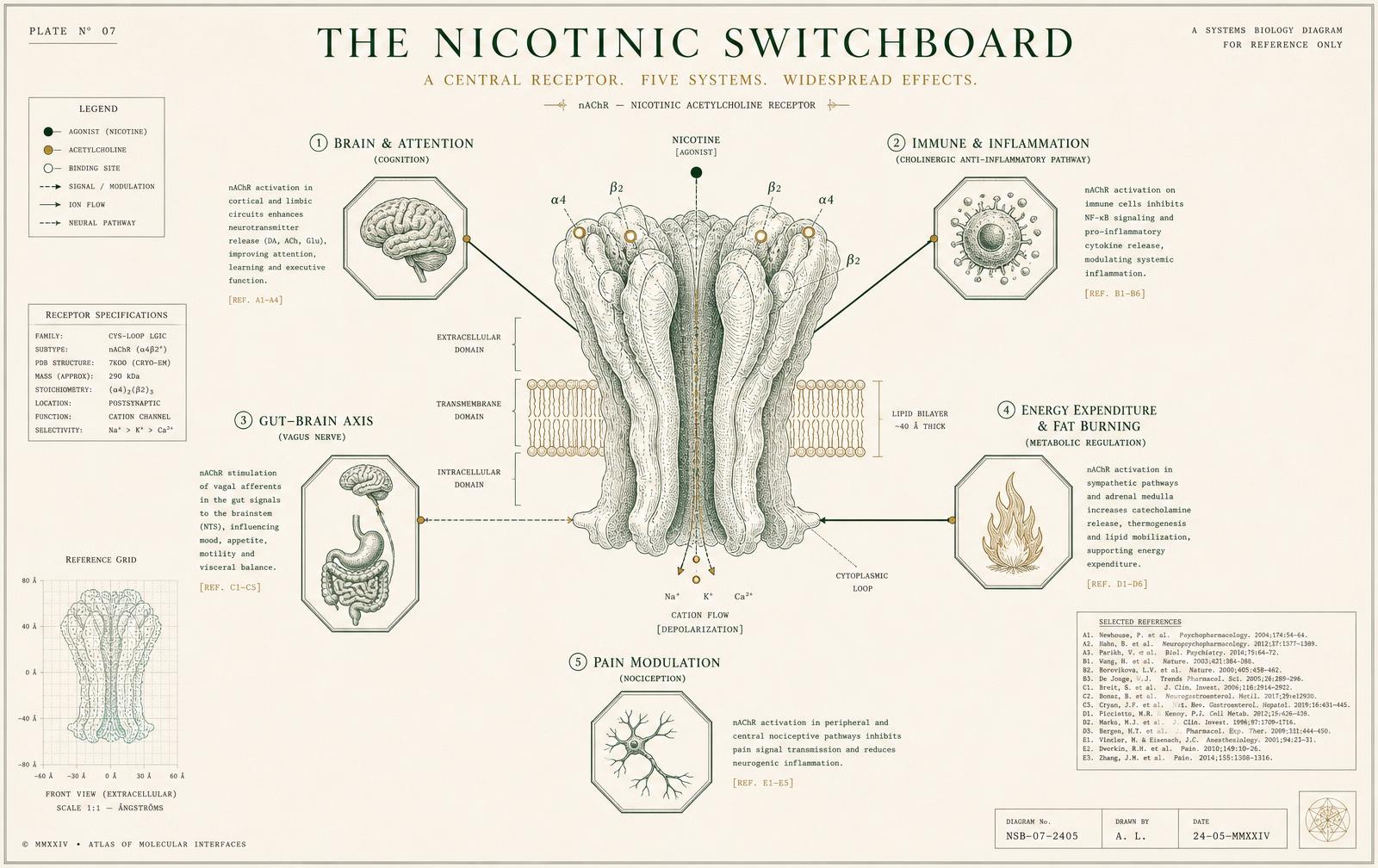
Nicotine-sensitive receptors are communication switches linking the brain, immune system, and metabolism.
Contents(23 sections)
Key takeaways
Nicotine is an agonist at nicotinic acetylcholine receptors, the same receptors acetylcholine uses across brain, nerve, gut, immune, and metabolic tissue.
The two central subtypes are α4β2 (attention, working memory, dopamine networks) and α7 (neuroimmune regulation, antioxidant signaling, cell survival).
Metabolic effects — reduced appetite, higher energy expenditure, increased lipolysis and thermogenesis — arise from hypothalamic feeding circuits plus autonomic catecholamine release.
α7 activation is the molecular core of the cholinergic anti-inflammatory pathway, reducing TNF-α, IL-1β, IL-6, and IL-12 signaling in experimental models while preserving host defense.
Most disease-relevant findings are mechanistic or preclinical, not clinical recommendations. Nicotine is addictive, raises heart rate and blood pressure, and is unsafe in pregnancy.
The therapeutic direction is subtype-selective agonists, positive allosteric modulators, cotinine-oriented compounds, and vagus-nerve stimulation — engaging the pathway without nicotine exposure.
The human trial record is mostly negative. The MIND trial (transdermal nicotine, mild cognitive impairment, topline 2025) showed no slowing of memory loss. NIC-PD (early Parkinson's) not only failed but trended toward worse motor progression. Nearly every selective α7 agonist — encenicline, ABT-126, bradanicline, the PAM AVL-3288 — failed for efficacy or GI toxicity.
The strongest positive recent finding is varenicline for vaping cessation, an α4β2 partial agonist helping young people quit nicotine — the mirror image of nicotine-as-therapy.
Nicotine worsens insulin sensitivity in humans, independent of combustion. Any "nicotine for metabolic health" framing has to answer for this.
Circulating claims that "25 patents" prove a suppressed nicotine cure misread the patent system: real nicotine and nAChR patents exist by the hundreds, they are public, and a patent is a claim of novelty — not evidence of efficacy.
The smoking–Parkinson's inverse association is real, but Mendelian-randomization and prodromal-trait evidence now point to reverse causation and confounding rather than nicotine neuroprotection.
The Primer
The key-and-lock idea
Nicotine works because it fits a lock the body already uses. Acetylcholine is the body's own key for nicotinic receptors; nicotine is a similar-shaped key that turns the same switches. Which switch gets turned depends entirely on which cell type the receptor sits on — a cortical neuron, a macrophage, a gut nerve, or a fat-mobilizing sympathetic pathway.
What shifts in the brain
At moderate levels, nicotinic activation affects:
- Focus and vigilance — sustained attention holds better under fatigue.
- Reaction time — processing speed measurably increases.
- Working memory — short-term holding and manipulation of information improves.
- Mental energy — a sense of drive and readiness.
- Learning signals — the plasticity systems used for adapting to new information.
What shifts in the immune system
Inflammation is necessary for defense and repair, but chronically elevated inflammatory tone damages healthy tissue. Activating the α7 receptor found on macrophages, monocytes, lymphocytes, microglia, and astrocytes can lower some of those alarm signals — the cytokines. Under study: reduced excessive inflammatory signaling, calmer overactive brain immune cells, and better vagus-nerve-to-immune communication.
What shifts in metabolism
| Metabolic output | What is observed |
|---|---|
| Appetite | Reduced food intake via hypothalamic feeding circuits |
| Energy expenditure | Increased resting and total daily expenditure |
| Fat oxidation | Increased lipolysis and free-fatty-acid mobilization |
| Thermogenesis | Increased heat production |
| Body weight | Lower average weight; weight gain is common on cessation |
These effects stem partly from sympathetic nervous system activation and partly from direct signaling in brain regions controlling hunger and energy balance.
The honest framing
The claim is not that nicotine is a therapy or that it is safe. It is addictive, it raises heart rate and blood pressure, it worsens insulin sensitivity, it is contraindicated in pregnancy, and adolescent brains are particularly vulnerable. When it has been tested as a treatment in large randomized trials — for memory loss, for Parkinson's — it has failed, and in Parkinson's it looked slightly worse than placebo. The claim is narrower and more interesting: nicotine-sensitive receptors are communication switches linking the brain, immune system, and metabolism, and those switches can likely be engaged more precisely than nicotine engages them. So far, the most successful nicotinic drug in clinical use is one that helps people stop using nicotine.
The Deep Dive
1. The receptor map
nAChRs are ligand-gated cation channels. Subtype identity determines function far more than ligand identity does.
| Receptor target | Major locations | Main functional opportunities |
|---|---|---|
| α4β2 nAChR | Cortex, hippocampus, thalamus, striatum, dopamine networks | Attention, alertness, working memory, sensory gating, dopamine regulation, network efficiency |
| α7 nAChR | Neurons, microglia, astrocytes, macrophages, lymphocytes, gut–immune interface | Neuroprotection, neuroimmune calibration, antioxidant signaling, inflammatory control |
| α3β4 / ganglionic | Autonomic ganglia, adrenal medulla, enteric nervous system | Catecholamine release, autonomic tone, GI motility, energy mobilization |
| α9-containing | Immune cells, sensory pathways, peripheral tissue | Inflammatory and neuropathic-pain modulation |
Tier II · Members only · Free
Continue into the deep dive
Tier I is free and always open. Tier II — the full mechanisms, dosing detail, nuance, and citations — unlocks with a free Vital Codex membership.
- Every Tier II deep dive across all hubs
- Saved reading progress across articles
- Member knowledge modules and their quizzes
- The Dispatch, if you opt in
Frequently asked
Is nicotine the same thing as smoking?
No. Nicotine is a single alkaloid that activates nicotinic acetylcholine receptors. Cigarette smoke is a combustion aerosol containing thousands of additional compounds, including tar, carbon monoxide, oxidants, and established carcinogens. Most smoking-attributable disease is driven by combustion products rather than by nicotinic receptor signaling.
Does nicotine actually increase metabolic rate?
Yes, measurably, but through sympathetic nervous system activation. Nicotine increases circulating catecholamines, which raises resting energy expenditure, lipolysis, and thermogenesis while suppressing appetite through hypothalamic feeding circuits. The same mechanism raises heart rate and blood pressure, which is why the effect is not a usable weight-management strategy.
Why do people gain weight when they quit?
Cessation removes both the appetite suppression and the catecholamine-driven increase in energy expenditure, and taste and reward sensitivity shift at the same time. Average post-cessation weight gain is a few kilograms, and it is far outweighed by the cardiovascular and cancer risk reduction from stopping combustion.
What is the cholinergic anti-inflammatory pathway?
It is the neural circuit through which acetylcholine signaling — particularly at α7 receptors on macrophages and microglia — reduces NF-κB-driven cytokine production. It links vagal tone to inflammatory tone, and it explains why vagus-nerve stimulation and selective α7 agonists are both being studied as anti-inflammatory interventions.
Is any of this a reason to start using nicotine?
No. Nicotine is addictive, raises cardiovascular load, worsens insulin sensitivity, is contraindicated in pregnancy, and affects developing brains disproportionately. The research value lies in identifying which receptor subtypes to target and how, so the useful signaling can be recruited by selective compounds or by nerve stimulation instead.
Has nicotine been tested as a treatment in humans?
Yes, repeatedly, and it has mostly failed. The MIND trial of transdermal nicotine in mild cognitive impairment showed no slowing of memory loss. The NIC-PD trial in early Parkinson's failed and trended toward worse motor progression. Selective α7 agonists including encenicline and ABT-126 and the allosteric modulator AVL-3288 did not produce clinical benefit, and encenicline was halted for serious gastrointestinal events. The main unresolved thread is late-life depression, where controlled augmentation trials are still reading out.
Are there really 25 patents on nicotine-based drugs?
Patents on nicotine and nicotinic receptor ligands are real and publicly searchable, including nicotine formulations for inflammatory bowel disease and for Parkinson's symptoms. The specific figure of 25 has no published source and is far too low — patent filings on nicotinic receptor ligands number in the hundreds. More importantly, a patent certifies novelty, not efficacy, and patents are public disclosures filed in government databases, so their existence is evidence of open commercial interest rather than of suppression.
Does nicotine cure Parkinson's disease or Alzheimer's?
No. Smokers do have a lower incidence of Parkinson's, but a randomized trial of nicotine patches in early Parkinson's failed and trended worse than placebo, and genetic Mendelian-randomization studies do not support a causal protective effect. The current explanation is reverse causation: prodromal Parkinson's changes reward sensitivity and novelty-seeking years before diagnosis, which makes people less likely to take up or continue smoking. For Alzheimer's and mild cognitive impairment, the controlled trials are negative.
Does nicotine help or harm metabolic health?
Both, in ways that do not cancel out. It suppresses appetite and raises energy expenditure, which lowers average body weight. It also measurably worsens insulin-stimulated glucose disposal in controlled human studies, through catecholamine-driven hepatic glucose output, elevated free fatty acids, and direct effects on β-cells — and this happens without combustion, so vapor and pouch users are not exempt. Lower weight with worse insulin sensitivity is not a metabolic improvement.
Is nicotinamide the same as nicotine?
No. Nicotinamide and niacinamide are vitamin B3 forms and NAD⁺ precursors with no meaningful affinity for nicotinic acetylcholine receptors, so they are not nicotine in disguise. The shared name comes from chemistry and history: nicotinic acid was first obtained by oxidizing nicotine in 1867, and vitamin B3 was renamed "niacin" around 1942 so fortified flour would not appear to contain nicotine. The two families do intersect downstream — nicotinamide disposal consumes methyl groups via NNMT and SAM, and NAD⁺-dependent SIRT1 signaling sits below the α7 anti-inflammatory pathway — but neither intersection has been resolved in humans. See Nicotine, Niacin, and Nicotinamide.
Research Notes & Sources(expand)
Therapeutic Targeting of the α7 Nicotinic Receptor: Challenges and Opportunities (2025) — α7 nAChR in cognitive dysfunction, neuroprotection, and inflammation.
Proposed Mechanisms of Neuroprotection for Nicotine in Parkinson's Disease (2024/2025) — dopamine-neuron survival, oxidative stress, and glial mechanisms.
Anti-inflammatory Effects of Astroglial α7 Nicotinic Acetylcholine Receptors Are Mediated by Inhibition of NF-κB and Activation of Nrf2 — astrocyte-specific inflammatory and antioxidant mechanisms.
The Neuroprotective Effects of Activated α7 Nicotinic Acetylcholine Receptors (2020) — α7 agonism, SOD1-related aggregation, and ALS-relevant cellular toxicity.
Stimulation of Nicotinic Acetylcholine Receptors Protects Motor Neurons (2005) — protection from glutamate-induced motor-neuron death in spinal-cord cultures.
Nicotinic Receptor Activation Contrasts Pathophysiological Bursting and Neurodegeneration Evoked by Glutamate Uptake Block on Rat Hypoglossal Motoneurons (2016) — excitotoxic motor-network protection.
Role of α7 Nicotinic Receptor in the Immune System and Inflammation — α7 receptors across macrophages, dendritic cells, and lymphocytes.
Nicotinic Receptors in Neuropathic and Inflammatory Pain — α7, α9, and related targets in pain and immune signaling.
Nicotine and Energy Balance: A Review Examining the Effect of Nicotine on Hormonal Appetite Regulation and Energy Expenditure (2021) — appetite and energy-expenditure biology.
A New Framework for Nicotinic Receptor-Targeted Therapeutics (2026) — subtype-selective ligands, allosteric modulation, and cotinine-oriented research.
MIND — Memory Improvement Through Nicotine Dosing (topline 2025) — multisite randomized trial of transdermal nicotine in amnestic mild cognitive impairment; no benefit on the primary cognitive endpoint.
NIC-PD — Randomized trial of transdermal nicotine in early Parkinson's disease (NEJM Evidence, 2023) — no slowing of motor progression, with an unfavorable trend.
Clearing the Smoke: What Protects Smokers from Parkinson's Disease? (Movement Disorders, 2024) — argues the epidemiological association is not nicotine-mediated.
Mendelian randomization analyses of smoking and Parkinson's disease risk (Scientific Reports 2021; npj Parkinson's Disease phenome-wide analysis, 2024) — null or inconsistent causal effects; reverse causation via prodromal traits.
A randomized trial of an α7 nicotinic positive allosteric modulator (AVL-3288) in schizophrenia (Neuropsychopharmacology, 2020) — safe, no cognitive or symptomatic benefit; reviews the wider failure of the α7 class.
Encenicline Phase 3 program discontinuation (2015–2016) — serious gastrointestinal events and missed primary endpoints.
Varenicline for Youth Nicotine Vaping Cessation: A Randomized Clinical Trial (JAMA, 2025) — significantly increased abstinence versus placebo.
Nicotine augmentation in late-life depression (Journal of Affective Disorders, 2024) — open-label improvement in affective symptoms and executive function; controlled trials ongoing.
Vagus nerve stimulation in rheumatoid arthritis (PNAS 2016 first-in-human; randomized sham-controlled auricular trial, 2023; Clinical Autonomic Research review, 2024) — modest but real reductions in TNF and disease activity.
GTS-21 in human endotoxemia (Shock, 2011) — anti-inflammatory ex vivo, weak systemic effect at tolerated doses.
Smoking, nicotine, and insulin resistance (Diabetes 2012; Scientific Reports 2022; European Journal of Epidemiology metabolomic analysis with gene–smoking interaction, 2024) — dose-dependent impairment of insulin sensitivity independent of combustion.
Central and peripheral actions of nicotine that influence blood glucose homeostasis and the development of diabetes (2023) — mechanistic synthesis.
Neurobiological mechanisms of nicotine's effects on feeding and body weight (Neuroscience & Biobehavioral Reviews, 2025) — hypothalamic and thermogenic pathways, largely preclinical.
Impact of Smokeless Oral Nicotine Products on Cardiovascular Disease (Circulation, American Heart Association statement, 2024) — cardiovascular effects of pouches and smokeless products.
Small pouches, but high nicotine doses (Frontiers in Pharmacology, 2024) — controlled human pharmacokinetics of tobacco-free nicotine pouches.
Cell signaling and epigenetic regulation of nicotine-induced carcinogenesis (Seminars in Cancer Biology, 2024); Nicotinic acetylcholine receptors in cancer: limitations and prospects (2023) — α7, α9, α10 signaling and tumor promotion.
α7 nicotinic receptor expression in human adipose tissue and obesity (International Journal of Obesity, 2012); hepatic cholinergic signaling in steatohepatitis and fibrosis (PLOS Biology and related work, 2024) — cell-type-specific, opposing effects.
Patent record consulted directly: US5889028A and US5846983 (Mayo Foundation, colonic nicotine delivery for inflammatory bowel disease); EP0893998B1 and EP0954337B1; US20050234024A1 (ulcerative colitis); US10653686B2 (Parkinson's Institute, 2020) and US12029734B2 (2024) for Parkinson's symptom compositions; US10308638B2 (selective α7 agonists). Nicotinic acetylcholine receptor ligands: a patent review — documents filings in the hundreds.
Independent fact-checks of circulating nicotine and snake-venom claims: Reuters (2022), FactCheck.org SciCheck (2022), USA Today (2022), Poynter (2022), Lead Stories (2022), Science Feedback ("No evidence for the claim that nicotine cures Parkinson's and other diseases," 2025; "Parkinson's has no cure; nicotine patches haven't been proven an effective treatment," 2024), Media Bias/Fact Check.
Editorial note: this entry is educational and describes mechanisms, clinical trial outcomes, and preclinical findings. It is not medical advice and is not a recommendation to use nicotine in any form. Where widely circulated online claims were examined, they are named and assessed against the published trial and patent record rather than repeated.
Continue exploring: Continue with the metabolism hub for the systems that set energy balance.
Explore Metabolism