The suffix -itis means inflammation. Tendinitis is inflammation of a tendon; colitis, of the colon; dermatitis, of the skin. Each term states where inflammation is occurring — and in many cases, that is the entire informational content of the label.
This is not a criticism of medicine so much as a caution about how patients hear these words. A name that describes location can feel like an explanation, which can end the search for a mechanism precisely when the mechanism is the actionable part.
Contents(12 sections)
Key takeaways
Many -itis diagnoses are descriptive, not etiologic: they locate a process without identifying its driver.
Some are genuinely mechanistic — appendicitis, bacterial meningitis, and autoimmune thyroiditis have identified causes and specific treatments.
Chronic tendon problems are often tendinopathy rather than tendinitis: histology shows collagen disorganization with minimal inflammatory infiltrate, which changes the treatment logic.
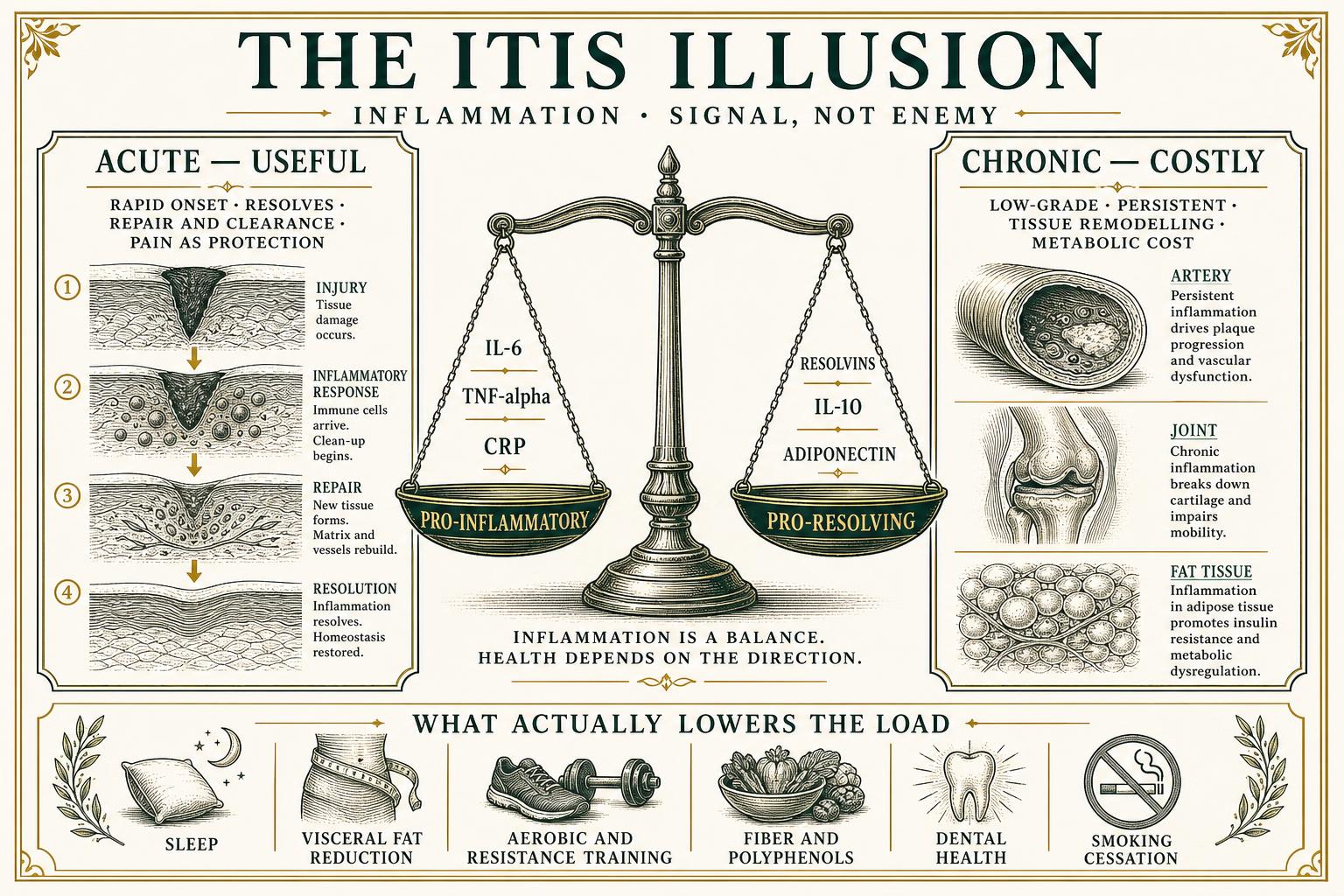
Chronic low-grade inflammation frequently traces upstream to insulin resistance, visceral adiposity, sleep restriction, dysbiosis, or persistent mechanical load.
Suppressing inflammation is legitimate symptom control, and is a different objective from removing the stimulus.
The Primer
What the suffix does and does not tell you
Inflammation is the immune system's response to injury, infection, irritation, or perceived threat. It is a mechanism, not a disease. When a diagnosis names inflammation at a site, the useful next question is why that site is inflamed and why the response has not resolved.
Some answers are already embedded in the diagnosis. Appendicitis implies obstruction and bacterial overgrowth in the appendix, with a defined treatment. Bacterial meningitis names an infection. Hashimoto's thyroiditis names an autoimmune process with detectable antibodies.
Others are open questions dressed as answers. "Gastritis" describes inflamed gastric mucosa; the cause may be H. pylori, NSAIDs, alcohol, bile reflux, or autoimmunity, and each implies different management. "Dermatitis" covers contact allergy, irritant exposure, atopic disease, and seborrheic conditions.
Why the distinction changes what you do
If inflammation is downstream of a removable stimulus — an allergen, a medication, a repeated mechanical load, a food, an infection — removing it addresses the disease. If it is downstream of a systemic metabolic or immune state, local suppression will control symptoms while the process continues.
Both approaches have a place. The error is treating them as interchangeable.
The upstream drivers worth checking
Insulin resistance and visceral fat, which produce a pro-inflammatory cytokine profile. Sleep restriction, which raises IL-6 and CRP within days. Gut barrier dysfunction and dysbiosis. Chronic mechanical overload or, equally often, chronic underloading with sudden spikes. Periodontal disease. Ongoing low-grade infection. Smoking and alcohol.
The Deep Dive
The tendinitis case study
The clearest example of a misleading -itis is chronic tendon pain. Histopathological studies of surgically excised chronic tendon tissue consistently show collagen fiber disorganization, increased ground substance, neovascularization, and absent or minimal inflammatory cell infiltrate. The condition is degenerative and failed-healing in character, which is why the sports medicine literature largely replaced "tendinitis" with "tendinopathy" (Khan et al., BMJ, 2002).
The therapeutic consequence is direct. Anti-inflammatory strategies address a process that is largely not present, while progressive mechanical loading — heavy slow resistance or eccentric protocols — addresses the tissue's actual failure to remodel. Corticosteroid injection provides short-term pain relief and worse long-term outcomes in several trials of lateral elbow tendinopathy. Acute tendon injury does involve genuine inflammation; the mislabeling applies to the chronic presentation.
Tier II · Members only · Free
Continue into the deep dive
Tier I is free and always open. Tier II — the full mechanisms, dosing detail, nuance, and citations — unlocks with a free Vital Codex membership.
- Every Tier II deep dive across all hubs
- Saved reading progress across articles
- Member knowledge modules and their quizzes
- The Dispatch, if you opt in
Frequently asked
Are all -itis diagnoses vague?
No. Appendicitis, bacterial meningitis, and Hashimoto's thyroiditis carry specific mechanisms and treatments. The caution applies to labels where the cause is left unstated.
Should I avoid anti-inflammatory medication?
No. Use it for symptom control and, in autoimmune disease, for disease modification. Just avoid treating it as an answer to why the inflammation started.
Does hs-CRP tell me if I have chronic inflammation?
It is a useful, imperfect screen. Values persistently above about 2 mg/L in the absence of acute illness warrant attention to metabolic and lifestyle drivers.
Why does my chronic tendon pain not respond to rest?
Because chronic tendinopathy is a failure of remodeling rather than active inflammation. Progressive loading is the better-supported treatment; complete rest often worsens tissue capacity.
Continue exploring: Inflammation — Cytokine signaling and chronic low-grade systemic stress.
Explore Inflammation