The dominant biomedical model was built on germ theory, genetic determinism, and symptom suppression. Over the last three decades, converging evidence from epigenetics, microbiome science, cellular biophysics, psychoneuroimmunology, and bioelectric medicine has complicated all three premises.
What emerges is not a rejection of medicine but a different default question. Conventional practice asks which disease this is and what suppresses it. The self-healing frame asks which conditions the body has lost, and how they are restored: terrain, cellular voltage, autonomic safety, and adaptive capacity.
Contents(15 sections)
Key takeaways
Genetic determinism has been substantially revised: gene expression is regulated by environmental inputs through epigenetic mechanisms.
Terrain theory — the internal environment as the decisive variable in susceptibility — has found partial empirical support in microbiome and immunometabolism research.
Cellular voltage is measurable and instructive, not metaphorical; bioelectric state influences growth and regeneration in experimental models.
Autonomic state modulates immunity through the vagus nerve and the cholinergic anti-inflammatory pathway.
The frame is a set of testable mechanisms, not a licence to bypass diagnosis. Acute disease still requires acute care.
The Primer
From germ theory to terrain
Pasteur's germ theory holds that specific pathogens cause specific diseases. It is correct and it transformed medicine. But it produced a system oriented toward killing things rather than building resilience.
Antoine Béchamp's terrain theory asks a different question: why does this body, at this time, become susceptible? Exposure is nearly universal; illness is not. The terrain — nutritional status, oxygenation, toxin burden, microbial ecology, autonomic state — helps explain the difference.
The four levers
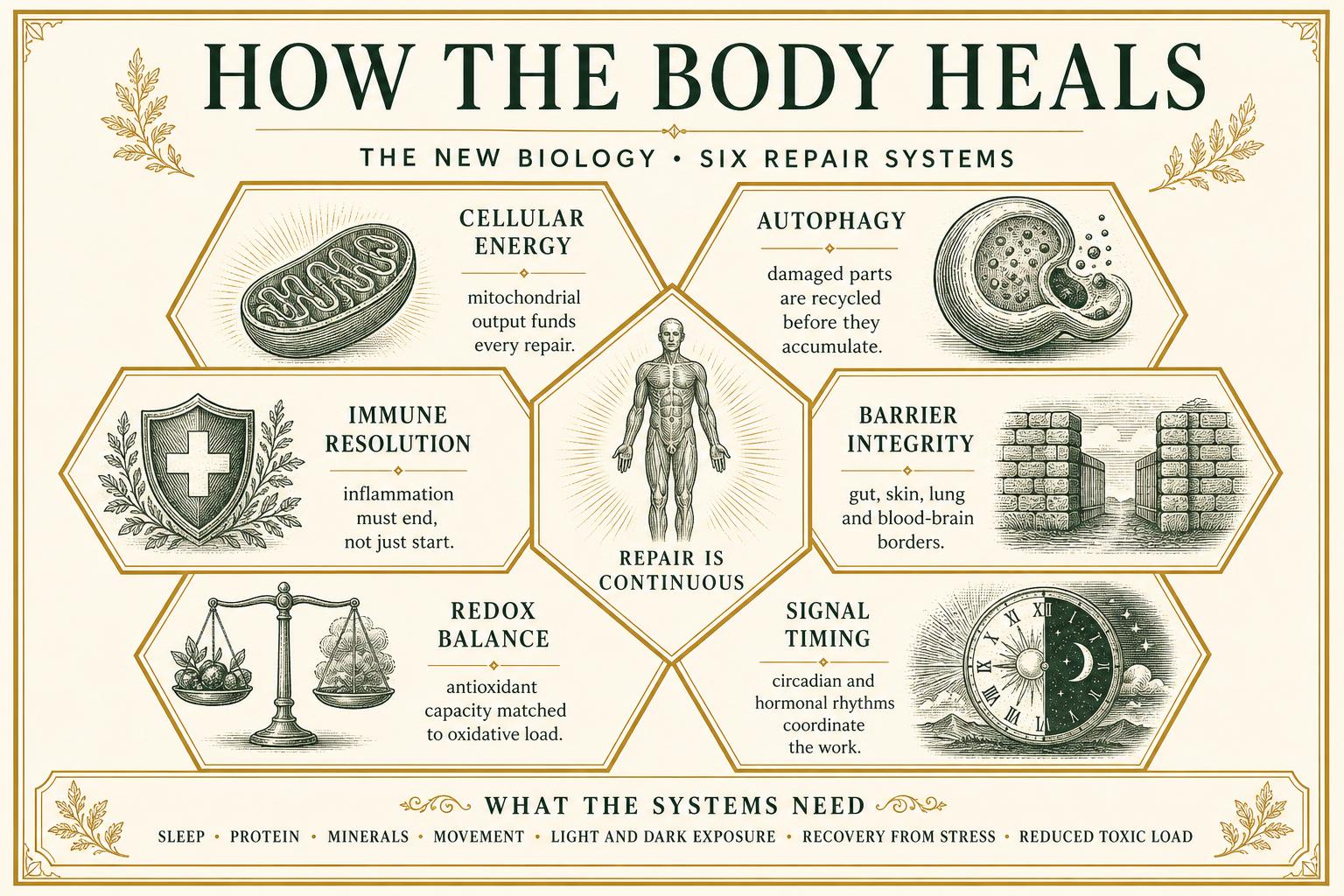
Terrain: nutrient density, microbiome diversity, and low toxin load. Cellular voltage: mineral status, mitochondrial function, and the metabolic capacity to run ion pumps. Autonomic safety: enough parasympathetic tone that the body is in a repair-permissive state rather than chronic threat. Adaptive capacity: the range across which the system can be stressed and recover — trained by exercise, temperature exposure, fasting, and supported by adaptogenic botanicals.
What shapes terrain
Inherited constitution; personal history of nutrition, exposures, infections, and emotional load; and the cumulative effect of suppressive interventions on physiological expression. None of these is fully controllable, and all of them are partly modifiable.
The realistic reading
This model earns its place where conventional medicine is weakest: chronic, multi-system, slowly accumulating dysfunction. It has no advantage in acute infection, trauma, or surgical disease, and should not be applied there.
The Deep Dive
Epigenetics and the end of hard determinism
The Human Genome Project's most consequential finding was how few protein-coding genes humans have — roughly 20,000 — and how much regulatory machinery sits above them. DNA methylation, histone modification, and non-coding RNA collectively determine which genes are expressed in which tissue at which time.
Environmental inputs feed this system directly. Nutritional methyl donors (folate, B12, choline, betaine) supply the substrate for methylation. Exercise alters methylation patterns in skeletal muscle within weeks. Early-life stress produces durable changes in glucocorticoid receptor regulation in animal models. The Dutch Hunger Winter cohorts remain the clearest human evidence that prenatal nutritional exposure leaves methylation signatures decades later.
Tier II · Members only · Free
Continue into the deep dive
Tier I is free and always open. Tier II — the full mechanisms, dosing detail, nuance, and citations — unlocks with a free Vital Codex membership.
- Every Tier II deep dive across all hubs
- Saved reading progress across articles
- Member knowledge modules and their quizzes
- The Dispatch, if you opt in
Frequently asked
Is terrain theory scientifically accepted?
Not as a wholesale replacement for germ theory. But its central claim — that host environment determines susceptibility and outcome — is well supported by immunometabolism, microbiome, and stress physiology research.
Does this mean the body can heal anything?
No. It means the body has substantial repair capacity that depends on conditions being met. Some conditions exceed that capacity entirely, and recognizing which is the clinical skill that matters most.
What is the single highest-yield lever?
For most people, sleep and autonomic state, because they gate the others. Repair processes — glymphatic clearance, growth hormone release, immune consolidation — are largely sleep-dependent.
Is "cellular voltage" measurable at home?
Not meaningfully. Membrane potential is measured with laboratory electrophysiology. Home devices claiming to read or restore body voltage are not measuring what the term denotes.
Continue exploring: Mitochondria — Cellular energy production and the mechanisms of senescence.
Explore Mitochondria