An ion is an atom carrying an electrical charge. Dissolved in the water that makes up most of the body, ions become electrolytes — and their movement across cell membranes generates the bioelectricity that runs nerve conduction, muscle contraction, hormone release, immune signaling, and tissue repair.
Iontology is the study of that system: how ions are acquired, distributed, and regulated, and what happens to physiology when their balance drifts. It sits at the intersection of ionomics, bioelectricity, electrophysiology, and ion-channel pharmacology.
Contents(15 sections)
Key takeaways
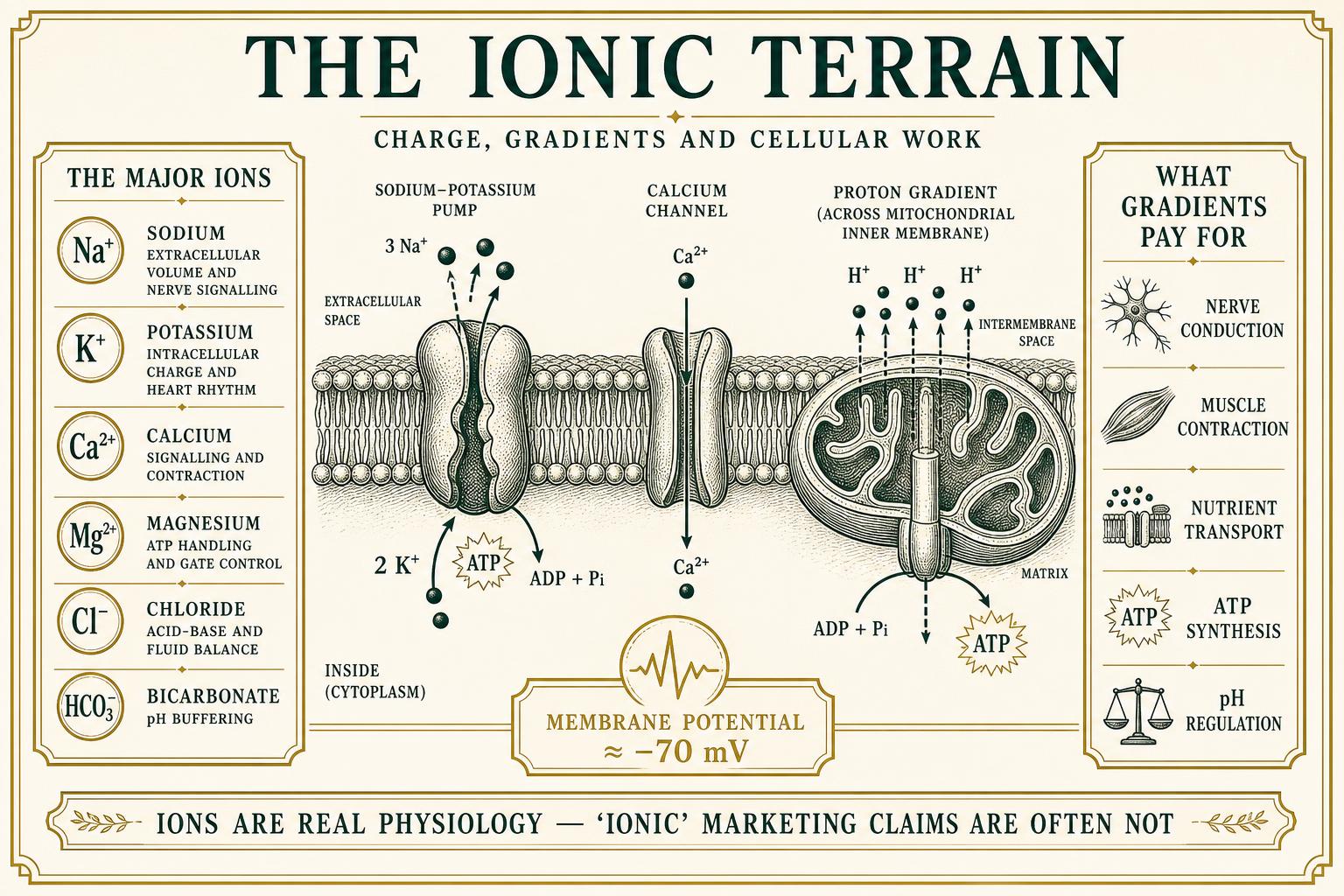
Cations (Na⁺, K⁺, Ca²⁺, Mg²⁺) and anions (Cl⁻, HCO₃⁻, PO₄³⁻) are the body's electrical currency.
Healthy cells hold a resting membrane potential of roughly −70 to −100 mV; cells in chronic disease measure closer to −30 to −50 mV, and cancer cells lower still.
The sodium-potassium pump consumes roughly one-third of the body's total ATP just to maintain those gradients.
Ion channels are extraordinarily selective protein pores — a calcium channel excludes sodium despite near-identical size.
Mineral status, hydration quality, and metabolic health are the practical levers on ionic function.
The Primer
What an ion is
Atoms are normally neutral. When one gains or loses an electron it carries a charge and becomes an ion. Positively charged ions are cations — sodium, potassium, calcium, magnesium. Negatively charged ions are anions — chloride, bicarbonate, phosphate.
Electrons flowing through a wire make electricity. Ions flowing across cell membranes make bioelectricity, and bioelectricity is what runs biology.
The battery in every cell
The fluid outside cells is sodium- and chloride-rich; the fluid inside is potassium-rich with very low free calcium. That concentration difference is not accidental. It is a maintained energy reservoir — a charged battery — and it drives nerve impulses, muscle contraction, and nutrient transport.
Every cell holds a voltage across its membrane, the resting membrane potential, measured in millivolts. Healthy tissue sits near −70 to −100 mV. In chronic disease that voltage tends to fall.
Ion channels as switches
Ion channels are gated protein tunnels that open in response to voltage changes, chemical signals, or mechanical pressure. They govern nerve transmission, muscle and cardiac contraction, hormone secretion, immune activation, and the bioelectric patterning that guides development and regeneration.
The practical picture
Ionic health is mostly mineral and metabolic health: adequate potassium and magnesium from whole food, sodium and chloride matched to sweat losses, sufficient calcium with the cofactors that direct it, real hydration rather than plain volume, and enough metabolic capacity to run the pumps.
The Deep Dive
The ionome and disease ionomics
The term ionome — the complete set of mineral ions functioning in a cell, tissue, or organism — was coined by Purdue researcher David Salt. High-throughput elemental analysis now allows dozens of elements to be measured simultaneously in blood, tissue, hair, and urine.
Disease ionomics looks for patterns rather than single deficiencies: characteristic multi-element signatures that track with chronic disease states. This is a more informative frame than isolated serum values, most of which are tightly defended and therefore poor indicators of tissue status.
Tier II · Members only · Free
Continue into the deep dive
Tier I is free and always open. Tier II — the full mechanisms, dosing detail, nuance, and citations — unlocks with a free Vital Codex membership.
- Every Tier II deep dive across all hubs
- Saved reading progress across articles
- Member knowledge modules and their quizzes
- The Dispatch, if you opt in
Frequently asked
Is "cellular voltage" a real measurement or wellness language?
It is real and standard: resting membrane potential is measured with patch-clamp and microelectrode techniques and has been characterized for decades. What is less rigorous is any claim that a consumer device restores whole-body voltage to a specific number.
Do I need an electrolyte supplement?
Most people do better with potassium- and magnesium-dense food plus salt matched to sweat losses. Electrolyte products earn their place with heavy sweating, heat, fasting, illness with fluid loss, or ketogenic transitions.
Does drinking more water improve ionic health?
Only up to a point. Water without minerals dilutes the gradients it is meant to support. Hydration is a water-plus-electrolyte question, not a volume question.
Is depolarization the cause of cancer?
No. Depolarization is a consistent feature of proliferative states and appears to be instructive in some experimental systems, but cancer is multifactorial. Treat bioelectric findings as one mechanistic layer, not an explanation of the whole disease.
Continue exploring: Mitochondria — Cellular energy production and the mechanisms of senescence.
Explore Mitochondria