Mudras are specific hand gestures from ancient healing traditions. Paired with slow 4-in, 6-out breathing, they are a zero-cost tool for shifting the nervous system out of fight-or-flight and into rest-and-digest.
Contents(8 sections)
Key takeaways
Gyan Mudra (index finger to thumb) is used for focus and mental clarity.
Prana Mudra (thumb to ring and pinky fingers) is used against fatigue.
Vayu Mudra (index finger to base of thumb) is used to calm agitation and joint stiffness.
Hold the mudra 5 to 15 minutes with a straight spine, inhaling 4 seconds and exhaling 6 seconds.
Mudras stack with morning sunlight, barefoot grounding and nasal breathing.
The Primer
The Deep Dive
The Biophysical Mapping of the Five Elements
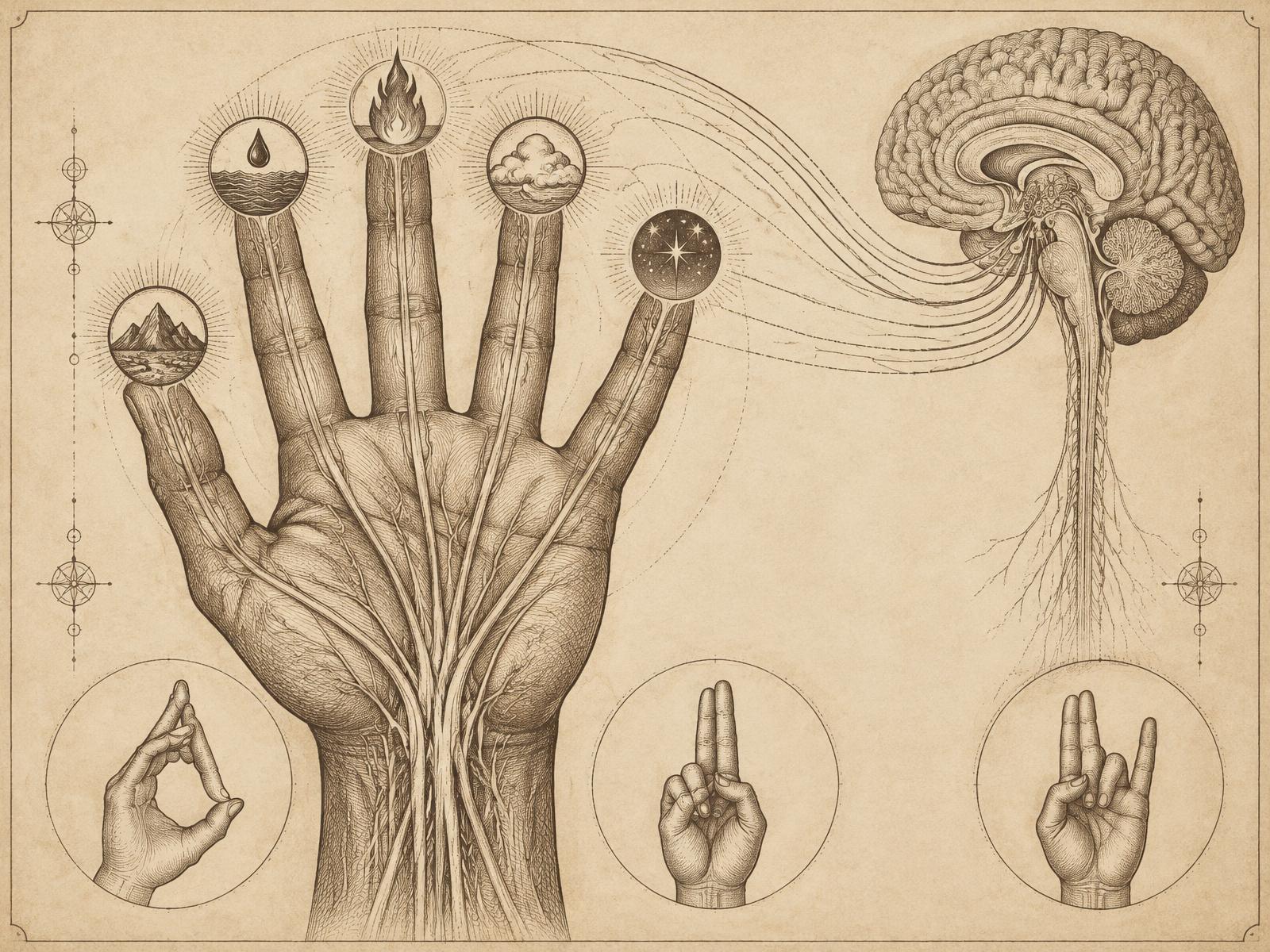
Ancient empirical observation mapped the human body to five elemental forces (Earth, Water, Fire, Air, Ether), assigning each to a specific digit. Modern neurophysiology and reflexology now confirm that these are not mystical metaphors, but accurate representations of bioelectric and neurological pathways.
- Prithvi (Earth / Ring Finger): Corresponds to structural integrity (bones, muscles, connective tissue). Pressing the ring finger to the thumb creates a bioelectric circuit that signals the body to stabilize cellular structure and reduce systemic inflammation, serving as a highly effective alternative for individuals unable to practice physical grounding (earthing).
- Varuna (Water / Pinky Finger): Governs fluid dynamics (kidneys, bladder, lymphatic system). This configuration modulates fluid balance signaling and supports renal function, optimizing cellular hydration when paired with mineralized water intake.
- Agni (Fire / Thumb): The central hub of the bioelectric hand circuit. The thumb is involved in every mudra because it activates the metabolic "fire" required to upregulate mitochondrial ATP production and support the specific physiological goal of the gesture.
- Vayu (Air / Index Finger): Regulates movement and neural signaling (lungs, nervous system, joint mobility). Pressing the index finger to the thumb base measurably downregulates sympathetic nervous system activity, making it a potent intervention for neuropathic pain, joint stiffness, and anxiety.
- Akasha (Ether / Middle Finger): Governs consciousness and neural networks. Bilateral configurations involving the middle finger, such as Hakini Mudra (all fingertips touching in a pyramid shape), measurably increase corpus callosum activity, synchronizing left and right brain hemisphere function to enhance working memory and cognitive coherence.
Tier II · Members only · Free
Join Vital Codex free
Unlock every Tier II deep dive, save your reading, and open the member knowledge modules. Free, no card, no paywall.
The Dispatch is a separate weekly email. Your membership works with or without it.
Frequently asked
How long should I hold a mudra?
5 to 15 minutes, seated with a straight spine, paired with 4-second nasal inhales and 6-second exhales.
Do mudras cost anything?
No. They require no equipment, no preparation, and no financial investment. Disclaimer: This information is for educational purposes only and does not constitute medical advice. Always consult a qualified healthcare practitioner before beginning any new health protocol, especially if managing chronic neurological, cardiovascular, or metabolic conditions.
Continue exploring: Cognition — Neurogenesis, synaptic plasticity, and focus architecture.
Explore CognitionThe Codex Dispatch
More on Cognition, one email a week
One considered email each Sunday: research translation, no hype, no supplement pitches. Separate from membership — unsubscribe anytime.