Acetylcholine (ACh) is the body's execution signal. Dopamine sets motivation and serotonin colors mood, but acetylcholine is the transmitter that actually contracts a muscle fiber, moves the gut, slows the heart, and writes a new memory into the hippocampus. Low cholinergic tone does not feel like a deficiency of a chemical — it feels like brain fog, a poor mind-muscle connection, sluggish digestion, and a nervous system that never quite drops out of alert.
The practical point is a biochemical one: acetylcholine cannot be taken as a supplement. It is a small charged ester that is hydrolyzed in the gut and does not cross the blood-brain barrier. Everything that raises cholinergic tone does so upstream — through the precursor choline, the acetyl group supplied by pantothenic acid, the methyl economy that recycles choline, and the vagal traffic that releases ACh in the periphery.
Dopamine gets credit for wanting things. Acetylcholine is what actually carries out the instruction.
Contents(11 sections)
The essentials at a glance
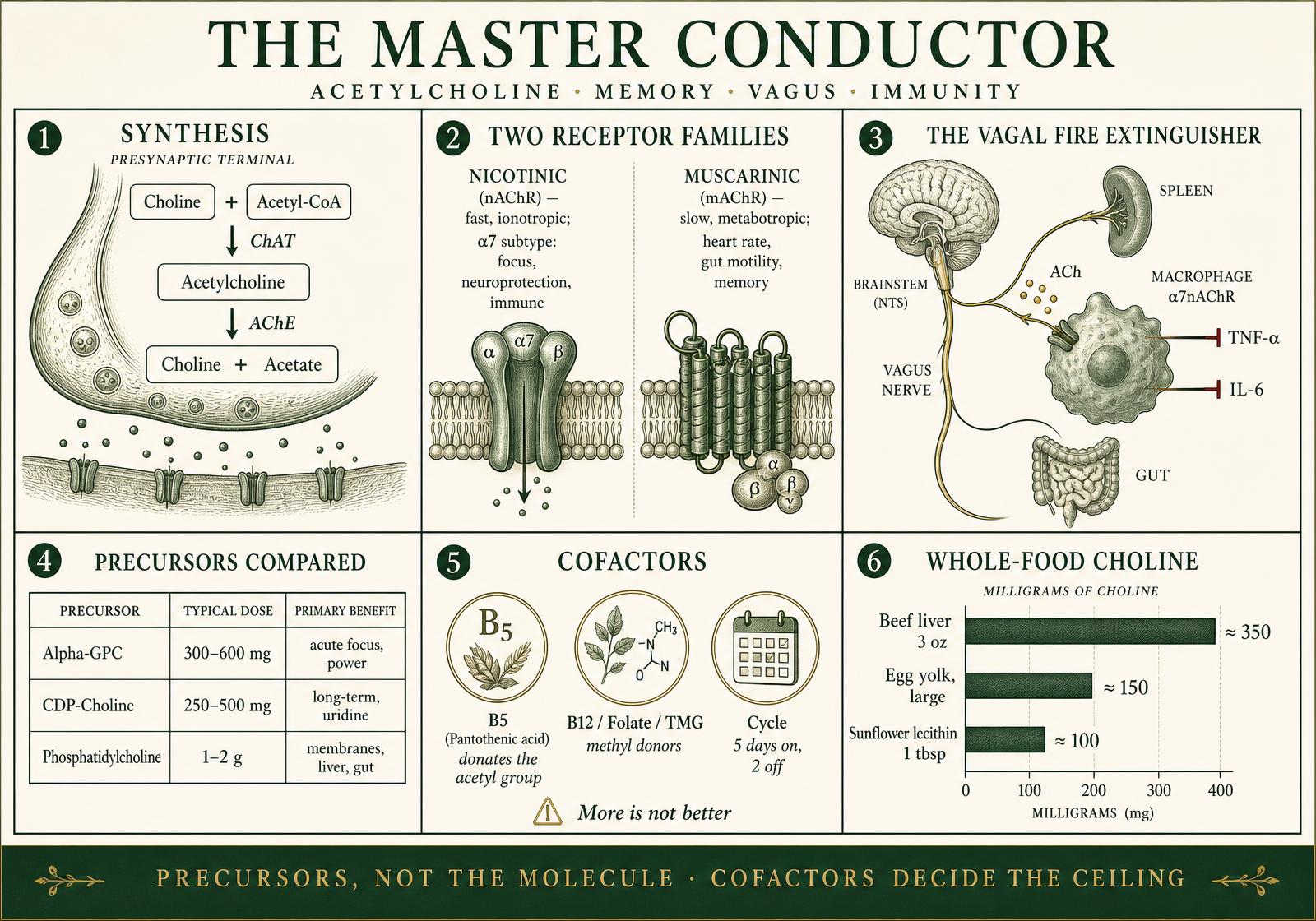
Acetylcholine is synthesized on site from choline plus acetyl-CoA by choline acetyltransferase (ChAT) and destroyed within milliseconds by acetylcholinesterase (AChE). Only precursors and cofactors are actionable.
It acts on two receptor families: fast nicotinic receptors (the α7 subtype drives focus, neuroprotection, and immune modulation) and slow muscarinic receptors (parasympathetic function and memory consolidation).
The vagus nerve uses ACh at α7 receptors on splenic and gut macrophages to suppress TNF-α and IL-6 — the cholinergic anti-inflammatory pathway, the body's built-in inflammation brake.
More choline is not better. Un-cycled high-dose supplementation depletes methyl groups and downregulates receptors, producing the lethargy and low mood widely reported as "choline depression."
Whole-food choline — beef liver (~350 mg per 3 oz) and free-range egg yolks (~150 mg each) — comes packaged with the B vitamins and betaine the pathway needs.
The Primer
The essential idea
Acetylcholine is the "pay attention" and "rest and digest" chemical at once. In the brain it gates attention and lays down memory; in the body it is the transmitter of the parasympathetic nervous system and the neuromuscular junction. When cholinergic signaling is strong you get sharp recall, deliberate focus, good gut motility, and higher heart rate variability. When it is weak, the whole set degrades together.
What actually moves the needle
- Eat the traditional staples. Three to four whole free-range egg yolks daily, or beef liver once or twice a week. Free-range matters here for the same reason it matters elsewhere in the Codex: pasture-raised yolks carry a better fatty-acid profile and higher fat-soluble vitamin content, and the choline arrives as phosphatidylcholine rather than an isolated salt.
- Supplement strategically, not constantly. Alpha-GPC 300–600 mg or CDP-choline (citicoline) 250–500 mg, timed 45–60 minutes before demanding cognitive work or heavy training. A ready-made Alpha-GPC + Creatine + Lion's Mane stack fits this protocol well; the affiliate link supports the Codex at no extra cost.
- Respect the cofactors. Choline without vitamin B5 (pantothenic acid, which supplies the acetyl group) and without B12/folate/TMG (which keep the methyl economy solvent) is largely inert.
- Cycle it. Five days on, two days off is a reasonable default to limit receptor downregulation and the mood dip that follows chronic loading.
The signs of low tone
Word-finding delays and poor short-term recall, difficulty entering focused work, weak mind-muscle connection during lifting, constipation and slow gastric emptying, dry eyes and dry mouth, and low HRV. Anticholinergic drug burden — many antihistamines, some sleep aids, older antidepressants, bladder medications — is a common and reversible contributor, and is worth reviewing with a clinician before adding anything.
The Deep Dive
The full mechanism
- Synthesis. In the presynaptic terminal, choline (imported by the high-affinity CHT1 transporter) is combined with acetyl-CoA by ChAT. Choline uptake, not ChAT activity, is usually rate-limiting — which is why precursor availability matters at all.
- Receptor binding. Nicotinic receptors (nAChRs) are ionotropic and fast; the homopentameric α7 subtype has high calcium permeability and is the principal target for cognition, neuroprotection, and immune modulation. Muscarinic receptors (mAChRs, M1–M5) are G-protein coupled and slow, dominating parasympathetic output and hippocampal memory consolidation.
- Termination. AChE hydrolyzes ACh to choline and acetate within milliseconds, and roughly half the liberated choline is recaptured for resynthesis. This tight recycling is why tonic flooding of the system is neither necessary nor benign.
- The cholinergic anti-inflammatory pathway (CAIP). Efferent vagal signaling, relayed through the splenic nerve, results in ACh release onto α7nAChRs on macrophages, which inhibits NF-κB translocation and suppresses TNF-α and IL-6 release (Tracey, Nature, 2002; Rosas-Ballina et al., Science, 2011). Inflammation control is therefore partly a neural reflex, not only a biochemical state.
Tier II · Members only · Free
Continue into the deep dive
Tier I is free and always open. Tier II — the full mechanisms, dosing detail, nuance, and citations — unlocks with a free Vital Codex membership.
- Every Tier II deep dive across all hubs
- Saved reading progress across articles
- Member knowledge modules and their quizzes
- The Dispatch, if you opt in
Frequently asked
Can I take an acetylcholine supplement directly?
No. Acetylcholine is a charged ester that is hydrolyzed by esterases in the gut and cannot cross the blood-brain barrier. Raising cholinergic tone requires precursors (Alpha-GPC, CDP-choline, dietary phosphatidylcholine) plus the cofactors — B5 for the acetyl group, B12 and folate for the methyl economy — that the body uses to synthesize it.
What is "choline depression" and how do I avoid it?
It is the lethargy, flat affect, and fog that follow sustained high-dose choline supplementation, attributed to methyl-group depletion and cholinergic receptor downregulation. Avoid it by using the lower end of the dose range, cycling (for example five days on, two off), and ensuring adequate B12, folate, or TMG intake.
Alpha-GPC or CDP-choline?
Alpha-GPC for acute needs — 45 minutes before deep work, study, or heavy resistance training — because it raises brain choline quickly. CDP-choline for daily long-term support, because its uridine metabolite contributes to neuronal membrane repair and dopamine receptor health.
Do egg yolks and liver raise my TMAO and heart risk?
Not reliably. TMAO production depends on specific gut bacteria, and it is highest in dysbiosis and with isolated choline salts. Whole foods deliver choline alongside betaine and phospholipids, and controlled egg-feeding studies do not show the harm implied by observational TMAO associations. Fix the microbiome rather than avoiding the food.
How long before I notice anything?
Acute precursors produce noticeable focus and mind-muscle connection in 45–60 minutes. The structural changes — better HRV, gut motility, and memory consolidation — track consistent precursor intake plus vagal work over two to four weeks.
Research Notes & Sources(expand)
- Tracey KJ. The inflammatory reflex. Nature. 2002;420(6917):853–859.
- Rosas-Ballina M, et al. Acetylcholine-synthesizing T cells relay neural signals in a vagus nerve circuit. Science. 2011;334(6052):98–101.
- Zeisel SH, da Costa KA. Choline: an essential nutrient for public health. Nutr Rev. 2009;67(11):615–623.
- Wallace TC, et al. Choline: the underconsumed and underappreciated essential nutrient. Nutr Today. 2018;53(6):240–253.
- Parnetti L, et al. Choline alphoscerate in cognitive decline. Mech Ageing Dev. 2001;122(16):2041–2055.
Educational content only, not medical advice. Cholinergic agents interact with anticholinergic drugs, AChE inhibitors, and cardiovascular medications — review any protocol with a qualified clinician first.
Continue exploring: The Vital Codex library on cognition, vagal tone, and the nutrients that carry the signal.
Explore Cognition