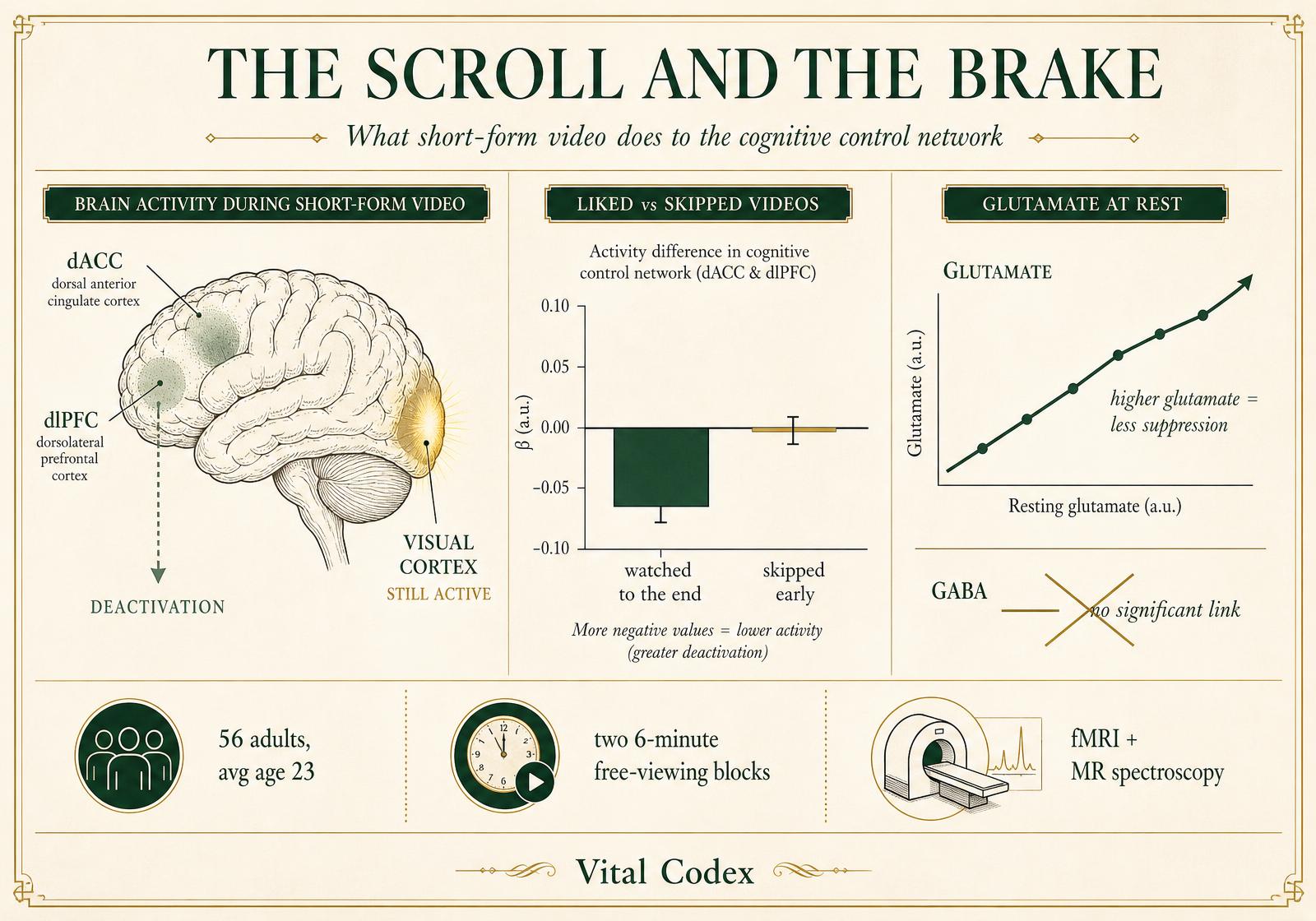
A preregistered brain-imaging study from Zhejiang University found that when young adults watched short videos they liked enough to finish, activity fell below baseline in two hubs of the cognitive control network — the dorsal anterior cingulate cortex (dACC) and the dorsolateral prefrontal cortex (dlPFC). The visual cortex kept working. What went quiet was the system that monitors behavior, detects conflict, and decides when to apply more effort or stop (Hong et al., NeuroImage, 2026; https://doi.org/10.1016/j.neuroimage.2026.121722).
That is a mechanistic account of a familiar experience. The feed does not only compete with your self-control; during the clips it selects best, it appears to briefly turn down the network self-control runs on.
Contents(13 sections)
Key takeaways
In 56 young adults (mean age ~23), both the dACC and dlPFC deactivated during preferred short videos watched to completion, compared with clips abandoned early.
The visual cortex remained strongly engaged — this is not disengagement, it is engagement without monitoring.
Resting glutamate in the dACC predicted individual differences: higher glutamate, less suppression. GABA showed no significant association.
Functional connectivity between the dACC and dlPFC increased during viewing, especially for preferred clips — the network coupled together as it dialed down.
This is a state effect measured during viewing, not proof of lasting damage. The larger concern comes from converging longer-horizon evidence on attention, memory, and impulsivity.
The Primer
What the study actually did
Researchers recruited 66 young adults and retained usable data from 56 (19 female, mean age ~23). Inside the scanner, participants watched two six-minute blocks of short videos on a real-world style feed and could skip any clip at will. Clips watched to the end were treated as "liked"; clips abandoned before the halfway point were treated as "disliked." Alongside fMRI, the team used proton magnetic resonance spectroscopy (1H-MRS) to measure resting glutamate and GABA concentrations in the dACC.
What they found
Three results matter.
First, the dACC and dlPFC both showed significant deactivation for preferred videos relative to skipped ones. Deactivation means activity dropped below the task baseline — not merely that it failed to rise.
Second, the visual cortex stayed active throughout. The brain was processing the stream intensely. The change was specific to the evaluative and regulatory layer sitting on top of that processing.
Third, resting dACC glutamate tracked the size of the effect. Participants with higher glutamate concentrations showed less suppression of both regions. GABA did not show a significant relationship, which argues against a simple "more inhibition" story and points toward excitatory metabolic capacity instead.
Why this is worth taking seriously
The dACC is the brain's conflict and effort monitor: it registers when what you are doing diverges from what you intended and signals that more control is needed. The dlPFC implements that control — holding a goal, resisting a competing pull. When both regions go quiet during exactly the content the algorithm has learned you will finish, the internal interrupt that would say that's enough, put it down is operating with less signal.
What it does not show
It does not show that a few minutes of scrolling causes permanent change. Deactivation is not damage; task-negative deactivation is a normal feature of immersive states, including flow and film viewing. The sample was small, mostly male, and young. "Liked" was inferred from watch-through behavior rather than measured with post-hoc ratings, and compulsive-use patterns were not thoroughly assessed. Read it as a clean state-level mechanism, not an epidemiological verdict.
The Deep Dive
The deactivation is not simply "default mode" reversal
The naive reading — attention inward versus outward — does not fit. If short videos merely pulled attention outward, you would expect default-mode suppression with control-network recruitment, the standard external-task signature. Here the control hubs went the other direction while sensory cortex stayed high. Together with the finding that dACC–dlPFC functional connectivity increased during preferred viewing, the pattern looks less like network disintegration and more like a coupled control system settling into a low-demand mode: monitoring stays coordinated but stops calling for effort, because the environment presents no conflict to resolve. Nothing needs deciding when the next reward arrives unrequested.
That is the frontier claim worth holding carefully. Low dACC output during a task with no conflict is arguably correct computation. The problem is behavioral, not physiological: the interface has engineered away the conflict signal that would otherwise terminate the session.
Tier II · Members only · Free
Continue into the deep dive
Tier I is free and always open. Tier II — the full mechanisms, dosing detail, nuance, and citations — unlocks with a free Vital Codex membership.
- Every Tier II deep dive across all hubs
- Saved reading progress across articles
- Member knowledge modules and their quizzes
- The Dispatch, if you opt in
Frequently asked
Does watching short videos damage your brain?
This study does not show damage. It shows a temporary state during viewing in which two control-network regions become less active. Longer-horizon studies report associations with attention, memory, and impulsivity, but they are largely cross-sectional and cannot establish that the videos caused the differences.
Why does the effect only appear for videos people like?
Preferred clips were those watched to completion, meaning no conflict arose and no decision was required. Skipped clips demand an evaluation and an action. The control network's job is exactly that evaluation, so it stays engaged when the content is unsatisfying and quiets when the content is doing its work.
What does glutamate have to do with self-control?
Resting glutamate in the dACC appears to index how robustly the control network holds up under immersive stimulation — higher levels were associated with less suppression. It is best read as a marker of individual capacity, not as something to supplement. Glutamate is not a supplement target.
Is this the same thing as dopamine addiction?
They describe different halves of the same loop. Dopaminergic reward-prediction signaling explains why the next clip is compelling; control-network deactivation explains why the decision to stop is not made. Neither requires the word "addiction" to be clinically accurate for most users.
What actually helps?
Structural friction rather than in-session resolve: pre-set stop conditions, app timers, removing one-tap access, and protecting sleep and aerobic fitness, which support the control capacity this study found to vary between individuals.
Continue exploring: Cognition — Neurogenesis, synaptic plasticity, and focus architecture.
Explore Cognition