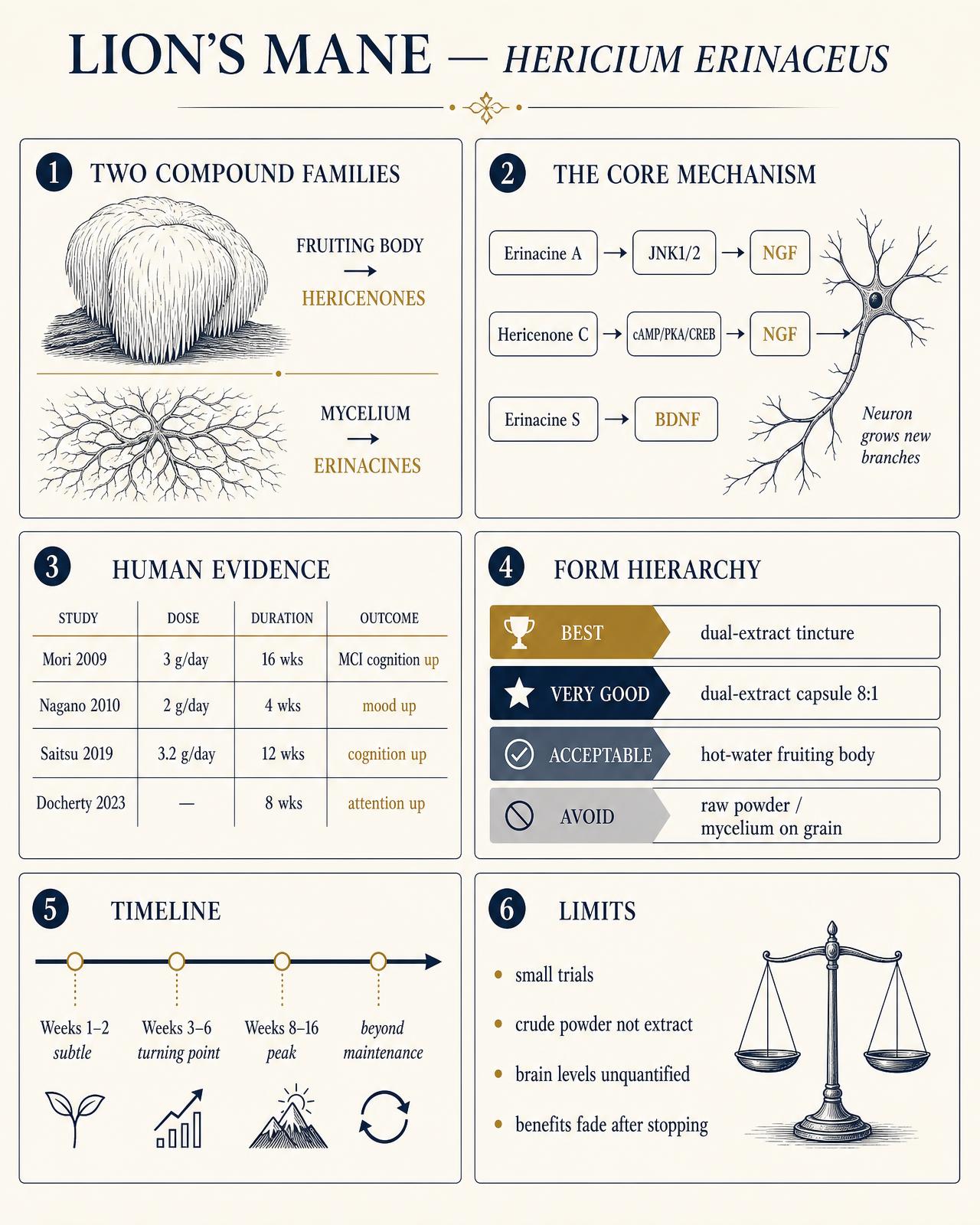
Lion's Mane (Hericium erinaceus) is the only edible organism known to contain compounds that directly increase nerve growth factor (NGF) synthesis in nervous tissue. Two families do the work: hericenones, concentrated in the fruiting body, and erinacines, concentrated in the mycelium. Both are small and lipophilic enough to cross the blood–brain barrier, which is what separates them from most plant "brain" compounds that act only peripherally.
That mechanism is genuinely unusual. The human evidence is genuinely thin. The most cited trial enrolled 30 people, ran 16 weeks, used crude powder rather than concentrated extract, and found that gains faded after participants stopped (Mori et al., 2009). Holding both facts at once is the whole point of this entry.
The mechanism is the strongest part of the story. The trials are the weakest. Both statements are true at once.
Contents(16 sections)
The essentials at a glance
Hericenones (fruiting body) and erinacines (mycelium) are the active families; erinacine A is the most potent known natural inducer of NGF synthesis, active at nanomolar concentrations in vitro.
The best human data: 3 g/day for 16 weeks improved cognitive scores in mild cognitive impairment, and the benefit reversed after discontinuation — this is a maintenance compound, not a permanent upgrade.
Mood and anxiety data are more consistent than cognition data in healthy adults, where effect sizes are modest and ceiling effects are likely.
Form beats dose. Dual extraction (water plus alcohol) with both fruiting body and liquid-cultured mycelium is the only preparation that captures both compound families. "Mycelium on grain" without extraction is largely starch.
Practical range: 500–1,000 mg concentrated extract daily for general support; 1,500–3,000 mg for neuroprotective goals. Take it in the morning or early afternoon.
Expect nothing dramatic in weeks 1–2, a turning point at weeks 3–6, and a plateau at weeks 8–16.
Safety is excellent: no serious adverse events in any human trial. Mushroom allergy is the clear exclusion; active malignancy warrants oncologist input given theoretical NGF concerns.
The Primer
The organism
Lion's Mane grows as a white cascading mass on hardwood across North America, Europe, and East Asia, and has been used in Traditional Chinese Medicine as a digestive and nervous-system tonic. Over the past fifteen years it has become the most studied medicinal mushroom in neuroscience, largely because of one discovery: its terpenoid and aromatic constituents raise the expression of the neurotrophins your brain uses to grow, repair, and protect neurons.
What the human evidence actually shows
Cognition. In adults with mild cognitive impairment, 3 g/day for 16 weeks significantly improved standardized cognitive function scores versus placebo — and scores drifted back toward baseline after discontinuation (Mori et al., 2009). In healthy adults, 3.2 g/day for 12 weeks improved cognitive function scale performance, with processing speed and executive tasks most affected (Saitsu et al., 2019). A 2023 randomized trial in healthy young adults found improved Stroop performance and lower self-reported stress after 8 weeks (Docherty et al., 2023).
Mood and anxiety. Women taking 2 g/day for 4 weeks reported significant reductions in depression and anxiety scores alongside fewer somatic complaints such as palpitations and irritability (Nagano et al., 2010). Replications cluster in subclinical depression and high perceived stress, with the effect strongest in the first 4–8 weeks.
Sleep. Reported improvements in subjective sleep quality and sleep latency look downstream of reduced anxiety and inflammatory tone rather than sedation. Results are more consistent with earlier dosing.
Gut. Human and translational data point to mucosal repair, reduced H. pylori colonization, and a shift in the microbiome toward beneficial species — which retroactively supports the traditional use for gastritis and ulcers.
Neuroprotection. Pilot work in early Alzheimer's disease and post-concussion recovery is encouraging and uncontrolled. The mechanistic rationale is strong; the outcome data are not yet there.
Form matters more than dose
The most common mistake is buying undifferentiated mushroom powder. The hierarchy:
| Tier | Form | Verdict |
|---|---|---|
| Best | Dual-extracted tincture (water + alcohol), fruiting body plus mycelium | Full spectrum: hericenones and erinacines |
| Very good | Dual-extracted capsule, ≥8:1 concentration, third-party tested | Convenient and reliable |
| Acceptable | Hot-water extract, fruiting body only | Hericenones and beta-glucans; misses erinacines |
| Avoid | Raw powder, "mycelium on grain" without extraction, unverified blends | Mostly starch, minimal actives |
Why dual extraction: alcohol pulls the terpenoid hericenones and erinacines; water pulls the beta-glucans. A single solvent gives you half the mushroom. And because hericenones come from the fruiting body while erinacines come from the mycelium, a product using only one raw material is incomplete by design, not by accident.
What to check on a label: dual extraction stated explicitly; fruiting body and liquid-cultured mycelium; DNA-confirmed Hericium erinaceus; a third-party certificate of analysis for heavy metals and microbes; beta-glucan content ≥20%; concentration ratio ≥8:1; organic or verified wild-harvest, because mushrooms bioaccumulate metals; no maltodextrin or rice-flour filler; dark glass if it is a tincture.
Dosing, timing, and what to expect
- General cognitive and mood support: 500–1,000 mg concentrated extract daily, or 1–2 mL of a quality dual extract twice daily.
- Mild cognitive impairment or active neuroprotection goals: 1,500–3,000 mg extract daily.
- Gut repair: 1,000–2,000 mg daily with food.
Take it in the morning or early afternoon; a minority of people report mild sleep disruption when dosing within four hours of bed. Cycling is optional — 5 days on / 2 off, or 3 weeks on / 1 off — and continuous use up to 6–12 months has shown no adverse effects in trials.
Timeline: weeks 1–2 subtle, mostly mood and less brain fog; weeks 3–6 the turning point, where verbal fluency, working memory, and emotional resilience become noticeable; weeks 8–16 the peak seen in trials; beyond that, maintenance for as long as you keep taking it.
Reasonable pairings: DHA/EPA for membrane fluidity and BDNF, Bacopa monnieri for complementary dendritic effects, magnesium L-threonate for synaptic density, and aerobic exercise, which raises BDNF on its own and is the one addition with better evidence than the mushroom itself.
Safety
Remarkably well tolerated: no serious adverse events reported in any human trial, with mild transient GI discomfort the usual complaint. Anyone with a mushroom allergy should avoid it. Theoretical concern about NGF stimulation during active malignancy is unproven but worth raising with an oncologist. No clinically significant drug interactions are documented.
The Deep Dive
Constituents, in detail
More than 70 bioactives have been identified. Two families dominate pharmacologically.
Hericenones (A–R) are aromatic compounds from the fruiting body. Hericenones C, D, and H are the most potent in vitro NGF inducers. They are lipophilic and need alcohol extraction to be recovered at meaningful concentration; hericenone C crosses the blood–brain barrier in rodents and potentiates NGF gene expression through the cAMP → PKA → CREB axis.
Tier II · Members only · Free
Continue into the deep dive
Tier I is free and always open. Tier II — the full mechanisms, dosing detail, nuance, and citations — unlocks with a free Vital Codex membership.
- Every Tier II deep dive across all hubs
- Saved reading progress across articles
- Member knowledge modules and their quizzes
- The Dispatch, if you opt in
Frequently asked
Does Lion's Mane actually cross the blood–brain barrier?
The individual compounds do. Hericenone C and erinacines A, H, and I have demonstrated barrier permeability in animal pharmacokinetic studies. What has not been established is what concentration reaches human brain tissue at supplemental doses — the honest answer is that the route exists and the dose–exposure relationship is unmeasured.
Fruiting body or mycelium — which should I buy?
Both, in one product. Hericenones come from the fruiting body and erinacines from the mycelium, so choosing one means giving up a compound family. What to reject is "mycelium on grain" sold unextracted, which is mostly the grain substrate.
How long before I notice anything?
Weeks 3–6 is the usual turning point, with the trial peak at 8–16 weeks. If nothing has changed by 12 weeks on a properly dual-extracted product at an adequate dose, it is reasonable to conclude you are a non-responder.
Do the benefits last after I stop?
Based on the Mori trial, no — cognitive scores drifted back toward baseline after discontinuation. Treat it as maintenance. Whether the frontier epigenetic findings change that picture is an open question, not a current claim.
Can it help peripheral neuropathy?
The remyelination and nerve-conduction data are the most mechanistically direct case for it, but that evidence is preclinical. It is a defensible adjunct alongside the established metabolic and B-vitamin work in neuropathy, not a substitute for it.
Who should not take it?
Anyone with a mushroom allergy. Anyone with an active malignancy should raise the theoretical NGF concern with their oncologist before starting. If you are pregnant, breastfeeding, or on immunosuppressants, there is no adequate human safety data — get clinical guidance.
Is a tincture really better than capsules?
A well-made dual-extracted capsule at ≥8:1 is close enough that convenience can decide it. The tincture advantage is a broader recovery of lipophilic compounds and the sublingual route; the capsule advantage is that you will actually take it daily for four months, which matters more than either.
Research Notes & Sources(expand)
- Mori K, et al. Improving effects of the mushroom Yamabushitake (Hericium erinaceus) on mild cognitive impairment: a double-blind placebo-controlled clinical trial. Phytother Res. 2009.
- Nagano M, et al. Reduction of depression and anxiety by 4 weeks Hericium erinaceus intake. Biomed Res. 2010.
- Saitsu Y, et al. Improvement of cognitive functions by oral intake of Hericium erinaceus. Biomed Res. 2019.
- Docherty S, et al. The acute and chronic effects of Hericium erinaceus on mood and cognitive performance. Nutrients. 2023.
- Kawagishi H, et al. Hericenones C, D and E, stimulators of nerve growth factor synthesis. Tetrahedron Lett. 1991.
- Lee KF, et al. Erinacine A-enriched Hericium erinaceus mycelium and neuroprotection. Int J Mol Sci. 2016.
- Ryu SH, et al. Erinacine S from Hericium erinaceus and hippocampal neurogenesis. J Nat Prod. 2018.
- Brandalise F, et al. Hericium erinaceus modulates hippocampal plasticity and recognition memory in mice. Evid Based Complement Alternat Med. 2017.
- Chong PS, et al. Therapeutic potential of Hericium erinaceus for depressive disorder. Int J Mol Sci. 2020.
This article is educational and is not medical advice. Discuss supplementation with a qualified clinician, particularly if you are pregnant, breastfeeding, managing a malignancy, or taking prescription medication.
Continue exploring: The Vital Codex library on neuroplasticity, cognitive resilience, and the compounds that credibly support them.
Explore Cognition