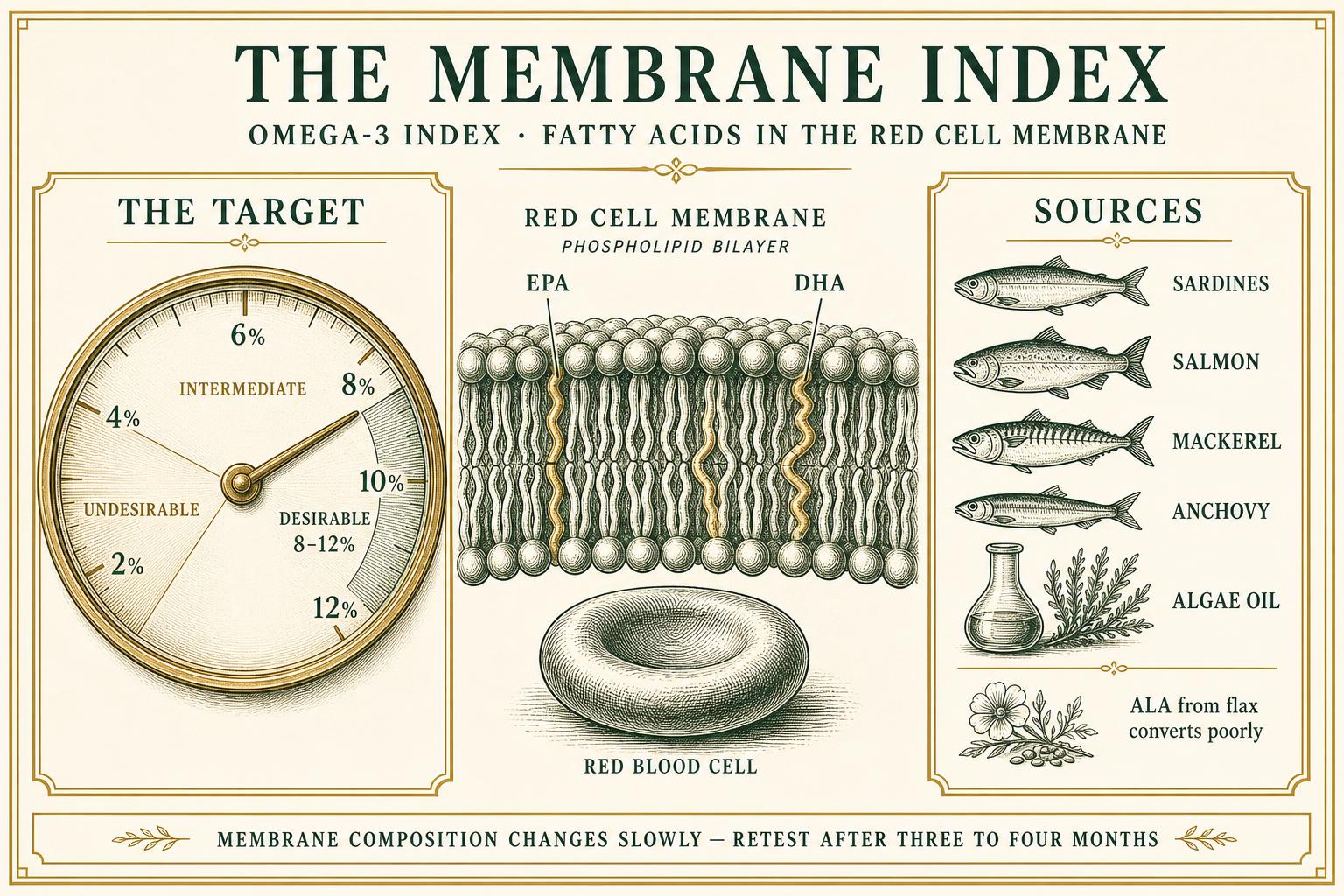
The omega-3 index measures EPA and DHA as a percentage of total fatty acids in red blood cell membranes. It reflects roughly the previous four months of intake and absorption, and in the Framingham cohort it predicted all-cause mortality about as well as smoking status. Almost nobody measures it.
Contents(12 sections)
Key takeaways
Target 8–12%; below 4% is associated with the highest cardiovascular risk.
Red cell membrane composition reflects ~120 days of status, unlike plasma or intake recall.
EPA and DHA do different jobs: EPA is more anti-inflammatory, DHA is structural in brain and retina.
Dose to a measured result — absorption varies severalfold between individuals.
The Primer
Why intake is a bad proxy
Two people taking the same 1 g of fish oil daily can land two full percentage points apart on the index. Formulation (triglyceride versus ethyl ester), whether it is taken with fat, gut absorption, and baseline diet all move the result. Asking what someone takes does not tell you what is in their membranes.
Red blood cells turn over roughly every four months, so their fatty acid composition is a smoothed integral of the recent past — the same logic that makes HbA1c more useful than a single glucose reading.
The target and what it means
An index of 8–12% is the range associated with the lowest cardiovascular event rates. Below 4% carries the highest risk. Typical Western values sit between 4% and 6%; Japanese population averages sit near 9–11%, which is the observation the target was built from.
The index is not simply a lipid measure. Membrane fatty acid composition affects fluidity, receptor behavior, and the raw material available for resolving inflammation.
Getting there
Two to three servings weekly of fatty fish — salmon, sardines, mackerel, herring, anchovies — moves most people into range. Supplementally, 1–2 g combined EPA plus DHA daily is a reasonable starting dose, taken with a fat-containing meal. Retest after three to four months and adjust. A tested, low-oxidation EPA/DHA omega-3 option works for this protocol; the affiliate link supports the Codex at no extra cost.
Plant sources (flax, chia, walnut) supply ALA, which converts to EPA at a few percent and to DHA at under 1% in most adults. ALA is worth eating; it is not a substitute.
The Deep Dive
Membranes, fluidity, and signaling
DHA is the most conformationally flexible fatty acid in human biology and is concentrated in retinal photoreceptor and synaptic membranes, where it accounts for a large fraction of phospholipid acyl chains. Its presence changes membrane thickness, curvature, and lipid raft organization, altering G-protein-coupled receptor kinetics — including rhodopsin activation and neurotransmitter receptor function.
EPA competes with arachidonic acid for cyclooxygenase and lipoxygenase, shifting eicosanoid output toward less inflammatory 3-series prostaglandins and leukotrienes. Both EPA and DHA are precursors to specialized pro-resolving mediators — resolvins, protectins, maresins — which actively terminate inflammation rather than merely suppressing its initiation. That distinction matters: these are the signals for resolution, not blockade.
Tier II · Members only · Free
Continue into the deep dive
Tier I is free and always open. Tier II — the full mechanisms, dosing detail, nuance, and citations — unlocks with a free Vital Codex membership.
- Every Tier II deep dive across all hubs
- Saved reading progress across articles
- Member knowledge modules and their quizzes
- The Dispatch, if you opt in
Frequently asked
What is a good omega-3 index?
8–12%. Below 4% is the highest-risk band, and typical Western values fall between 4% and 6%.
Is flaxseed a substitute for fish oil?
No. ALA conversion to EPA runs at a few percent and to DHA at under 1%, so flax does not meaningfully raise the index.
Should I take EPA or DHA?
Both for general use. EPA-dominant for triglycerides and inflammation, DHA-dominant for brain, retina, and pregnancy.
Is fish oil safe at high doses?
Bleeding risk at typical doses is minimal, but 4 g daily is associated with a small increase in atrial fibrillation. High doses deserve a specific indication and clinical oversight.
Continue exploring: Labs & Biomarkers — Reading bloodwork beyond the reference range.
Explore Labs & Biomarkers