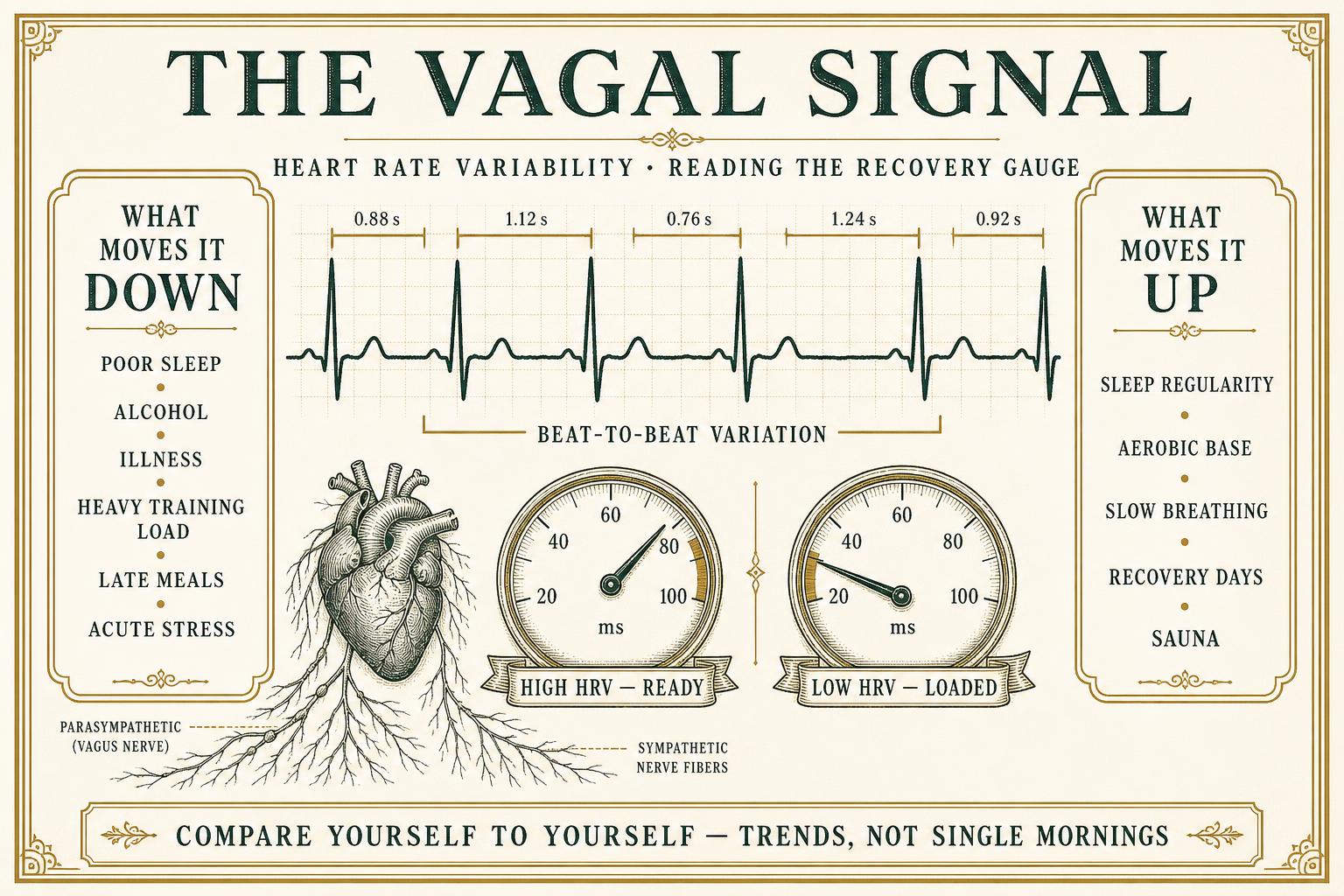
Heart rate variability is the variation in time between consecutive heartbeats. High variability means the autonomic system is responsive; low variability means it is locked into a single mode. It is the closest thing to a daily readout of physiological stress load — and comparing your absolute number to someone else's is the fastest way to render it useless.
Contents(13 sections)
Key takeaways
HRV is individual: only your own baseline and trend are meaningful.
Measure at the same time each day, ideally on waking, in the same posture.
RMSSD is the most robust short-recording metric and reflects parasympathetic activity.
Alcohol, illness, late meals, heat, and training load all suppress it — often before you feel anything.
The Primer
What variability indicates
A healthy heart does not beat like a metronome. The interval between beats fluctuates constantly as the vagus nerve and sympathetic nervous system push against each other. When the parasympathetic (recovery) side has influence, intervals vary more. Under stress, illness, or heavy sympathetic drive, intervals become regular and HRV falls.
Low HRV is consistently associated with worse cardiovascular outcomes, higher inflammatory markers, and greater all-cause mortality in cohort studies. But population associations do not translate directly into individual daily interpretation.
Why your absolute number means little
HRV varies enormously between people — healthy adults span roughly 20 to 200 ms on common metrics. Age, genetics, resting heart rate, and measurement method all shift it. A value of 45 ms may be excellent for one person and a warning for another. The only useful comparison is against your own rolling baseline, typically 30 to 60 days.
Device method matters too. Chest straps read the electrical signal directly; wrist and ring optical sensors infer it from blood volume and are noisier. Mixing devices breaks your own trend line.
How to measure it usefully
Same time daily, immediately on waking, before caffeine or looking at your phone, in the same position — lying or seated, consistently. Two to five minutes is enough. A single low morning is not information; three consecutive low mornings, or a clear drop below your normal range, is.
The Deep Dive
The metrics and what they capture
- RMSSD — root mean square of successive differences. Beat-to-beat, dominated by vagal activity, and stable in short recordings. The default for daily use.
- SDNN — standard deviation of all intervals. Captures total variability including slower rhythms; requires longer recordings (ideally 24 hours) to be meaningful.
- HF power (0.15–0.4 Hz) — respiration-linked, largely parasympathetic.
- LF power (0.04–0.15 Hz) — mixed baroreflex and sympathetic influence. The old "LF/HF = sympathetic balance" interpretation is not supported and should be discarded.
- ln(RMSSD) scaled scores — most consumer platforms report a log-transformed 0–100 value; convenient, but not portable between apps.
Tier II · Members only · Free
Continue into the deep dive
Tier I is free and always open. Tier II — the full mechanisms, dosing detail, nuance, and citations — unlocks with a free Vital Codex membership.
- Every Tier II deep dive across all hubs
- Saved reading progress across articles
- Member knowledge modules and their quizzes
- The Dispatch, if you opt in
Frequently asked
What is a good HRV number?
There isn't a universal one. Healthy adults range from roughly 20 to 200 ms depending on age, genetics, and measurement method — only your own baseline and trend are interpretable.
Why did my HRV crash after one drink?
Alcohol suppresses parasympathetic activity for hours and disrupts sleep architecture. It is one of the largest reproducible single-night HRV effects.
Should I skip training when HRV is low?
Not on a single low day. Two to three consecutive low readings, especially with elevated resting heart rate, justify reducing intensity.
Are wrist and ring devices accurate enough?
For trends, generally yes, provided you use the same device consistently. Chest straps remain more accurate for absolute values and beat-to-beat detection.
Continue exploring: Labs & Biomarkers — Reading bloodwork beyond the reference range.
Explore Labs & Biomarkers