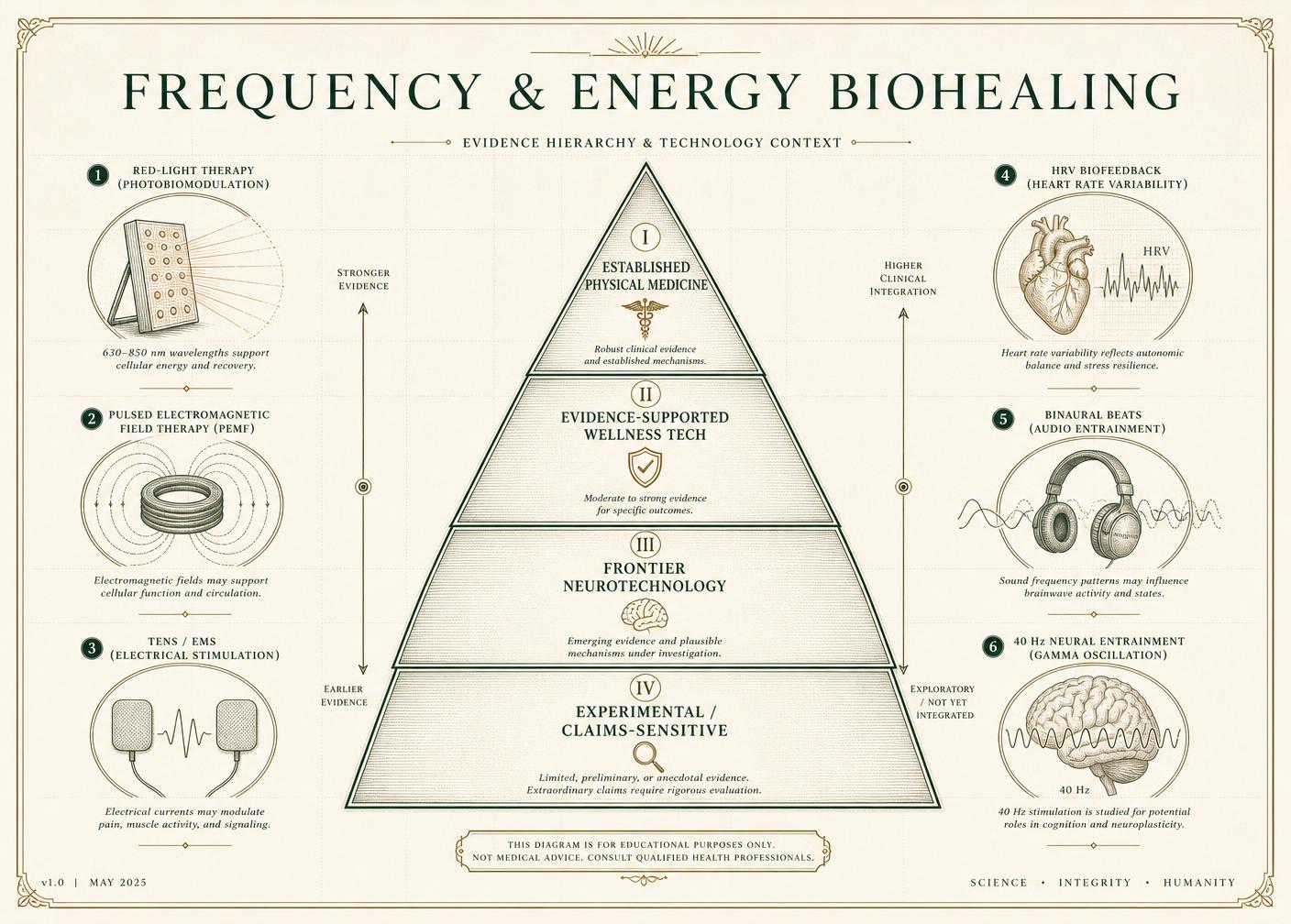
Frequency- and energy-based health technology spans a spectrum from conventional physical medicine to experimental bioenergetics. At the established end sit photobiomodulation, TENS/NMES, indication-specific electromagnetic stimulation, HRV biofeedback, prescription neuromodulation, and clinical vagus nerve stimulation — modalities with identifiable physical outputs, plausible pathways, measurable parameters, and in some cases regulatory authorization.
At the speculative end sit devices marketed as Rife, plasma-frequency, scalar-wave, radionics, remote-frequency, or "quantum frequency" healing. Some produce real light, current, magnetic fields, heat, or vibration. The distinctive claims attached to them — scalar fields, remote transfer, pathogen frequencies, disease eradication — are not established by independent biomedical evidence.
The credible future of bioenergetic technology is closed-loop, personalized, dose-controlled, and measurable — not a universal list of frequencies claimed to heal every condition.
Contents(21 sections)
Key takeaways
"Frequency healing" is not one mechanism. Light, electrical current, magnetic fields, sound, mechanical vibration, and ultrasound are physically distinct inputs with distinct evidence bases.
The strongest evidence belongs to defined indications with defined dosimetry: PBM for specific tissue and pain protocols, TENS for short-term analgesia, electromagnetic stimulation for certain bone-healing indications, HRV biofeedback for autonomic regulation, rTMS for depression.
Dose governs outcome. Wavelength, irradiance, field strength at target distance, waveform, duty cycle, and session duration matter far more than a device's frequency list.
Consumer and medical devices are not interchangeable — a CE-marked or FDA-cleared indication belongs to a specific product, not a whole category.
Rife, plasma, scalar, and radionics systems should be described as experimental wellness hardware, never as substitutes for diagnosis, antimicrobials, oncology, or emergency care.
The most defensible frontier is adaptive bioenergetics: validated measurement plus conservative, well-characterized stimulation, guided by the individual's observed response.
The Primer
The technology map
| Modality | Physical input | Operating principle | Expected effects | Evidence maturity |
|---|---|---|---|---|
| Photobiomodulation | Red/NIR light | Photon absorption, cellular signaling | Mitochondrial, nitric oxide, inflammation, repair | Strong for selected uses |
| PEMF | Pulsed magnetic fields | Induced electric fields, cell signaling | Bone, pain, circulation, recovery | Strong for specific orthopedic uses; mixed for wellness |
| TENS / NMES / IFC | Surface electrical current | Sensory or motor nerve stimulation | Short-term analgesia, muscle recruitment | Well established in specific uses |
| HRV biofeedback | Cardiac feedback + paced breathing | Resonance breathing, baroreflex training | Autonomic flexibility, stress reduction | Strong practical evidence |
| EEG neurofeedback | EEG + feedback loop | Operant conditioning of neural activity | Attention, arousal, self-regulation | Promising; protocol-dependent |
| Audio entrainment | Rhythmic acoustic stimulus | Frequency-following response | Relaxation, focus, sleep support | Mixed / moderate |
| Vibroacoustics | Low-frequency sound + tactile vibration | Somatosensory and autonomic modulation | Relaxation, pain and stress support | Emerging / moderate |
| Vagus nerve stimulation | Auricular/cervical current | Afferent vagal pathway modulation | Autonomic, headache, mood, pain | Meaningful for medical products |
| tDCS / rTMS | Weak current or magnetic pulses | Cortical excitability and plasticity | Mood, cognition, rehabilitation | Established clinical category |
| 40 Hz sensory gamma | Synchronized 40 Hz light/sound | Gamma oscillation entrainment | Memory circuits, sleep, neurodegeneration research | High-potential frontier |
| Focused ultrasound | Focused acoustic energy | Deep-circuit neuromodulation | Reversible deep excitation/inhibition | Research frontier |
| Rife / plasma / scalar | Variable current, plasma, coils, lasers | Claimed resonance or field effects | Broad wellness or disease claims | Experimental / unsupported |
Photobiomodulation, briefly
PBM uses non-ionizing red and near-infrared light, typically 600–1,100 nm, to influence signaling without destructive heat. The leading mechanism is absorption by mitochondrial chromophores — particularly cytochrome c oxidase — altering respiration, nitric oxide availability, reactive oxygen species signaling, and inflammatory gene expression. The response is biphasic: too little does nothing, too much reduces benefit.
Its strongest evidence is not "whole-body optimization" but defined applications with defined dosimetry. Clinical lasers and consumer LED panels differ in output, wavelength, thermal profile, beam geometry, and regulatory status.
Electrical and magnetic inputs
PEMF uses time-varying magnetic fields; the changing field induces weak electric effects in tissue, with proposed downstream action on ion channels, calcium and adenosine signaling, nitric oxide, angiogenesis, and bone remodeling. The best-established use is medical orthopedic stimulation, including certain delayed-union contexts. Claims of "cellular charging," immune enhancement, or systemic detoxification are much weaker and highly product-dependent.
Electrical stimulation splits by target. TENS is primarily sensory, for pain modulation. NMES/EMS drives motor nerves for contraction and rehabilitation. IFC uses medium-frequency currents for comfort. Microcurrent has the least consistent evidence. The defensible TENS claim is short-term pain reduction during or immediately after correctly delivered stimulation — not cure, detoxification, or pathogen eradication.
Measurement as the honest starting point
HRV biofeedback is the least glamorous and best-supported entry point: a cardiac sensor plus paced resonance breathing trains baroreflex sensitivity and autonomic flexibility. It costs the least, generates real data, and makes every subsequent modality easier to evaluate, because you can see whether a session moved your physiology at all.
How to read a claim
Ask four questions of any device: what physical output does it actually produce, at what measured dose at the target, for which specific indication, and in whose published data on this exact hardware? A device that cannot answer all four is a wellness product — which may still be worth owning, provided nobody pretends otherwise.
The Deep Dive
Evidence tiers
Tier A — established physical medicine. PBM for defined tissue, skin, pain, and recovery protocols. TENS/NMES for pain modulation and rehabilitation. Medical electromagnetic stimulation for specific orthopedic uses. HRV biofeedback for autonomic and stress regulation. Clinical rTMS, prescription tDCS, and indication-specific VNS.
Tier B — evidence-supported wellness technology. Consumer PEMF, EEG neurofeedback, vibroacoustic therapy, audio-visual entrainment, consumer vagal wearables, and sleep/respiration/HRV-guided feedback systems. Useful for relaxation, pain support, recovery routines, and self-regulation; outcomes depend heavily on protocol, dose, population, and individual response.
Tier II · Members only · Free
Continue into the deep dive
Tier I is free and always open. Tier II — the full mechanisms, dosing detail, nuance, and citations — unlocks with a free Vital Codex membership.
- Every Tier II deep dive across all hubs
- Saved reading progress across articles
- Member knowledge modules and their quizzes
- The Dispatch, if you opt in
Frequently asked
Is "frequency healing" a real scientific field?
Not as a single field. It is an umbrella label covering physically distinct inputs — light, current, magnetic fields, sound, vibration, ultrasound — with very different evidence bases, alongside systems marketed with unverified mechanisms.
Which of these has the best evidence?
For defined indications: photobiomodulation, TENS/NMES, medical electromagnetic bone stimulation, HRV biofeedback, clinical rTMS, and indication-specific vagus nerve stimulation. Evidence attaches to specific protocols and specific devices, not to categories.
Do Rife or scalar devices treat disease?
No accepted independent biomedical evidence supports claims that scalar fields, remote transmission, or "pathogen frequencies" diagnose or treat cancer, infections, parasites, or organ disease. Treat them as experimental wellness hardware and never as a substitute for diagnosis or care.
Is a stronger device a better device?
No. Field strength, irradiance, and current follow biphasic dose-response curves — under-dosing does little and over-dosing can reduce benefit or cause harm. Documented dose at the actual target distance matters more than raw output.
Where should someone start?
With measurement. A validated heart-rate sensor plus paced resonance breathing costs the least, has strong practical evidence, and gives you a baseline against which any later device can be judged.
Are consumer and medical versions of the same modality equivalent?
No. Regulatory clearance is granted to a specific product for a specific indication. A consumer wearable that stimulates the same nerve or emits the same wavelength does not inherit that evidence.
Continue exploring: Frequency & Number Theory — Resonance, spectra, and the mathematics beneath biological signal.
Explore Frequency & Number Theory