Of all frequency-based therapies, sound is the most intuitively plausible and the most aggressively marketed. Everyone has felt music change their state; the leap to "specific frequencies heal specific conditions" feels small. But the evidence landscape is sharply uneven, and the most interesting real science — 40Hz gamma sensory stimulation — is almost never what the marketing is selling.
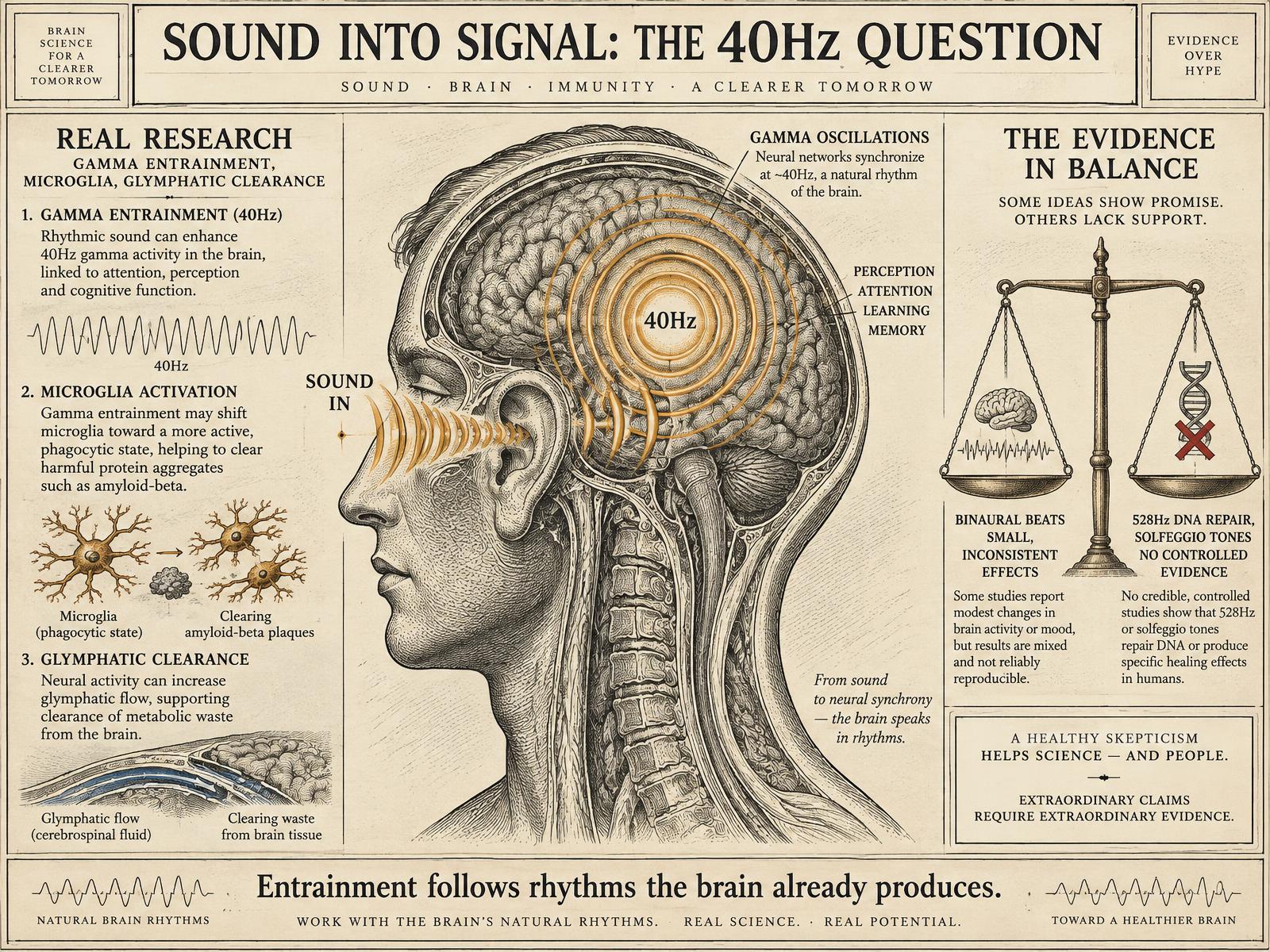
The honest map has three zones. At one end: 40Hz gamma-frequency light and sound stimulation, which has genuine mechanistic research from MIT showing effects on brain immune cells and amyloid pathology in animal models, with early human trials underway. In the middle: binaural beats and brainwave entrainment, where small trials show modest, inconsistent effects on anxiety and attention. At the far end: claims that specific frequencies cure specific diseases, repair DNA, or "resonate" organs back to health — none of which have controlled human evidence.
Contents(12 sections)
Key takeaways
Gamma-frequency (40Hz) sensory stimulation — flickering light and clicking sound — has real peer-reviewed mechanistic research behind it, originating in Alzheimer's disease models at MIT.
In mouse models, 40Hz stimulation reduced amyloid and tau pathology and engaged microglia, the brain's immune cells; human trials are early and small but show the approach is safe and can entrain brain rhythms.
Binaural beats — two slightly different tones, one per ear — show small, inconsistent effects on anxiety and attention in trials; the marketing far exceeds the data.
"Solfeggio frequencies," 528Hz "DNA repair," and organ-specific healing tones have no controlled human evidence.
Sound therapy's strongest established clinical uses are not exotic: music therapy for mood, and white/pink noise for sleep onset, both with ordinary but real evidence.
The Primer
Why 40Hz specifically
The gamma band — brain rhythms around 30–100Hz, with 40Hz as the canonical frequency — is associated with attention, working memory, and the binding of sensory information into coherent perception. In Alzheimer's disease, gamma rhythms are disrupted early. The MIT question was simple and elegant: if the brain's gamma rhythm is failing, can you drive it externally?
The answer, in mice, was yes. Exposing animals to light flickering at 40Hz (and later, sound clicking at 40Hz) entrained gamma activity in sensory cortex, and — remarkably — reduced amyloid plaques and tau tangles while activating microglia, the brain's resident immune cells that clear debris. The effect appeared to work partly through the glymphatic system, the brain's waste-clearance pathway.
Where the human evidence stands
Early human trials of 40Hz light-and-sound devices (the leading effort is Cognito Therapeutics' system) have shown the stimulation is safe, tolerable, and does entrain gamma rhythms in people with Alzheimer's. A Phase 3 trial reported mixed results in 2025 — the therapy did not clearly beat the control on its primary endpoints, though subgroup analyses kept the research programme alive. The honest status: a genuinely promising mechanism, an unproven treatment.
Binaural beats: real effect, small size
Binaural beats work differently. Play 200Hz in one ear and 210Hz in the other, and the brain perceives a phantom 10Hz "beat." The claim is that this entrains the corresponding brain rhythm. Trials show small effects on pre-surgical anxiety and possibly attention, but results are inconsistent, and many studies are poorly controlled. If binaural beats help you relax, there is no reason to stop — but the effect is closer to a relaxation aid than a neurological intervention.
The claims with no evidence
"Solfeggio frequencies" (396Hz, 528Hz, and so on), claims that 528Hz repairs DNA, and charts mapping specific tones to specific organs circulate widely. None have controlled human trial support. The 528Hz claim traces to a single misread study on cell cultures and UV damage — a long way from repairing human DNA with a tuning fork.
The Deep Dive
The gamma mechanism, in more detail
The 40Hz research is notable for having an actual mechanistic chain, rare in frequency medicine. The proposed sequence: sensory stimulation at 40Hz entrains local neural circuits → entrained gamma synchrony recruits microglia and changes their gene expression → microglia engulf amyloid more effectively → glymphatic clearance of metabolic waste increases, partly via aquaporin-4 channels in astrocytes. A 2024 paper in Nature (Murdock et al.) added evidence that 40Hz stimulation promotes amyloid clearance through glymphatic flow — strengthening the chain from rhythm to plumbing.
Two cautions matter. First, mouse Alzheimer's models are notoriously poor predictors of human benefit; dozens of mouse cures have failed in people. Second, entrainment strength varies between individuals, and the optimal dose — session length, daily versus intermittent, light versus sound versus both — is not established.
Tier II · Members only · Free
Join Vital Codex free
Unlock every Tier II deep dive, save your reading, and open the member knowledge modules. Free, no card, no paywall.
The Dispatch is a separate weekly email. Your membership works with or without it.
Frequently asked
Does 40Hz therapy cure Alzheimer's?
No. It is an investigational approach with strong animal data and early, mixed human trial results. It is not an approved treatment, and no one should delay standard care to pursue it. The research is worth watching precisely because the mechanism is real — but mechanism is not cure.
Are binaural beats dangerous?
No — they are ordinary sound at safe volumes. The risk is financial and expectational: paying for elaborate programs promising neurological transformation that the evidence does not support.
What about sound baths and gong therapy?
These are relaxation practices, and relaxation is genuinely valuable — stress reduction has real physiological effects. What they are not is frequency-targeted medicine; any benefit comes from rest, attention, and the parasympathetic shift, not from the specific tones.
Can I try 40Hz stimulation myself?
Consumer devices exist, but the parameters used in research (precise flicker and click timing, verified entrainment) are not guaranteed in consumer products. Simpler, better-evidenced options exist for the same goals: sleep, exercise, and light hygiene all support gamma-band function indirectly.
Research Notes & Sources(expand)
Iaccarino HF, Singer AC, Martorell AJ, et al. "Gamma frequency entrainment attenuates amyloid load and modifies microglia." Nature (2016). The founding MIT paper on 40Hz sensory stimulation.
Martorell AJ, Paulson AL, Suk HJ, et al. "Multi-sensory gamma stimulation ameliorates Alzheimer's-associated pathology and improves cognition." Cell (2019). Combined light-and-sound 40Hz stimulation in mouse models.
Murdock MH, Yang CY, Sun N, et al. "Multisensory gamma stimulation promotes glymphatic clearance of amyloid." Nature (2024). The glymphatic-clearance mechanism paper.
Ngo HVV, Martinetz T, Born J, Mölle M. "Auditory closed-loop stimulation of the sleep slow oscillation enhances memory." Neuron (2013). Phase-locked acoustic stimulation in slow-wave sleep.
Editorial note: this article is an educational synthesis of published research and is not medical advice. Gamma sensory stimulation for Alzheimer's disease remains investigational.
Continue exploring: Frequency & Number Theory — Resonance, spectra, and the mathematics beneath biological signal.
Explore Frequency & Number TheoryThe Codex Dispatch
More on Frequency & Number Theory, one email a week
One considered email each Sunday: research translation, no hype, no supplement pitches. Separate from membership — unsubscribe anytime.