Among frequency-based therapies, photobiomodulation — red and near-infrared light applied to tissue — stands apart for one reason: it has a identified molecular target. Specific wavelengths of light are absorbed by cytochrome c oxidase, the fourth enzyme complex in the mitochondrial electron transport chain, and that absorption measurably changes cellular energy production and signaling. This is not a metaphor. It is photochemistry with a known absorber.
That grounding cuts both ways. Because the mechanism is specific, the therapy is specific: wavelength, dose, and target tissue determine whether anything happens at all. The consumer market's suggestion that any red-tinted glow delivers systemic benefits ignores the actual biophysics — including the uncomfortable finding that beyond an optimal dose, the effect diminishes and can reverse.
Contents(12 sections)
Key takeaways
Photobiomodulation uses red light (roughly 620–700nm) and near-infrared light (roughly 800–880nm); these bands are absorbed by cytochrome c oxidase in mitochondria.
The mechanism is real and partially validated: light absorption displaces inhibitory nitric oxide from the enzyme, improving electron flow and ATP output, and triggering downstream signaling.
The dose-response is biphasic: too little does nothing, too much can inhibit — the "more is better" assumption is actively wrong here.
Best-supported uses: skin (wrinkles, wound healing), some musculoskeletal pain, and possibly exercise recovery. Evidence for systemic or cognitive claims is preliminary.
Device quality varies wildly; irradiance (power per area) and wavelength accuracy matter more than panel size or LED count.
The Primer
Why these wavelengths
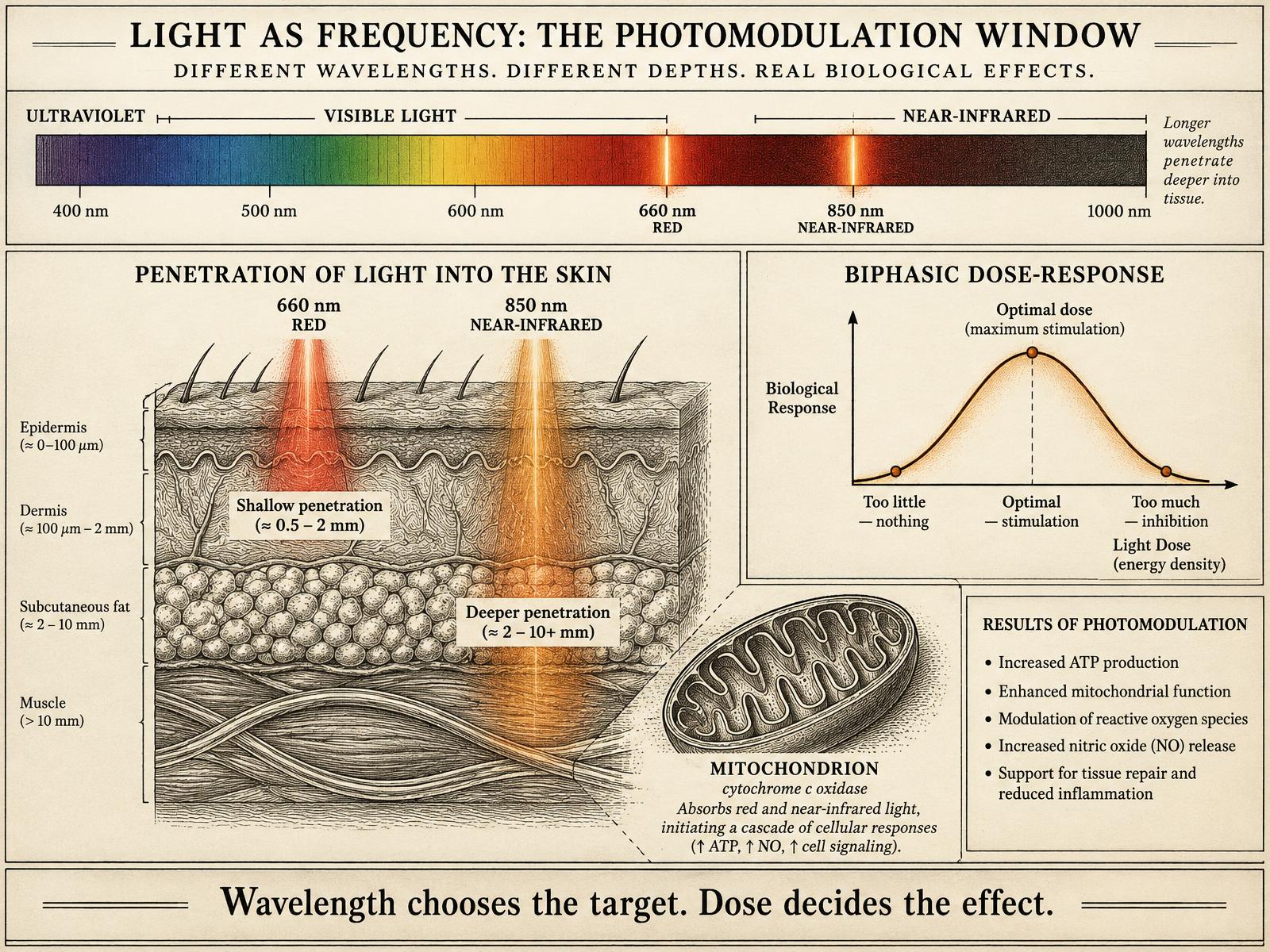
Light interacts with tissue only where it is absorbed. Red light around 660nm penetrates a few millimeters — enough for skin. Near-infrared around 850nm penetrates several centimeters — reaching muscle and, weakly, bone and brain. Both bands coincide with absorption peaks of cytochrome c oxidase. Shorter wavelengths (blue, green) are absorbed superficially by other molecules; longer wavelengths are absorbed by water before reaching anything interesting. The therapeutic "window" is physics, not branding.
What happens in the cell
The leading model: in stressed or hypoxic cells, nitric oxide binds to cytochrome c oxidase and slows the electron transport chain. Photon absorption at the right wavelength displaces that nitric oxide, restoring electron flow, increasing the mitochondrial membrane potential, and raising ATP output. The released nitric oxide also acts as a vasodilation and signaling molecule. Secondary effects include brief, signaling-level increases in reactive oxygen species — a hormetic nudge that activates protective gene programs.
What the evidence supports
The strongest human evidence is in skin: multiple randomized trials show red and near-infrared light improve collagen density, fine lines, and wound healing speed. Musculoskeletal pain and tendinopathy have supportive but heterogeneous trials. Exercise recovery shows reduced muscle damage markers in several studies, though performance effects are small. Claims about systemic fat loss, thyroid optimization, or cognitive enhancement rest on thin or preliminary data.
The dose problem
Photobiomodulation follows the Arndt-Schulz curve: a biphasic response where low doses stimulate and high doses inhibit. A session twice as long is not twice as good — it may be worse than nothing. This makes the "biggest panel, longest session" consumer instinct counterproductive, and it means device dosing guidance should come from measured irradiance, not marketing copy.
The Deep Dive
The cytochrome c oxidase story, precisely
Cytochrome c oxidase (Complex IV) contains two copper centers and two heme groups, each with distinct absorption spectra in the red and near-infrared. Absorption peaks cluster around 620–680nm and 800–880nm — which is exactly why device manufacturers converge on 660 and 850nm. The photochemistry is legitimate; what remains debated is how much of the clinical effect flows through this channel versus through other chromophores (water, opsins, flavins) and through local heating.
An honest complication: cultured-cell and animal studies show robust effects at doses that translate awkwardly to human skin, where scattering and absorption eat most of the photons. The distance between "works in a dish" and "works through 2cm of tissue" is where many enthusiastic claims quietly die.
Tier II · Members only · Free
Join Vital Codex free
Unlock every Tier II deep dive, save your reading, and open the member knowledge modules. Free, no card, no paywall.
The Dispatch is a separate weekly email. Your membership works with or without it.
Frequently asked
Is red light therapy the same as photobiomodulation?
Yes — photobiomodulation (PBM) is the scientific term; "red light therapy" is the consumer name. Older literature calls it low-level laser therapy (LLLT). Modern devices mostly use LEDs rather than lasers, with comparable results.
Does it matter which wavelengths my device uses?
Yes. The evidence clusters around 630–680nm (red) and 800–880nm (near-infrared). Devices at other wavelengths may work through other mechanisms, but they cannot borrow the trial evidence from the studied bands.
Can you overdo red light therapy?
Yes — the dose-response is biphasic. Excessive fluence can inhibit rather than stimulate, and eye protection matters with near-infrared, which you cannot see but which reaches the retina. Follow measured dosing, not session-length escalation.
Will a cheap red light panel work?
Maybe, if its wavelength is accurate and its irradiance at your treatment distance is adequate. The problem is that cheap panels rarely publish verified measurements. A device with stated, third-party-measured irradiance at a defined distance is worth more than a larger panel with neither.
Research Notes & Sources(expand)
Hamblin MR. "Mechanisms and applications of the anti-inflammatory effects of photobiomodulation." AIMS Biophysics (2017). The standard mechanistic review by the field's most-cited researcher.
de Freitas LF, Hamblin MR. "Proposed mechanisms of photobiomodulation or low-level light therapy." IEEE Journal of Selected Topics in Quantum Electronics (2016). The cytochrome c oxidase / nitric oxide model in detail.
Avci P, Gupta A, Sadasivam M, et al. "Low-level laser (light) therapy (LLLT) in skin: stimulating, healing, restoring." Seminars in Cutaneous Medicine and Surgery (2013). The skin-evidence review.
Huang YY, Chen ACH, Carroll JD, Hamblin MR. "Biphasic dose response in low level light therapy." Dose-Response (2009). The paper establishing why more light is not better.
Editorial note: this article is an educational synthesis of published research and is not medical advice. Photobiomodulation devices are regulated differently by jurisdiction and indication.
Continue exploring: Frequency & Number Theory — Resonance, spectra, and the mathematics beneath biological signal.
Explore Frequency & Number TheoryThe Codex Dispatch
More on Frequency & Number Theory, one email a week
One considered email each Sunday: research translation, no hype, no supplement pitches. Separate from membership — unsubscribe anytime.