Pulsed electromagnetic field (PEMF) therapy sits in an unusual position: it is simultaneously an FDA-cleared medical treatment with decades of clinical use and a wellness-market buzzword attached to claims that have never been tested in controlled trials. Both things are true, and confusing them is how people waste money — or dismiss a legitimate therapy.
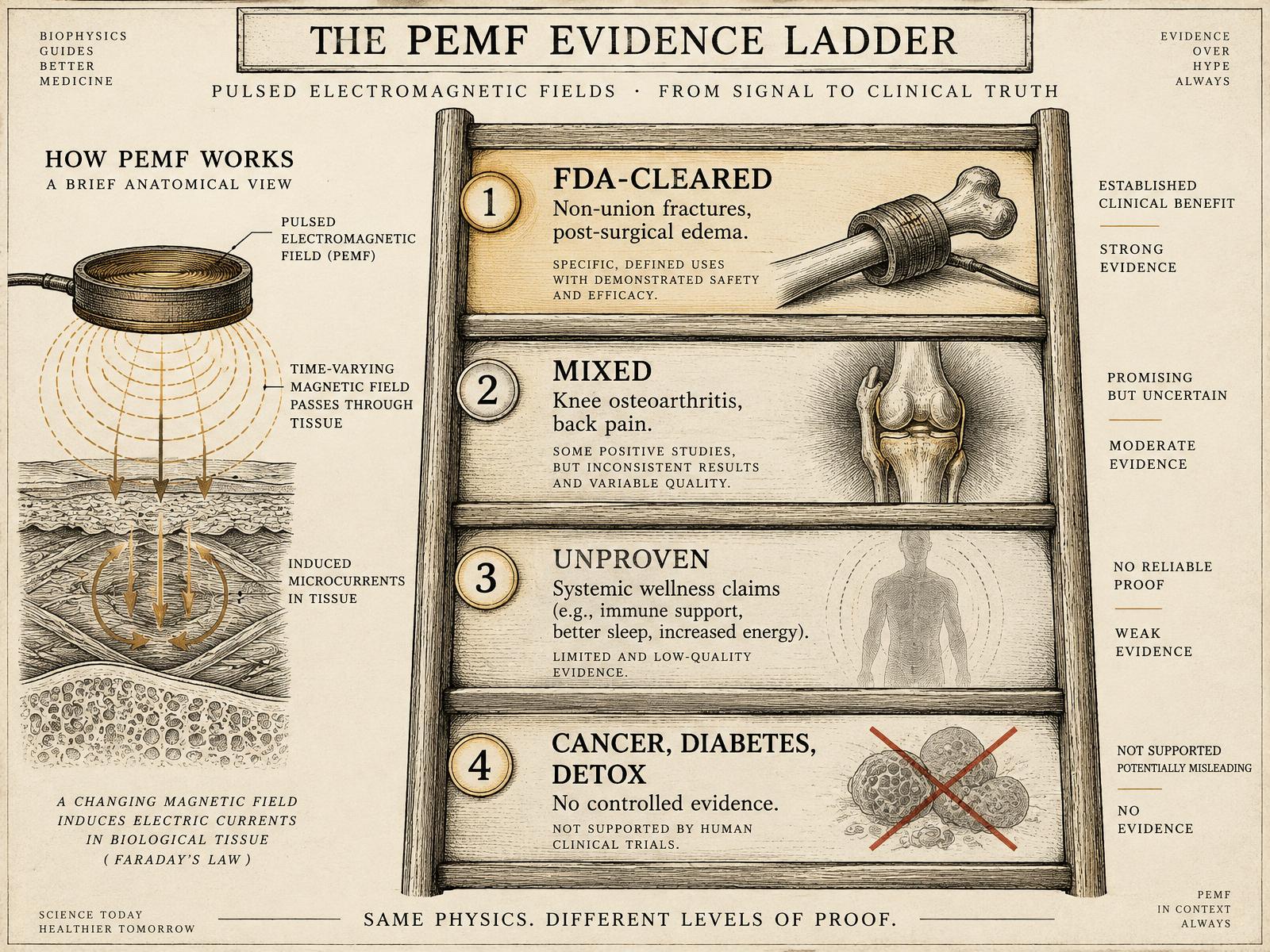
The honest summary is short. PEMF has strong, regulator-reviewed evidence for helping broken bones that refuse to heal (non-union fractures) and for reducing post-surgical pain and swelling. It has mixed, lower-quality evidence for osteoarthritis pain and some other musculoskeletal conditions. And it has essentially no controlled human evidence for the broad systemic claims — "recharging your cells," curing chronic disease, detoxifying — that dominate consumer marketing.
Contents(12 sections)
Key takeaways
PEMF devices are FDA-cleared for non-union bone fractures and post-surgical pain and edema; these clearances rest on randomized controlled trials.
The best-studied mechanism is not mystical: pulsed fields induce tiny electrical currents in tissue that influence calcium signaling, growth-factor release, and bone-cell activity.
Evidence for osteoarthritis and general pain relief is mixed — small trials, inconsistent device parameters, and few replications.
Claims that PEMF treats cancer, diabetes, or systemic disease have no controlled human evidence behind them.
"FDA-cleared" applies to specific devices for specific conditions — it does not transfer to every mat, pad, or wand sold online.
Dose matters: frequency, intensity, waveform, and treatment time vary enormously between devices, which is why study results don't generalize.
The Primer
What PEMF actually is
A PEMF device generates a magnetic field that switches on and off in pulses — anywhere from a few pulses per second to thousands. When that changing field passes through tissue, it induces a very small electrical current, the same physical principle behind an electrical generator. That induced current is the treatment: cells respond to it as a signal.
This is different from static magnets (which produce no changing field and have no comparable evidence) and from the high-intensity electromagnetic energy used in imaging or surgery. PEMF is low-energy, non-invasive, and at therapeutic doses produces no sensation in most people.
Where the evidence is strong
The flagship indication is non-union fractures — broken bones that have failed to heal after months. PEMF received its first FDA clearance for this in 1979, and it remains a standard option when surgery is undesirable. Randomized trials show healing rates broadly comparable to surgical intervention in selected patients, which is remarkable for a device you strap on at home.
The second established use is post-surgical pain and swelling, particularly after breast augmentation and foot and ankle surgery, where cleared devices reduced pain medication use in controlled trials.
Where the evidence is mixed
Osteoarthritis, especially of the knee, is the most-studied "wellness-adjacent" use. Some trials show modest pain reduction; others show nothing. A fair reading: there may be a real but small effect, and we cannot yet say which patients, devices, or dosing schedules it applies to. The same pattern holds for chronic lower back pain and fibromyalgia — suggestive small trials, no definitive replication.
Where there is no evidence
Claims that PEMF treats cancer, reverses diabetes, cures Lyme disease, or "detoxifies" the body have no controlled human trial support. Some of these claims borrow credibility from legitimate but unrelated research — for example, tumor-treating fields (a completely different, much higher-intensity technology that is FDA-approved for glioblastoma) are sometimes cited as if they validate consumer PEMF mats. They do not.
The Deep Dive
The mechanism, as far as it is known
The leading mechanistic model runs through calcium signaling. Pulsed fields induce microcurrents in tissue; these currents affect voltage-gated calcium channels and the calcium-calmodulin pathway, which in turn modulates the release of growth factors including BMPs (bone morphogenetic proteins) and VEGF. In bone, this cascades into increased osteoblast activity and accelerated callus formation — a plausible, partially validated chain from field to healing.
A second proposed pathway involves adenosine receptors (A2A and A3), which mediate anti-inflammatory effects. Animal studies show PEMF exposure upregulates these receptors, offering a candidate explanation for the post-surgical edema findings.
Tier II · Members only · Free
Join Vital Codex free
Unlock every Tier II deep dive, save your reading, and open the member knowledge modules. Free, no card, no paywall.
The Dispatch is a separate weekly email. Your membership works with or without it.
Frequently asked
Is PEMF therapy FDA-approved?
Specific PEMF devices are FDA-cleared for non-union fractures and post-surgical pain and edema. "Cleared" (via the 510(k) pathway) is a lower bar than "approved," and it applies only to the cleared device and condition — not to PEMF generally.
Is PEMF the same as magnet therapy?
No. Static magnets produce a constant field and induce no current in tissue; their evidence base is essentially negative. PEMF uses pulsed, changing fields that induce measurable microcurrents — a different physical intervention with a real (if narrow) evidence base.
Can PEMF help with arthritis pain?
Possibly, modestly, for some people. Trials of knee osteoarthritis show inconsistent small benefits. It is reasonable as a low-risk adjunct, but expectations should be calibrated: the effect sizes in positive trials are mild, not transformative.
Are home PEMF mats worth buying?
For the cleared indications (non-union fractures, post-surgical recovery), prescribed devices have real evidence. General wellness mats are a different matter: their parameters often differ from anything studied, and systemic health claims are unproven. If you try one, treat it as an experiment with a defined trial period, not a medical treatment.
Is PEMF safe?
At therapeutic intensities, PEMF has an excellent safety record across decades of clinical use — no serious adverse events in the major trials. It is contraindicated with implanted electronic devices such as pacemakers, and during pregnancy out of caution.
Research Notes & Sources(expand)
Bassett CAL. "The development and application of pulsed electromagnetic fields (PEMFs) for ununited fractures and arthrodeses." Orthopedic Clinics of North America (1984). Foundational clinical review by the field's pioneer.
Assiotis A, Sachinis NP, Chalidis BE. "Pulsed electromagnetic fields for the treatment of tibial delayed unions and nonunions: a prospective clinical study and review of the literature." Journal of Orthopaedic Surgery and Research (2012). Prospective data and literature synthesis on the flagship indication.
Yang X, He H, Ye W, Perry TA, He C. "Effects of pulsed electromagnetic field therapy on pain, stiffness and physical function in patients with knee osteoarthritis: a systematic review and meta-analysis of randomized controlled trials." Physical Therapy (2020). Meta-analysis showing modest, inconsistent benefit — the fair summary of the arthritis literature.
Varani K, Vincenzi F, Ravani A, et al. "Adenosine receptors as a biological pathway for the anti-inflammatory and beneficial effects of low frequency low energy pulsed electromagnetic fields." Mediators of Inflammation (2017). The adenosine-receptor mechanism paper.
Editorial note: this article is an educational synthesis of published research and is not medical advice. Device clearances cited refer to specific FDA-cleared products, not to PEMF devices generally.
Continue exploring: Frequency & Number Theory — Resonance, spectra, and the mathematics beneath biological signal.
Explore Frequency & Number TheoryThe Codex Dispatch
More on Frequency & Number Theory, one email a week
One considered email each Sunday: research translation, no hype, no supplement pitches. Separate from membership — unsubscribe anytime.