While official science moves at its customary, careful pace, three field-based therapies — Tumor Treating Fields, pulsed electric field ablation, and histotripsy — have already destroyed tumors in human trials, and each works without a single drug molecule.
Contents(11 sections)
Key takeaways
Tumor Treating Fields (TTFields) are low-intensity alternating electric fields delivered through a wearable device; they disrupt cancer cell division and are approved for glioblastoma and mesothelioma.
In 2024–2025 trials, adding TTFields to chemotherapy extended survival in pancreatic cancer (PANOVA-3) and in lung cancer after platinum failure (LUNAR).
Histotripsy uses focused ultrasound to mechanically liquefy tumor tissue through cavitation — no heat, no incision; it received FDA clearance for liver tumors in 2023.
Pulsed electric field ablation (including nano-second pulses) opens irreversible pores in cell membranes, killing cells while sparing nearby collagen structures like bile ducts and vessels.
PEMF research in cancer remains preclinical; home PEMF mats are not cancer devices.
These therapies are additions to standard oncology care, not replacements for it.
The Primer
Tumor Treating Fields: the wearable that slows division
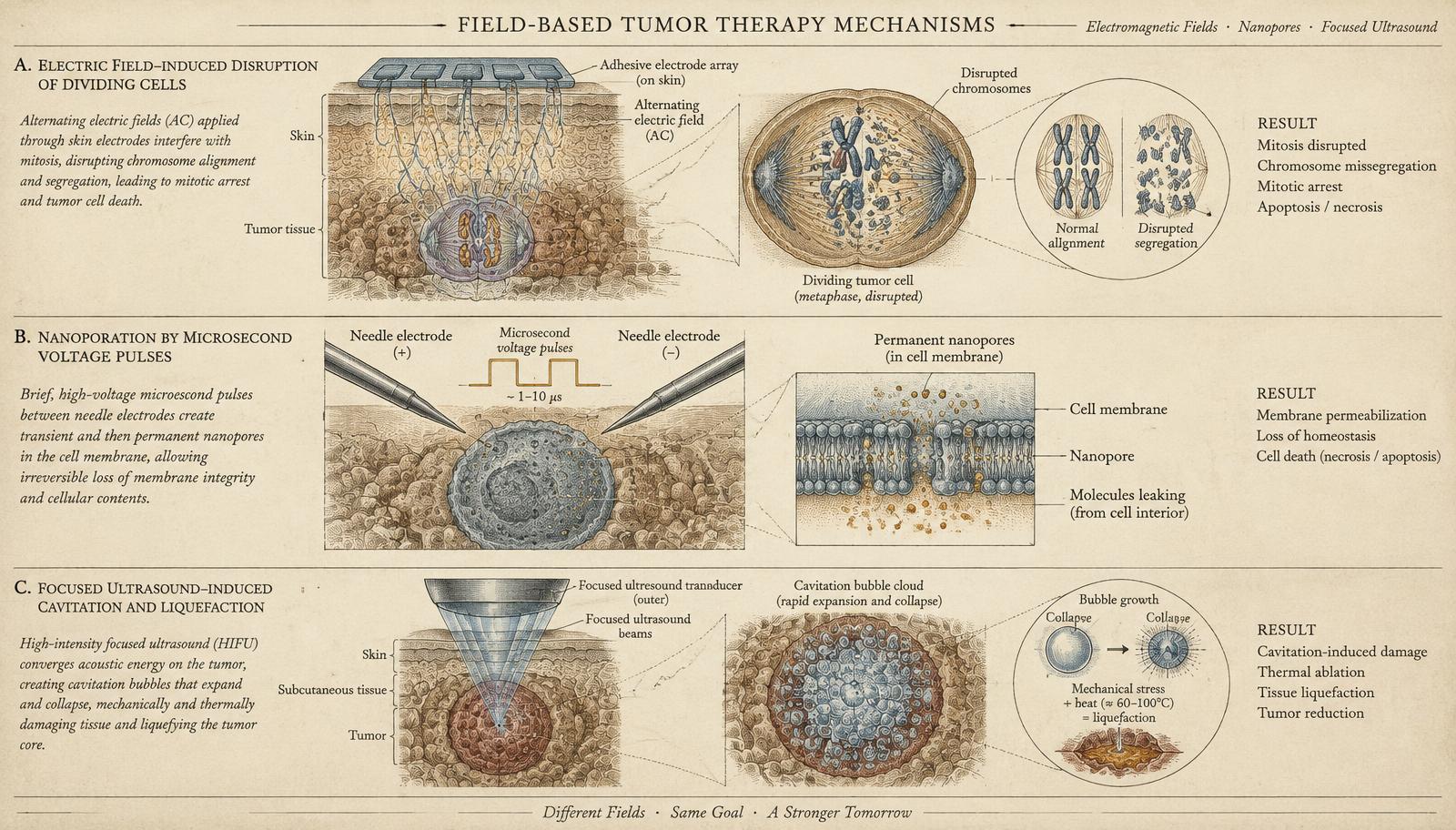
Dividing cells must arrange charged proteins and structures with exquisite timing. TTFields exploit this: alternating electric fields at tumor-specific frequencies (around 100–300 kHz) push on those charged components and scramble the geometry of division. The result is that cancer cells — which divide constantly — die in mitosis, while most healthy tissue, which divides rarely, is largely unaffected.
The device (Optune) is a set of adhesive transducer arrays worn on the shaved scalp or torso, connected to a portable field generator. It is approved for glioblastoma and pleural mesothelioma, and the recent trial news is what makes this frontier worth watching:
- Pancreatic cancer (PANOVA-3, 2025): adding TTFields to standard chemotherapy in 571 patients with locally advanced disease extended median overall survival by roughly two months and significantly delayed pain progression — meaningful in one of the deadliest cancers.
- Lung cancer (LUNAR, 2024): in metastatic non-small-cell lung cancer after platinum therapy failed, TTFields plus standard therapy improved median survival from about 10 to 13 months.
- Glioblastoma (EF-14): the original landmark — TTFields plus temozolomide extended median survival from 16 to 21 months, and five-year survival from 5% to 13%.
The main burden is wearing the device most of the day and managing skin irritation under the arrays. There is no systemic toxicity, because nothing enters the bloodstream.
Histotripsy: sound that liquefies tumors
Histotripsy is focused ultrasound taken in a different direction. Instead of heating tissue, extremely short, intense ultrasound pulses create clouds of micro-bubbles that expand and collapse in microseconds, mechanically tearing cells apart within a precisely targeted volume. The boundary between destroyed and untouched tissue can be sharper than a millimeter.
The HistoSonics Edison system received FDA clearance for liver tumors in 2023, and early clinical series report high rates of complete tumor destruction with few complications — including in patients whose tumors sit near structures that make surgery or heat ablation risky. Because the mechanism is mechanical rather than thermal, it works even in tissue with high blood flow that would carry heat away, and the destroyed tissue is resorbed by the body over the following weeks.
Pulsed electric fields: opening doors that never close
Irreversible electroporation delivers microsecond bursts of high voltage between needle electrodes placed around a tumor. The pulses open permanent nanopores in cell membranes; the cells die over the following days, but the collagen scaffolding of the tissue — ducts, vessels, nerves — survives. That makes it useful for tumors wrapped around structures that heat-based ablation would damage.
A newer variant, nano-pulse stimulation (nanoelectroablation), uses even shorter pulses that appear to trigger regulated cell death rather than simple membrane failure, with early human data in skin and other accessible tumors, and a notable observation: treated sites often show an immune response against the tumor, not just local destruction.
The Deep Dive
Why fields, why now
The common thread is that each modality exploits a physical difference between tumor and host — division rate, membrane properties, mechanical susceptibility — rather than a biochemical one. That sidesteps two classic problems of drug oncology: systemic toxicity and mutation-driven resistance. A cell cannot easily mutate its way out of physics.
Tier II · Members only · Free
Join Vital Codex free
Unlock every Tier II deep dive, save your reading, and open the member knowledge modules. Free, no card, no paywall.
The Dispatch is a separate weekly email. Your membership works with or without it.
Continue exploring: Frequency & Number Theory — Resonance, spectra, and the mathematics beneath biological signal.
Explore Frequency & Number TheoryThe Codex Dispatch
More on Frequency & Number Theory, one email a week
One considered email each Sunday: research translation, no hype, no supplement pitches. Separate from membership — unsubscribe anytime.