Dimethyl sulfoxide (DMSO) is one of the most heavily studied small molecules in twentieth-century medicine and one of the least discussed in modern clinical practice. It is also not a herb, which is why it belongs on Vital Codex rather than a botanicals site.
This piece summarizes what the research literature actually shows for the nervous system, where the evidence is strongest, and where the appropriate response is caution rather than enthusiasm.
Contents(10 sections)
Key takeaways
DMSO crosses the blood–brain barrier and functions as a hydroxyl radical scavenger, chemical chaperone, and microcirculatory agent.
The strongest neurological signals are in acute injury (stroke, TBI, spinal cord injury) and in select neurodegenerative contexts.
It has a long safety record, distinctive side effects (garlic-like body odor, occasional skin irritation), and specific contraindications — pregnancy, active hepatic or renal disease, and interaction with medications it may carry into tissues.
It is not a substitute for standard-of-care neurology.
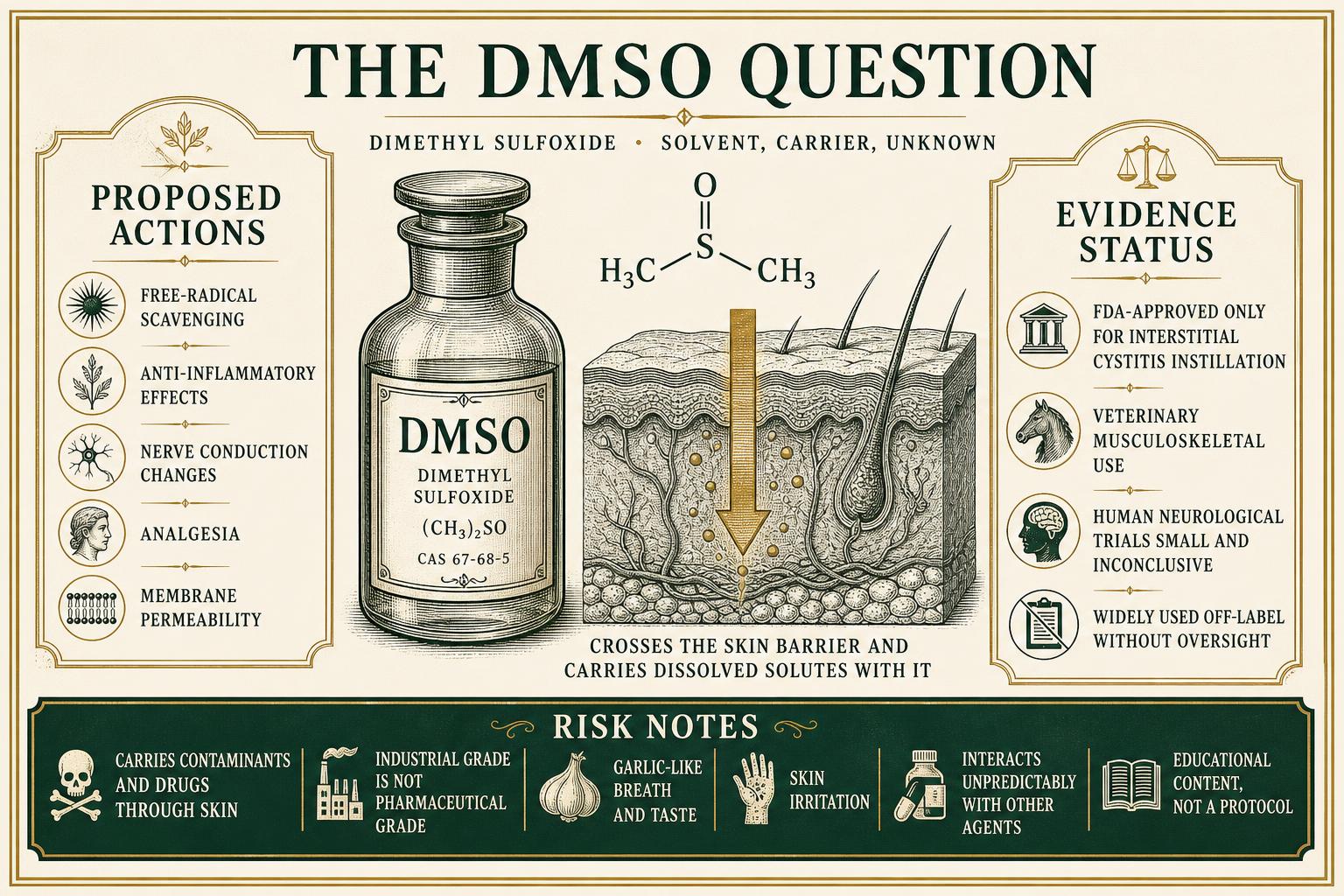
The Primer
What DMSO is
DMSO is a small sulfur-containing molecule originally derived as a byproduct of wood-pulp processing. It has been studied in more than 2,000 peer-reviewed papers since the 1960s and is FDA-approved for interstitial cystitis, with a much broader off-label research literature.
Two properties account for most of its therapeutic interest: it crosses the blood–brain barrier at practical concentrations, and it can carry other compounds across tissue barriers with it.
Why the nervous system pays attention
DMSO scavenges hydroxyl radicals, one of the more damaging reactive oxygen species in brain injury. It reduces cerebral edema without the rebound seen with mannitol, supports microcirculation, and acts as a chemical chaperone that helps misfolded proteins refold — a mechanism relevant to several neurodegenerative diseases.
The Deep Dive
Where the acute-injury evidence is strongest
In stroke, traumatic brain injury, and spinal cord injury, animal and small human studies show meaningful reductions in neuronal loss and improved recovery when DMSO is administered within the therapeutic window (typically the first 90–120 minutes). The largest documented gains have come with intravenous administration in acute contexts.
This is not an at-home protocol. It is a research area with mostly clinical-setting relevance.
Tier II · Members only · Free
Continue into the deep dive
Tier I is free and always open. Tier II — the full mechanisms, dosing detail, nuance, and citations — unlocks with a free Vital Codex membership.
- Every Tier II deep dive across all hubs
- Saved reading progress across articles
- Member knowledge modules and their quizzes
- The Dispatch, if you opt in
Frequently asked
Is DMSO a supplement?
No. It is a small-molecule compound with pharmacological activity and specific contraindications. Treat it accordingly.
What are the most consistent side effects?
A characteristic garlic-like body odor, mild skin irritation at higher concentrations, occasional nausea, and rare allergic reactions. It is contraindicated in pregnancy and in active hepatic or renal disease.
Should I try it at home?
Casual home use is not the appropriate frame. The therapeutic contexts with the strongest evidence — acute injury and progressive neurological disease — belong in a clinical setting with someone who understands the compound.
Continue exploring: Cognition — Neurogenesis, synaptic plasticity, and focus architecture.
Explore Cognition