Lung health is not merely about suppressing a cough. A complete natural approach aims to improve the quality and movement of airway mucus, calm irritated respiratory tissue, support local immune intelligence, protect the lung's antioxidant system, improve circulation and diaphragmatic movement, and reduce the daily inputs that burden the airways.
This is where botanical medicine is especially useful. Herbs can be selected according to the pattern: dry and inflamed, tight and reactive, thick with mucus, post-viral and depleted, or chronically burdened by smoke, dust, mold, pollution, and sluggish clearance. The most effective approach is rarely a single herb. It is a well-designed stack: a broad-spectrum tincture, targeted nutritional support, sterile airway hydration, and carefully chosen aromatic support.
Route of administration is not a detail. It is the safety question.
Contents(16 sections)
Key takeaways
A pattern-matched tincture outperforms a generic "lung herb" blend: dry and irritated, damp and congested, and post-viral depleted each need a different formula.
Thyme and ivy leaf are the best-established expectorant pairing for productive cough; Pelargonium has its own evidence base in uncomplicated acute respiratory illness.
Oral NAC at 600 mg once or twice daily supports glutathione and reduces mucus stickiness through disulfide-bond disruption.
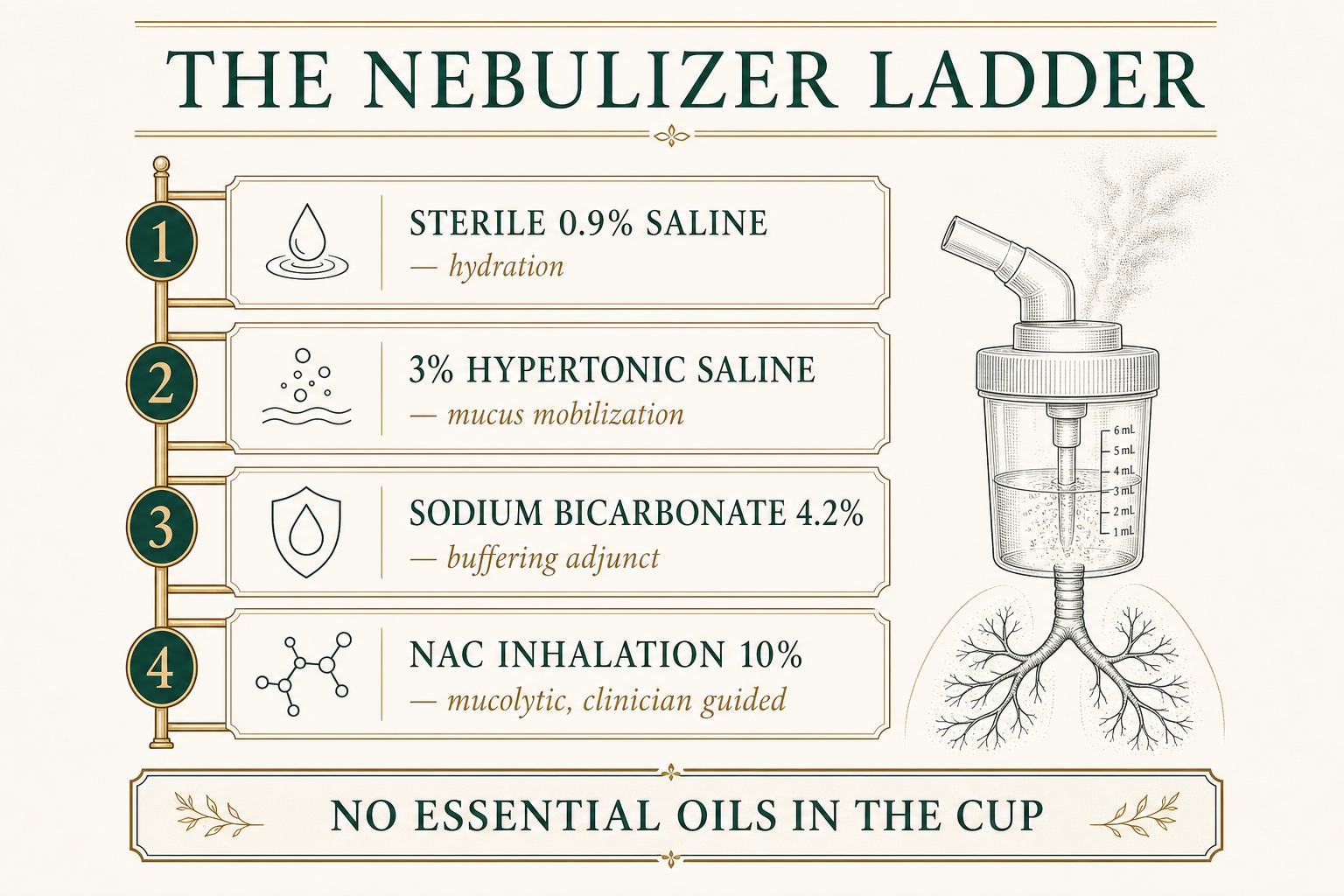
Sterile 0.9% saline is the baseline nebulizer option; 3% hypertonic saline is the tool for thick, slow-moving mucus.
Sodium bicarbonate and inhalation-grade NAC are pharmacist- or clinician-guided adjuncts, never kitchen or oral-grade substitutes.
Eucalyptus belongs in a diffuser, never in a nebulizer cup — aerosolized oil droplets can irritate airways and, rarely, cause lipoid pneumonia.
The Primer
The central formula: Bronchial Renewal tincture
This formula combines warming expectorants, mucus-moving herbs, soothing demulcents, and immune-active roots. It is intended as a versatile daily or short-term formula for bronchial congestion, lingering cough, seasonal chest heaviness, post-viral mucus, and respiratory recovery.
| Herb | Botanical name | Formula share | Primary action |
|---|---|---|---|
| Thyme | Thymus vulgaris | 22% | Aromatic expectorant; helps shift stagnant bronchial secretions |
| Ivy leaf | Hedera helix | 18% | Supports mucus thinning and bronchial openness |
| Mullein leaf/flower | Verbascum thapsus | 18% | Soothes irritated mucosa while supporting fluid movement |
| Elecampane root | Inula helenium | 15% | Deep, warming expectorant for dense, slow-moving chest mucus |
| Pelargonium root | Pelargonium sidoides | 12% | Acute and post-viral respiratory support |
| Plantain leaf | Plantago lanceolata | 10% | Demulcent, tissue-soothing ally for scratchy, inflamed airways |
| Grindelia | Grindelia squarrosa or G. robusta | 5% | Resinous respiratory relaxant for tight, congested patterns |
Adult use: 3–5 mL in warm water, three times daily. In an acute congested phase, 5 mL can be used up to four times daily for one or two days, then returned to three daily doses. The flavor is intentionally aromatic, resinous, and bitter: those qualities are part of its expectorant character.
This is not a random "all lung herbs" blend. Thyme and ivy create a well-established fluid-extract pairing for productive cough; Pelargonium has a distinct evidence base in uncomplicated acute respiratory illness; mullein, plantain, elecampane, and grindelia make the formula more complete for real-world patterns of dryness, irritation, mucus, and chest tightness.
Pattern-specific tincture variations
Dry, raw, or allergy-reactive airways. For a dry cough, throat tickle, bronchial irritation after infection, or a "too much heat, not enough moisture" pattern, use a gentler blend: mullein 30%, ribwort plantain 25%, marshmallow root (Althaea officinalis) 20%, licorice root (Glycyrrhiza glabra) 15%, grindelia 10%. Use 3–5 mL three times daily in warm water. Marshmallow and plantain bring mucosal hydration; mullein offers respiratory affinity; licorice contributes sweetness, adrenal support, and anti-inflammatory character; grindelia gives the formula a mild opening quality. Avoid substantial or long-term licorice use with uncontrolled hypertension, edema, kidney disease, low potassium, or relevant medication interactions.
Dense, damp, hard-to-expectorate mucus. When mucus is thick, copious, cold, or difficult to move, use a more stimulating variation: thyme 25%, elecampane 20%, ivy leaf 20%, horehound (Marrubium vulgare) 15%, mullein 10%, ginger (Zingiber officinale) 10%. Use 3–5 mL three times daily with extra warm fluids. This is a short-term "move it out" formula rather than an everyday tonic. If the mouth and throat become noticeably dry, reduce frequency or transition to the Bronchial Renewal formula.
Post-viral recovery and respiratory resilience. When the acute infection is gone but energy, airway tone, and respiratory comfort have not fully returned, use a restorative rather than aggressively expectorant blend: mullein 25%, plantain 20%, astragalus root (Astragalus membranaceus) 20%, reishi (Ganoderma lucidum) 15%, eleuthero (Eleutherococcus senticosus) 10%, thyme 10%. Take 3–5 mL twice daily for three to six weeks, adjusting to the individual. This formula supports recovery, resilience, and respiratory terrain without treating every lingering symptom as an infection.
NAC and the glutathione system
N-acetylcysteine (NAC) is among the most useful tools for a mucus-heavy, oxidatively stressed lung pattern. It supports glutathione production and helps reduce the stickiness of mucus through disulfide-bond disruption. A common oral approach is 600 mg once or twice daily, adjusted for individual tolerance. Clinical research in chronic bronchitis and COPD populations suggests NAC can reduce exacerbation burden in some contexts, especially with sustained use and adequate dosing.
For deeper redox support, pair NAC with nutrient-dense foods rich in sulfur compounds and cofactors: garlic, onions, free-range eggs, legumes, leafy greens, cruciferous vegetables, citrus, guava, berries, and adequate protein. Glutathione is not an abstract laboratory concept; the lung depends on a continuous supply of amino acids, minerals, and plant antioxidants to maintain it. The underlying chemistry is covered in the NAC deep dive.
Minerals, fats, and flavonoids
Magnesium supports normal neuromuscular and smooth-muscle function, making it a sensible foundational mineral for people with tense breathing patterns. Omega-3-rich foods — sardines, salmon, chia, flax, hemp, and walnuts — support a balanced inflammatory response. Quercetin-rich foods and herbs, including onions, capers, apples, berries, citrus peel, and nettle, provide useful flavonoid support without requiring a long supplement list.
Botanical supplements worth considering
- Black seed (Nigella sativa): a traditional respiratory and immune ally with promising emerging research; use as seed oil or standardized extract according to product labeling.
- Boswellia (Boswellia serrata): useful when inflammatory stiffness or reactivity is a dominant feature; better considered a longer-term oral support than an acute rescue agent.
- Reishi (Ganoderma lucidum): a tonic mushroom with immune-modulating and adaptogenic qualities; often pairs well with astragalus in recovery phases.
- Cordyceps (Cordyceps militaris or quality cultured C. sinensis): traditionally used for respiratory capacity, exercise tolerance, and fatigue patterns; most useful as part of a several-week restoration program.
These are supportive agents, not substitutes for urgent care or prescribed rescue medication. Their strength is in shaping the terrain over weeks, not in replacing rapid bronchodilation during an emergency.
The Deep Dive
Nebulizer support: local hydration and mucus release
Nebulizer therapy has a distinct role because it delivers moisture and selected water-based agents directly to airway surfaces. It is especially useful when mucus is stubborn, the chest feels dry or congested, or oral herbs alone are not shifting secretion quality.
| Solution | When it fits | Typical home session |
|---|---|---|
| Sterile 0.9% saline | Dry, irritated, dusty, smoky, or mildly congested airways | 2.5–5 mL as needed |
| Sterile 3% hypertonic saline | Thick, sticky mucus and slow clearance | 3–5 mL; begin conservatively and assess response |
Tier II · Members only · Free
Continue into the deep dive
Tier I is free and always open. Tier II — the full mechanisms, dosing detail, nuance, and citations — unlocks with a free Vital Codex membership.
- Every Tier II deep dive across all hubs
- Saved reading progress across articles
- Member knowledge modules and their quizzes
- The Dispatch, if you opt in
Frequently asked
What is the best all-round herbal formula for lung congestion?
A pattern-matched blend beats a single herb. The Bronchial Renewal tincture — thyme, ivy leaf, mullein, elecampane, Pelargonium, plantain, and grindelia — covers expectoration, mucosal soothing, and immune support at 3–5 mL in warm water three times daily for adults.
Can I make my own saline for a nebulizer?
No. Homemade saline is not sterile and can introduce bacteria and particulates directly into the lower airway. Use only preservative-free, sterile unit-dose inhalation saline.
Is hypertonic saline better than normal saline?
Only for a specific problem. 3% saline is the better tool when thick, sticky mucus is hard to clear. For dryness and irritation without heavy secretions, 0.9% saline is gentler and usually more comfortable.
Can I nebulize oral NAC capsules?
No. Oral NAC powder is not formulated, buffered, or sterilized for inhalation. Only a labeled inhalation-grade NAC solution is appropriate, and it should be used under clinician guidance because of bronchospasm risk.
Why can't I add eucalyptus oil to the nebulizer if it helps my breathing?
The perceived benefit comes from aromatic nasal inhalation, which does not require a nebulizer. Aerosolizing an oil delivers lipid droplets to the alveoli, a route with known irritation risk, rare lipoid pneumonia risk, and no validated safety data.
How long should a post-viral lung recovery formula be used?
Typically three to six weeks. Restorative blends built on mullein, plantain, astragalus, reishi, and eleuthero are taken twice daily and reassessed rather than continued indefinitely.
Research Notes & Sources(expand)
Thyme–ivy fluid extract combinations for productive cough: randomized trials of standardized Thymus vulgaris / Hedera helix preparations report improved cough resolution versus placebo in acute bronchitis.
Pelargonium sidoides (EPs 7630) has a Cochrane-reviewed evidence base for symptom reduction in acute bronchitis and uncomplicated upper respiratory illness.
N-acetylcysteine and exacerbation burden: PANTHEON and related trials, plus meta-analyses in chronic bronchitis/COPD, support sustained dosing (commonly 600 mg once or twice daily) for reduced exacerbation frequency in selected populations.
Hypertonic saline and mucociliary clearance: airway surface liquid rehydration underlies its use in cystic fibrosis and bronchiectasis mucus-clearance protocols.
Sodium bicarbonate and mucus rheology: laboratory and small clinical work indicates pH-dependent changes in mucin network viscoelasticity.
1,8-cineole (eucalyptol): randomized trials of standardized oral cineole show anti-inflammatory and mucoregulatory effects; inhalation of whole essential oil is a different exposure with documented irritation and rare exogenous lipoid pneumonia risk.
Continue exploring: Nutrition — Protein sufficiency, micronutrient density, and food quality.
Explore Nutrition