Opinion and hypothesis—not clinical guidance. Could recurring sores described as “herpes” sometimes be better understood as a local tissue response, without a virus in the explanation? For a sore that has been misidentified, the answer can be yes: inflammatory ulcers, medication reactions, and irritation are recognized non-viral possibilities. Extending that idea to all confirmed herpes simplex, however, is a different and much stronger proposition. The no-virus hypothesis has not been established and conflicts with current molecular and clinical evidence for HSV.
This essay takes the question seriously without turning it into a diagnosis. Inspired by Unbekoming's *What Is Herpes?*, it explores what a tissue-first model might illuminate, where its assumptions begin, and what an honest investigation would need to measure. The practical companion is Recurring Herpes-Like Sores: Non-Viral Explanations.
A useful hypothesis does more than explain a story. It tells us what to measure—and what would change our minds.
Contents(11 sections)
Key takeaways
“Some herpes-like sores are non-viral” and “herpes simplex has no viral cause” are different claims; evidence for the first does not establish the second.
A tissue-first hypothesis can ask useful questions about irritation, inflammatory disease, medication exposure, nutritional deficiency, and repair capacity.
A recurring lesion, stress trigger, or improvement after a dietary change does not identify the cause by itself.
Testing has limits, but those limits must be evaluated for the particular test; a false-positive blood result is not evidence that all lesion tests are invalid.
A serious alternative model must explain HSV-specific sequences, recoverable infectious virus, and transmission findings—not just the appearance of sores.
Exploring a hypothesis does not establish that lesions are noncontagious or justify abandoning prescribed care or partner precautions.
The Primer
Start with the experience, not the label
A sore returns after sleepless nights. Another appears after friction, a new toothpaste, or a particular medication. Someone changes their diet and then has fewer episodes. It is understandable to ask whether the label attached to the symptom has obscured its context.
My editorial position is that this question deserves room. A person should not have to choose between accepting a label without explanation and rejecting every laboratory finding. The useful starting point is the lesion itself: where it occurs, what it looks like, what precedes it, and what has actually been demonstrated.
“Herpes-like” describes an appearance. “Herpes simplex” names a specific infection. Those terms should not quietly substitute for one another.
State the no-virus hypothesis clearly
For this thought experiment, the strong hypothesis is: sores diagnosed as herpes are generated by tissue injury, inflammation, or repair processes, and a virus is not a necessary causal agent. Some versions also propose that particles interpreted as viruses are cellular material, or that outbreaks serve a detoxification function. These are additional speculative claims, not established findings.
It helps to separate three propositions:
- Non-viral mimic: the sore has been called herpes, but its cause is another condition. This is a recognized diagnostic possibility.
- Terrain contribution: local tissue conditions and systemic physiology influence when symptoms occur. This can apply to non-viral disease and to confirmed infection.
- No-virus explanation of confirmed HSV: the findings used to identify HSV must be reinterpreted as something other than a causal infectious agent. This is the unestablished hypothesis under discussion.
Keeping these propositions separate makes exploration more precise, not less open-minded.
What a tissue-first lens brings into focus
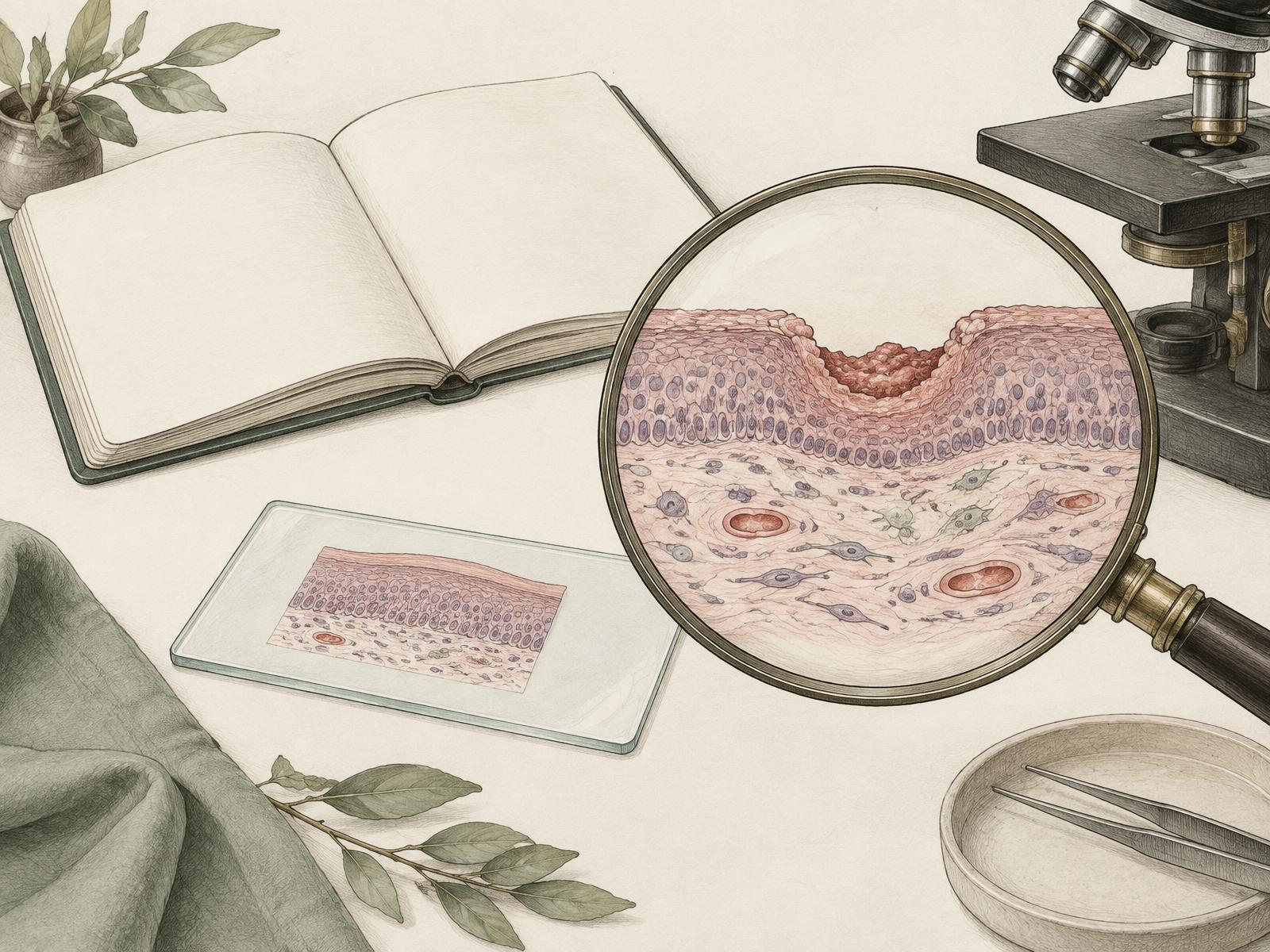
The mouth and genital skin are living interfaces. Friction, chemical irritation, allergy, inflammatory signaling, and inadequate repair can all affect their integrity. A recurrent aphthous ulcer is not an HSV lesion. A fixed drug eruption can return to precisely the same site after re-exposure to a medication. Contact dermatitis can repeatedly flare with the same product. DermNet's differential guidance describes several such alternatives.
Nutritional context also deserves attention. Iron, vitamin B12, and folate deficiency can accompany recurrent oral ulceration in a subset of patients; correcting a documented deficiency addresses a genuine problem. It does not follow that everyone with sores is deficient, that high-dose supplements are helpful, or that nutrition explains every lesion. Recurrent aphthous stomatitis guidance distinguishes these associations from a universal cause.
The strongest contribution of this perspective is a richer clinical history. What touched the tissue? What changed before the episode? Is there a repeated medicine exposure? Are there bowel symptoms, eye inflammation, or ulcers elsewhere? These are actionable questions whether or not a person endorses the stronger hypothesis.
Recurrence and improvement: meaningful, but not decisive
A same-site recurrence is compatible with a fixed drug eruption, repeated friction, and established HSV recurrence. Stress can influence immunity, behavior, sleep, and inflammatory conditions. Neither observation uniquely selects one explanation.
Likewise, improvement after lysine, rest, or removal of an irritant can be real without settling causation. Episodes naturally fluctuate; treatment may affect a trigger rather than the initiating cause; and several changes may occur together. Mailoo and Rampes' review found limited and inconsistent clinical evidence for lysine. A response to an amino acid does not distinguish a non-viral process from a pathogen whose replication depends on host metabolism.
This is not a reason to dismiss a person's experience. It is a reason to document it carefully and avoid asking one observation to prove more than it can.
How far can uncertainty about tests take us?
The FDA warns that HSV-2 blood tests can produce false-reactive results, especially in particular testing circumstances. A low-positive result can need confirmation. Blood antibodies also do not establish that a particular sore is caused by HSV.
A lesion PCR/NAAT asks a different question: is HSV genetic material detectable at the sampled site? According to CDC guidance, lesion NAAT is highly sensitive, but a negative result does not exclude infection in every circumstance. Healing lesions, sampling quality, and intermittent shedding matter. Repeated appropriately timed negative results can strengthen the case for investigating alternatives; they do not prove the universal no-virus hypothesis.
The fairest approach is neither “tests are infallible” nor “all tests are meaningless.” It is to ask what was measured, how the sample was obtained, and how much that result changes the likely explanation.
What the stronger hypothesis would need to explain
Current HSV evidence is not confined to a photograph of a blister or a positive antibody test. It includes characterized viral genomes, recovery of infectious virus, specific viral proteins and gene expression, neural latency research, and clinical transmission studies. Johnston and Corey review this evidence; Nicoll and colleagues examine latency mechanisms.
An alternative that calls viral particles cellular debris must account for their specific genetic organization, replication behavior, and infectivity. Human extracellular vesicles are real, and viruses can interact with them; morphological similarity alone does not establish that they are the same thing.
An alternative that says lesions expel toxins must name the substance, demonstrate its movement into the lesion, measure the quantities involved, and show that this pathway explains symptoms better than competing models. Without those measurements, “detoxification” is an interpretation, not a demonstrated mechanism.
Turn the idea into a testable investigation
A useful research programme would start with well-described patient groups, not one presumed explanation for everyone. It would compare confirmed HSV lesions, diagnosed non-viral ulcers, and appropriate controls, using independent laboratories and blinded assessment where possible.
- Define the claim in advance. Is the model about misdiagnosis in a subgroup, or about all HSV disease? State what result would count against it.
- Use more than appearance. Combine clinical examination, properly timed lesion sampling, and additional diagnostic methods where appropriate. Interpret discordant results rather than discarding them.
- Measure the proposed alternative. Track named irritants, medication exposures, documented deficiencies, or specific inflammatory diagnoses. A general reference to “terrain” is not yet a measurement.
- Separate symptom relief from causal proof. Removing an irritant might improve a non-viral lesion; improved sleep might reduce symptoms across several diagnoses. Neither outcome alone identifies an infectious agent or excludes one.
- Protect participants. An ethical study must not deliberately expose partners, withhold necessary treatment, or use hazardous substances to provoke or “clear” lesions.
Finding a non-viral diagnosis in one patient would support the mimic explanation. It would not erase positive HSV findings in another. Detecting HSV in someone without a sore is also compatible with established asymptomatic infection, rather than a unique prediction of the no-virus model.
My conclusion: curiosity without a premature verdict
I favor asking more about the tissue and the person, not less. Recurring symptoms can become an invitation to investigate local exposures, inflammatory patterns, nutritional context, and whether the original diagnosis was adequately supported.
I do not think that curiosity requires presenting the no-virus hypothesis as established biology. Its strongest practical insight is the warning against diagnosing by appearance alone. Its broadest claim still faces substantial contrary evidence. A good inquiry allows both statements to stand, leaves room for new findings, and specifies what would change its conclusion.
Safety boundary: Until a lesion's cause is clarified, do not assume it is noncontagious. Avoid direct contact with active oral or genital sores and discuss appropriate precautions with a clinician. Do not stop prescribed treatment on the strength of this essay. Eye pain or vision changes, new genital lesions in pregnancy, severe illness, or lesions with significant immune suppression need prompt medical assessment.
For the practical differential, read Recurring Herpes-Like Sores: Non-Viral Explanations, covering irritation, medication reactions, inflammatory conditions, and nutritional context.
Frequently asked
Is this article claiming that herpes viruses do not exist?
No. It explores the no-virus proposition as an unestablished hypothesis. Current molecular and clinical evidence supports HSV as an infectious cause of herpes simplex. Recognized non-viral causes of similar sores are a separate diagnostic issue.
Can a sore called herpes turn out to be non-viral?
Yes. Aphthous ulcers, fixed drug eruptions, contact dermatitis, friction injury, and inflammatory conditions can resemble herpes. A clinician can review the pattern and arrange appropriate testing rather than relying on appearance alone.
Does a negative HSV swab prove a no-virus explanation?
No. Timing, lesion healing, sampling, and intermittent shedding affect results. Repeated well-timed negative tests may support evaluation for other causes, but do not establish a universal claim about herpes.
Does improvement with lysine or diet prove the cause is metabolic?
No. Improvement may reflect a trigger change, natural fluctuation, or another diagnosis. Lysine research is limited and inconsistent, and symptom relief alone cannot distinguish viral from non-viral causation.
Can I stop treatment or tell a partner there is no transmission risk?
Not on the basis of a hypothesis essay. Discuss diagnosis and medication decisions with a qualified clinician. Confirmed HSV can transmit without visible sores; unexplained lesions should not be assumed noncontagious.
Research Notes & Sources(expand)
Original Vital Codex opinion and synthesis. The source essay supplies a question, not clinical evidence for the no-virus hypothesis. The other references address diagnostics, recognized mimics, nutrient research, and the evidence any alternative must explain.
- Unbekoming. “What Is Herpes?” — source opinion essay.
- CDC. “Genital Herpes — STI Treatment Guidelines.” — lesion tests, interpretation, and transmission precautions.
- FDA. “HSV-2 Tests for Genital Herpes Can Produce False Reactive Results.” 2023 — limitations of HSV-2 serology.
- DermNet. “Differential diagnosis of vulval ulcers.” — infectious and non-infectious alternatives.
- MSD Manual Professional. “Recurrent Aphthous Stomatitis.” — oral ulcer patterns and contributing factors.
- Mailoo VJ, Rampes S. “Lysine for Herpes Simplex Prophylaxis: A Review of the Evidence.” Integrative Medicine. 2017.
- Johnston C, Corey L. “Current Concepts for Genital Herpes Simplex Virus Infection.” Clinical Microbiology Reviews. 2016.
- Nicoll MP, Proença JT, Efstathiou S. “The molecular basis of herpes simplex virus latency.” FEMS Microbiology Reviews. 2012.
Continue exploring: Inflammation — Cytokine signaling and chronic low-grade systemic stress.
Explore InflammationThe Codex Dispatch
More on Inflammation, one email a week
One considered email each Sunday: research translation, no hype, no supplement pitches. Separate from membership — unsubscribe anytime.