Fulvic and humic acids are humic substances: organic compounds formed over long periods as plant matter decomposes in living soil. They were never something the body had to seek out — they arrived with food grown in biologically active soil.
Humic acid is the larger molecule and works primarily in the gut, binding toxins and interacting with the microbiome and immune tissue. Fulvic acid is small enough to enter cells, where it functions as a mineral carrier and electron shuttle. Industrial agriculture has depleted both from most agricultural soil.
Contents(14 sections)
Key takeaways
Humic acid is high-molecular-weight and largely stays in the gut; fulvic acid is low-molecular-weight and is systemically absorbed.
Fulvic acid chelates minerals into forms cells can take up, and it can carry molecules across membranes.
Both are redox-active: they can donate and accept electrons, which is the basis of their antioxidant and electron-shuttle behaviour.
Soil depletion through chemical fertilization, monocropping, and loss of soil microbial life is the reason dietary intake has collapsed.
Quality and source matter enormously — humic substances concentrate whatever was in their source deposit, including heavy metals.
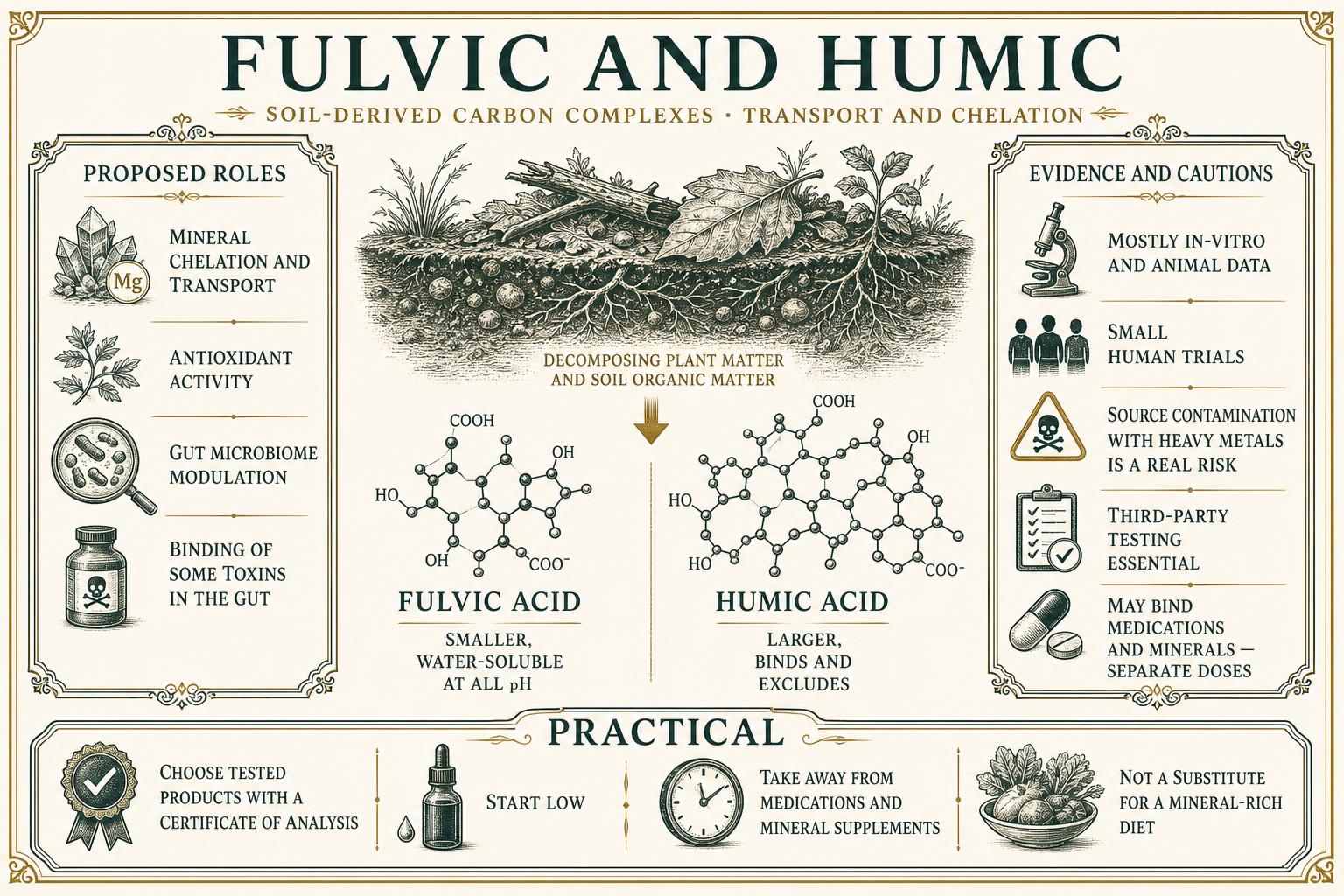
The Primer
What they are
Both are natural organic acids, not synthetic chemicals, and both belong to the class called humic substances — the end product of biological decomposition.
Humic acid is the larger, darker, more complex molecule. It is not well absorbed and does most of its work inside the digestive tract. Fulvic acid is much smaller, soluble across a wide pH range, and readily absorbed, which is why it shows up in tissue rather than only in stool.
Why the modern diet lacks them
Traditional farming maintained abundant humic substances in soil. Chemical fertilizer dependence, pesticide use, monocropping, and over-cultivation degrade the soil microbial communities that generate them. Crops still grow, but the mineral and humic content of that soil — and therefore of the food — is substantially lower than it was a century ago.
This is documented soil science rather than a fringe claim, and it is the honest core of the argument for mineral-dense food and, for some people, supplemental humic sources.
What they do in practical terms
Humic acid binds a range of toxins and contributes to gut barrier and immune signaling in the intestinal environment. Fulvic acid escorts minerals into cells in a usable form, participates in redox reactions, and supports mitochondrial substrate handling.
How to think about using them
Food first: mineral-dense produce, mineral-rich water, and food from soil that is actually alive. If supplementing, source is everything — a reputable deposit with published heavy-metal testing, taken away from medications, since fulvic acid can alter absorption of things taken with it.
The Deep Dive
Molecular structure and behaviour
Humic substances are heterogeneous supramolecular assemblies rather than single defined compounds, which is why they resist tidy characterization. Humic acid is soluble at alkaline pH and precipitates in acid; fulvic acid remains soluble across the entire pH range, which is one reason it survives gastric passage and is absorbed.
Fulvic acid carries a high density of carboxyl and phenolic hydroxyl groups. These give it strong cation-exchange capacity — the structural basis for chelating metal ions — and make it redox-active, able to accept and donate electrons reversibly through quinone-hydroquinone moieties.
Tier II · Members only · Free
Continue into the deep dive
Tier I is free and always open. Tier II — the full mechanisms, dosing detail, nuance, and citations — unlocks with a free Vital Codex membership.
- Every Tier II deep dive across all hubs
- Saved reading progress across articles
- Member knowledge modules and their quizzes
- The Dispatch, if you opt in
Frequently asked
What is the difference between fulvic and humic acid?
Molecular size and destination. Humic acid is large, poorly absorbed, and acts mainly in the gut. Fulvic acid is small, absorbed systemically, and acts as a mineral carrier and redox-active molecule inside cells.
Is shilajit the same as fulvic acid?
No. Shilajit is a natural exudate that contains fulvic acid along with dibenzo-α-pyrones, minerals, and other constituents. It is the most studied traditional fulvic-containing material, but it is a mixture, not a purified compound.
Are these products safe?
The main risk is contamination rather than the molecules themselves. Humic substances concentrate whatever was in the source deposit, including lead, arsenic, and cadmium. Use products with published third-party heavy-metal testing, and separate them from medications.
Can I just eat better instead?
Largely yes. Food grown in biologically active soil, mineral-rich water, and a diverse plant intake address the same deficit. Supplementation is a reasonable adjunct where food access is limited, not a prerequisite.
Continue exploring: Nutrition — Protein sufficiency, micronutrient density, and food quality.
Explore Nutrition