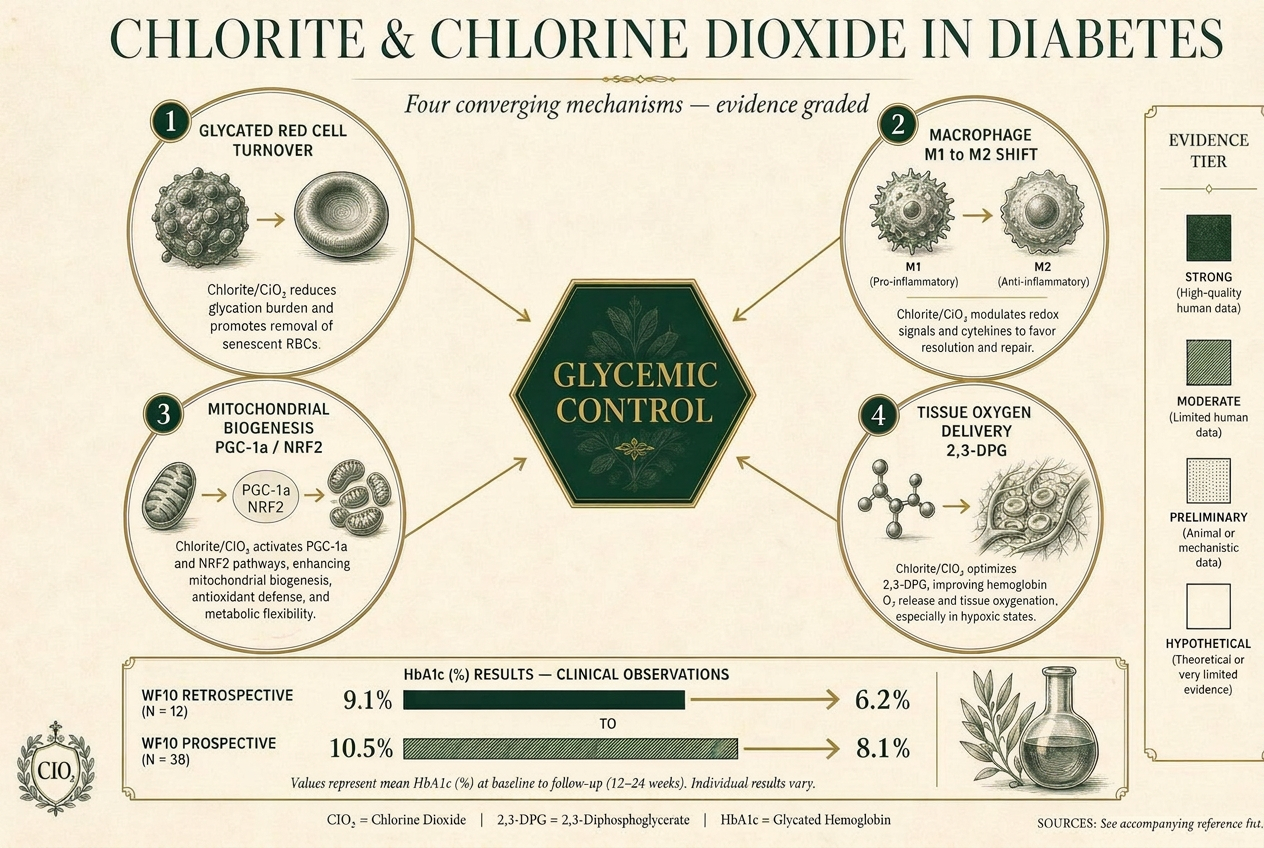
A chlorite-based intravenous drug called WF10 (tetrachlorodecaoxide, marketed in Thailand as Immunokine for diabetic foot ulcers) lowered mean HbA1c from 9.1% to 6.2% in a small retrospective series, and from 10.5% to 8.1% in a larger prospective trial — with the improvement persisting for eight to sixteen weeks after a short infusion course. That is a published, peer-reviewed finding with a coherent mechanism behind it.
It is also not the same thing as drinking chlorine dioxide. This review holds those two claims apart deliberately: what the pharmaceutical chlorite literature supports, what oxidative-therapy biology plausibly extends, and what remains anecdote awaiting a trial.
The published evidence is about a pharmaceutical chlorite infusion given under supervision. The internet conversation is about oral protocols. They are not the same intervention.
Contents(14 sections)
Key takeaways
WF10, an intravenous chlorite drug, reduced HbA1c by roughly 2.4–2.9 percentage points in published diabetic foot studies, with effects lasting 8–16 weeks after five infusions (Maraprygsavan et al., 2016; Yingsakmongkol et al., 2021).
The proposed mechanism is hematological, not glucose-lowering: chlorite inactivates cytotoxic free hemoglobin species, clears heavily glycated red cells, and stimulates fresh erythropoiesis — a "blood rejuvenation" effect that also mechanically lowers measured HbA1c.
NP001, a purified pH-adjusted sodium chlorite formulation studied in ALS, shifts macrophages from M1 toward M2 and normalizes CRP, IL-18, and LPS — the same inflammatory axis that drives insulin resistance and beta-cell failure.
The extension to oral chlorine dioxide rests on mitohormesis theory (PGC-1alpha, NRF2, autophagy) and analogy with ozone therapy, not on controlled diabetic trials. That gap is the central limitation of the entire field.
Nothing here is a self-treatment protocol. Chlorite pharmaceuticals were given intravenously under clinical supervision at defined doses; oral consumer protocols have no comparable safety or efficacy data in diabetes.
The Primer
Diabetes is not only a sugar problem
Type 2 diabetes is usually described as a glucose disorder, but the machinery underneath it is inflammatory and mitochondrial. Chronic low-grade inflammation impairs insulin signalling. Damaged mitochondria in muscle, fat, and pancreatic beta cells reduce the cell's ability to burn fuel cleanly. In Type 1 diabetes, immune cells destroy beta cells outright. Conventional drugs manage the number on the meter without touching most of that.
That framing matters here, because the chlorite research does not act on glucose transport at all. It acts on blood cells and immune cells — and the glucose numbers move downstream.
What WF10 is, and what it did
WF10 is an aqueous chlorite solution given by intravenous infusion. It is approved in Thailand as adjunct therapy for diabetic foot ulcers. Across four published studies — including a double-blind placebo-controlled trial — it improved wound severity and prevented amputations. The unexpected finding was glycemic:
| Study | Design | Baseline HbA1c | Follow-up HbA1c |
|---|---|---|---|
| Maraprygsavan 2016 | Retrospective, n=12, 5 daily infusions | 9.1% ± 1.6 | 6.2% ± 1.1 at week 8 (p<0.001) |
| Yingsakmongkol 2021 | Prospective, n=38 per-protocol, 5 weekly infusions | 10.48% ± 1.46 | 8.06% ± 1.55 at week 8 (p<0.0001) |
| Yingsakmongkol 2011 | Double-blind, placebo-controlled, n=40 | — | Wound severity improved vs placebo over 9 weeks |
| Yingsakmongkol 2013 | Open-label, n=129 | — | Good outcomes in neuropathic and severely infected ulcers |
Wound severity score in the 2021 trial fell from 8.0 to 1.4 by week 12. Red cell distribution width narrowed. In patients with high neutrophil-to-lymphocyte ratios, that ratio halved. No serious adverse events were reported.
The red blood cell cycle it interrupts
The investigators' explanation is specific and testable:
- Hyperglycemia damages red cells. Erythrocytes take up glucose without insulin, so they glycate proteins, stiffen, and accumulate sorbitol through aldose reductase.
- Damaged red cells rupture. The degree of hemolysis tracks fasting glucose and HbA1c in Type 2 diabetes.
- The debris is toxic. Free methemoglobin and hemin scavenge nitric oxide, impairing circulation and promoting clotting and tissue damage.
- Chlorite breaks the loop. It inactivates those hemoglobin species, prompts the spleen to clear the worst-damaged cells, restores nitric oxide availability, and depresses aldose reductase activity.
The result described in the 2021 paper is blood rejuvenation: glycated cells are removed, reticulocytes transiently rise, and the replacement population carries far less glycation. Because HbA1c is an average over the red cell population, replacing that population lowers the number for months — which is exactly the durability pattern observed.
The immune-modulation arm
NP001 is a purified, pH-adjusted sodium chlorite formulation developed for ALS. In pooled Phase 2 data, 2 mg/kg for six months was associated with a 4.8-month median survival advantage (10.8 months in patients aged 65 or under), with no benefit at 1 mg/kg — a clean dose-response signal.
Its documented mechanism is macrophage reprogramming: a shift from pro-inflammatory M1 toward reparative M2, reduced microbial translocation from the gut, and normalization of CRP, IL-18, and LPS. That axis is not incidental to diabetes. Adipose tissue macrophages in Type 2 diabetes adopt the M1 phenotype and secrete TNF-alpha, IL-6, and IL-1beta, which directly impair insulin signalling; IL-1beta specifically drives beta-cell dysfunction and apoptosis.
Where the evidence becomes theory
Everything above concerns intravenous pharmaceutical chlorite. The step to oral chlorine dioxide is an inference, supported by two indirect lines of reasoning — mitohormesis biology and the ozone therapy literature — and by testimonial reports. Those are covered in Tier 2 with their limitations stated plainly. There is no controlled trial of oral chlorine dioxide in any diabetic population.
The Deep Dive
Chlorite versus chlorine dioxide: not interchangeable
Precision matters in this literature. Sodium chlorite (NaClO₂) is the anion used in WF10 and NP001. Chlorine dioxide (ClO₂) is a dissolved gas and a distinct chemical species with an oxidation potential near 1.5 V. CDS refers to pre-formed chlorine dioxide in water; "MMS" refers to acid-activated sodium chlorite that generates the gas in situ and leaves a residual chlorite load. NP001 deliberately delivers unactivated, pH-adjusted chlorite — closer to the pharmaceutical model than to activated consumer preparations.
Any argument that moves from WF10 data to an oral chlorine dioxide protocol crosses two boundaries at once: the species boundary and the route boundary. Both change pharmacokinetics substantially.
Tier II · Members only · Free
Continue into the deep dive
Tier I is free and always open. Tier II — the full mechanisms, dosing detail, nuance, and citations — unlocks with a free Vital Codex membership.
- Every Tier II deep dive across all hubs
- Saved reading progress across articles
- Member knowledge modules and their quizzes
- The Dispatch, if you opt in
Frequently asked
Did chlorine dioxide actually reverse diabetes in a clinical trial?
No. The trials that lowered HbA1c used WF10 — an intravenous, pharmaceutical-grade chlorite solution — in patients with diabetic foot ulcers, and measured HbA1c and wound healing rather than diabetes remission. No trial has tested oral chlorine dioxide in diabetes.
Why would HbA1c fall so much without a glucose-lowering drug?
Two reasons operate together. Chlorite appears to clear heavily glycated red blood cells and stimulate fresh erythropoiesis, so the measured average glycation drops as the cell population turns over. Separately, restored nitric oxide availability and reduced aldose reductase activity improve microcirculation and peripheral glucose utilization.
Is sodium chlorite the same as MMS or CDS?
No. NP001 and WF10 use purified, pH-adjusted, unactivated sodium chlorite delivered intravenously at controlled doses. "MMS" is acid-activated sodium chlorite that generates chlorine dioxide gas in situ; CDS is pre-formed chlorine dioxide dissolved in water. Different species, different routes, different safety profiles.
How strong is the ozone therapy comparison?
Useful for mechanism, insufficient as substitution. Ozone and chlorine dioxide both act through transient hydrogen peroxide and lipid oxidation products, activate the same NRF2 and mitochondrial pathways, and differ mainly in oxidation potential. But ozone has dose-quantified human diabetic trials and a defined therapeutic window; oral chlorine dioxide has neither.
What are the actual risks of self-administering these compounds?
Chlorite and chlorine dioxide are oxidants with documented risks of methemoglobinemia, hemolysis, gastrointestinal injury, and — in diabetics on insulin or sulfonylureas — unpredictable hypoglycemia if glucose handling shifts. Regulatory agencies have issued warnings against oral consumer use. This review does not provide dosing guidance for that reason.
What should someone with diabetes prioritize instead?
The evidence-dense levers remain unchanged: build and keep skeletal muscle, walk after meals, reduce ultra-processed carbohydrate density, protect sleep, and track fasting insulin and triglyceride-to-HDL ratio rather than waiting for HbA1c to drift. See Insulin Resistance: The Silent Engine.
Continue exploring: Metabolism — Glucose variability, insulin sensitivity, and substrate flexibility.
Explore Metabolism