Erythritol is marketed as the safe one: zero calorie, zero glycemic impact, “natural,” keto-friendly. It is also the most common bulking agent inside sweetener blends people believe are pure plant extracts. A 2025 laboratory study from the University of Colorado Boulder found that a single-serving dose of erythritol measurably degraded the function of human brain blood-vessel cells across four separate mechanisms at once.[1]
- · Erythritol exposure equivalent to one sweetened drink impaired four distinct brain-endothelial functions in cell studies.[1]
- · Higher circulating erythritol has been associated with major adverse cardiovascular events, including stroke.[2][3]
- · Truvia is a blend, not pure stevia — erythritol is often the first-listed ingredient.[4]
- · Verified erythritol-free stevia, verified erythritol-free monk fruit, and allulose are the lower-concern swaps.
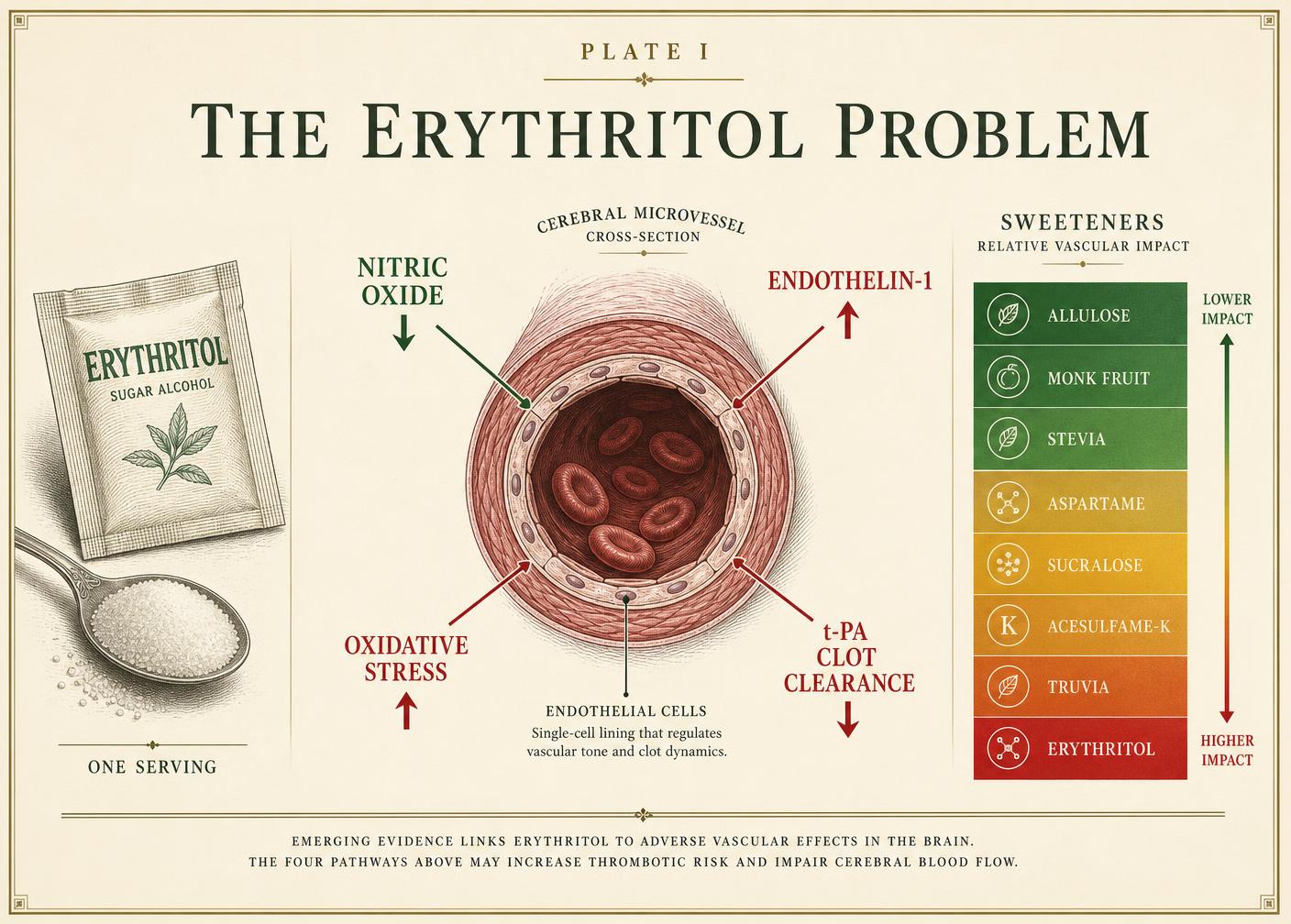
What the Colorado study actually did
Researchers at the University of Colorado Boulder treated cultured human cerebral microvascular endothelial cells — the cells lining the small arteries and capillaries that feed the brain — with erythritol at a concentration matched to what circulates after a single typical serving of an erythritol-sweetened beverage. Not a megadose. One drink.[1]
Four changes appeared, and each one moves the vessel in the wrong direction:
- Nitric oxide production fell. Nitric oxide is the endothelium’s primary vasodilator signal. Less nitric oxide means less capacity to widen vessels and increase blood flow on demand.[1]
- Endothelin-1 rose. Endothelin-1 is the body’s most potent vasoconstrictor. Rising endothelin-1 alongside falling nitric oxide is the textbook signature of endothelial dysfunction.[1]
- Oxidative stress increased. Reactive oxygen species climbed, which both damages the cell and chemically destroys nitric oxide already produced — a compounding loss.[1]
- Clot-dissolving capacity dropped. Stimulated release of t-PA (tissue plasminogen activator) — the enzyme the vessel wall uses to break down a forming clot — was blunted. This is the mechanism that connects a laboratory finding to the word “stroke.”[1]
This mechanistic picture sits on top of earlier population work. A 2023 Nature Medicine analysis found that people with higher circulating erythritol had a substantially elevated risk of major adverse cardiovascular events, including stroke, and showed enhanced platelet reactivity and clot formation in follow-up experiments.[2][3]
One honest caveat: the Colorado work is cell-culture research, not a randomized human outcome trial. It explains a plausible mechanism; it does not by itself prove that erythritol causes strokes in people. Read together with the cohort data, though, the direction of evidence is consistent enough to change a shopping habit.[1][2][5]
The molecule is the concern — which is why brands matter
Nothing in this research indicts stevia leaf extract or monk fruit mogrosides. The concern is erythritol, specifically. That distinction sounds like it should make the problem small. In practice it makes it larger, because erythritol is almost never the thing on the front of the package.
Steviol glycosides and mogrosides are hundreds of times sweeter than sugar, so a usable spoon-for-spoon product needs bulk. Erythritol is the industry’s default bulk. The result: a shopper reaches for what the label calls a stevia sweetener and consumes several grams of erythritol per serving.
Truvia is the clearest example. It is a branded blend of stevia leaf extract plus erythritol in many common formulations, with erythritol frequently listed first — meaning it is the largest ingredient by weight.[4] Anyone avoiding erythritol on the strength of this research, while using Truvia because they believe it is stevia, has not actually reduced their exposure.
Sweeteners at a glance
Concern levels below reflect the current weight of vascular and cerebrovascular evidence, not overall nutritional merit.
Erythritol
Red — high concern- Type
- Sugar alcohol (polyol), fermentation-derived
- Formulation
- Sold pure and used as the bulk carrier in most “natural” sweetener blends; ~4–8 g per typical serving
- Evidence
- Reduced nitric oxide production, increased endothelin-1, higher oxidative stress, and blunted t-PA release in brain microvascular endothelial cells at a single-serving-equivalent dose; higher circulating levels associated with major adverse cardiovascular events and stroke
Truvia
Amber to red — depends on product variant and erythritol content- Type
- Branded blend (stevia leaf extract + erythritol)
- Formulation
- Brand containing stevia leaf extract plus erythritol in many common formulations. Not a pure stevia product — erythritol is frequently the first-listed bulk ingredient
- Evidence
- Inherits the erythritol evidence above in proportion to erythritol content; packets and granulated versions may deliver several grams of erythritol per serving
Aspartame
Amber — moderate concern- Type
- Dipeptide artificial sweetener
- Formulation
- Used in tabletop packets and diet beverages; not heat-stable
- Evidence
- Classified by IARC in 2023 as possibly carcinogenic to humans (Group 2B) on limited evidence; no comparable brain-endothelial signal
Sucralose
Amber — moderate concern- Type
- Chlorinated sucrose derivative
- Formulation
- Often bulked with maltodextrin or dextrose in retail packets
- Evidence
- Mixed data on glucose tolerance and gut microbiome shifts; heat-degradation products under study; no established brain-endothelial signal
Acesulfame-K
Amber — moderate concern- Type
- Artificial sweetener, usually blended
- Formulation
- Almost always paired with aspartame or sucralose for taste
- Evidence
- Some cohort associations with cardiovascular events; limited mechanistic human vascular data
Stevia
Green — low concern if verified erythritol-free- Type
- Plant-derived steviol glycosides
- Formulation
- Pure leaf extract or high-purity Reb A/M — but many retail products bulk it with erythritol
- Evidence
- Generally favorable safety profile for the glycosides themselves; risk in practice comes from the bulking agent, not the stevia
Monk fruit
Green — low concern if verified erythritol-free- Type
- Plant-derived mogrosides
- Formulation
- Rarely sold pure; the majority of retail monk fruit sweeteners are erythritol-based blends
- Evidence
- No adverse vascular signal for mogrosides; check the panel — erythritol is the common carrier
Allulose
Green — low concern- Type
- Rare sugar (monosaccharide), minimally metabolized
- Formulation
- Sold as granules or syrup; bakes and browns like sugar, no polyol carrier needed
- Evidence
- Neutral-to-favorable effects on postprandial glucose in controlled trials; GI tolerance is the main limit; no brain-endothelial signal reported
A three-minute pantry audit
Truvia is not automatically erythritol-free. Check the ingredient panel.
Many Truvia products use erythritol as the bulk ingredient — it appears first on the panel, ahead of stevia leaf extract and natural flavors, because it makes up most of the product by weight.[4] Packet and granulated versions may contain several grams of erythritol per serving, and people rarely stop at one packet.
- 01Read the exact ingredient list, not the front of the package. “Stevia sweetener” on the front tells you nothing about the bulk agent.
- 02Look for erythritol by name, and for its label aliases: E968, or a generic “sugar alcohol” line in the Nutrition Facts carbohydrate breakdown.
- 03Check the serving size. A “0 g sugar” claim is compatible with several grams of erythritol per packet or teaspoon.
- 04Count real-world servings. Three packets in coffee, twice a day, is a very different exposure than the single serving used in the study.
- 05Audit hidden sources: protein bars, keto desserts, sugar-free chocolate, electrolyte powders, and “no sugar added” ice cream are common erythritol carriers.
- 06Confirm before you re-buy. Formulations change; brand names do not.
Lower-concern replacements
Verified erythritol-free stevia
High-purity steviol glycosides with no polyol carrier — usually liquid drops or a pure powder. The glycosides themselves carry no comparable vascular signal.
Verified erythritol-free monk fruit
Pure mogroside extract, again typically liquid. Most granulated monk fruit on shelves is an erythritol blend, so verification is the whole job.
Allulose
A rare sugar that behaves like sugar in baking with minimal glycemic impact and no polyol bulking agent. GI tolerance is the practical limit at higher doses.
Whole-food sweeteners, used sparingly
Raw honey or date syrup. These are real sugar and should be treated as such — small amounts, in food, not as an all-day beverage sweetener.
Marketing language is not a safety claim
“Natural” is a marketing term with no regulatory meaning relevant to vascular biology. “Keto-friendly” describes a glycemic property, not a safety profile. Erythritol satisfies both labels and still, in the best available mechanistic work, degraded four distinct functions of brain endothelial cells at a realistic dose.[1]
Say it plainly: branded blends like Truvia can still carry meaningful erythritol exposure. Buying a product because the front of the package says stevia, while the panel says erythritol first, is exactly the failure mode this research should correct.[4]
The broader point is not about one sweetener. Endothelial function is the shared substrate of cognitive resilience, blood pressure regulation, erectile function, exercise capacity, and stroke risk. Anything that chronically lowers nitric oxide availability, raises endothelin-1, and blunts fibrinolysis is operating on the same system that determines how well your brain is perfused in your seventies. That is the frame worth carrying out of this article — the sweetener is just where the evidence happened to land.
Practical position: if you are avoiding erythritol, verify every panel; prefer liquid pure extracts or allulose; and treat vascular health as a system you support with sleep, movement, polyphenols, and nitrate-rich food — not something you protect by swapping one powder for another.
Module 4 — Vascular & Cerebral Protection Protocol
Four lessons expanding on this article: endothelial physiology, a dosage-level sweetener deep dive, an evidence-based herb and compound directory, and an interactive exposure assessment that builds your personal protocol.
Open the moduleSources & further reading6 references
- [1]Auburn A, Berry AR, Bock JM, et al. The non-nutritive sweetener erythritol adversely affects brain microvascular endothelial cell function. Journal of Applied Physiology, 2025. University of Colorado Boulder.
- [2]Witkowski M, Nemet I, Alamri H, et al. The artificial sweetener erythritol and cardiovascular event risk. Nature Medicine, 2023;29:710–718.
- [3]Cardiovascular Health Study / Cleveland Clinic follow-up analyses of circulating erythritol and incident major adverse cardiovascular events, including stroke.
- [4]Truvia product ingredient panels (Original Calorie-Free Sweetener packets and spoonable/granulated blends), Cargill — erythritol listed as the first ingredient in common formulations.
- [5]European Food Safety Authority (EFSA) Panel on Food Additives. Re-evaluation of erythritol (E 968) as a food additive. EFSA Journal, 2023.
- [6]Han Y, et al. Allulose and metabolic outcomes in humans: a review of controlled trials. (Comparative safety context for sugar substitutes.)
Educational content only. Nothing here is medical advice, diagnosis, or treatment. Discuss changes to diet, supplements, or medication with a qualified clinician — particularly if you are pregnant, taking anticoagulants or antiplatelet drugs, or managing cardiovascular or cerebrovascular disease.